

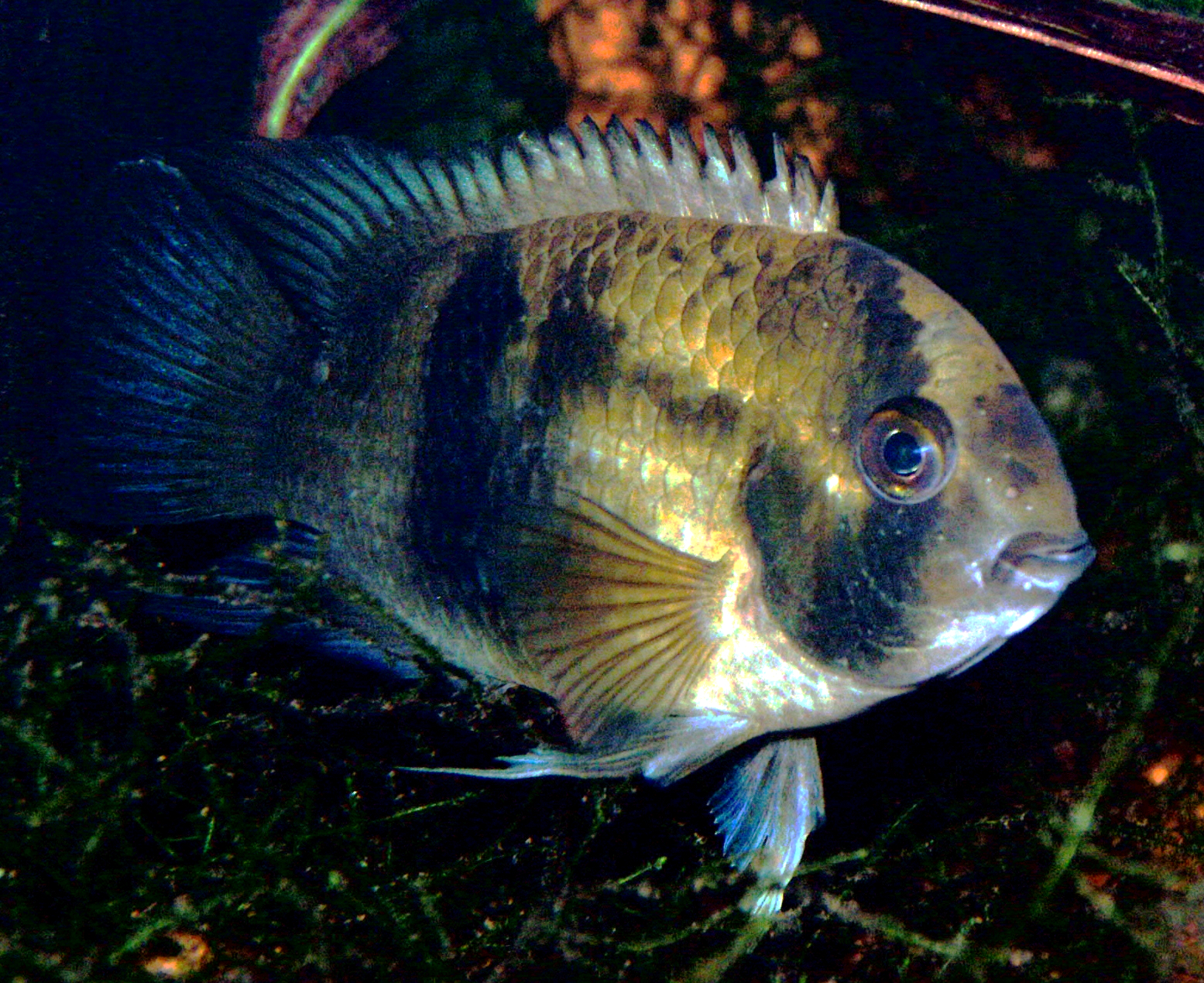
Some cichlids announce themselves. The keyhole cichlid, Cleithracara maronii, does the opposite. It is a small, shy, leaf-coloured fish from the Orinoco and the Guianas — Venezuela, Guyana, Suriname — that wears a dark, keyhole-shaped blotch on the caudal peduncle and spends a lot of the day hoping you will go away. That shyness is not a defect. It is the species. Keepers who wanted a Jack Dempsey in a smaller body are in the wrong aisle. Keepers who wanted a cichlid that can live in a planted, relatively peaceful tank without rearranging the geology are closer.
It is the only species in its genus. Older books filed it under Aequidens. The behaviour is closer to a nervous dwarf than to a big earth-eater. Adults reach 8 to 10 cm. They do not need a 400 litre hall. They do need cover, dim light, and tank-mates that will not treat hesitation as an invitation to bully.
The mark, and the mood that changes the rest of the paint
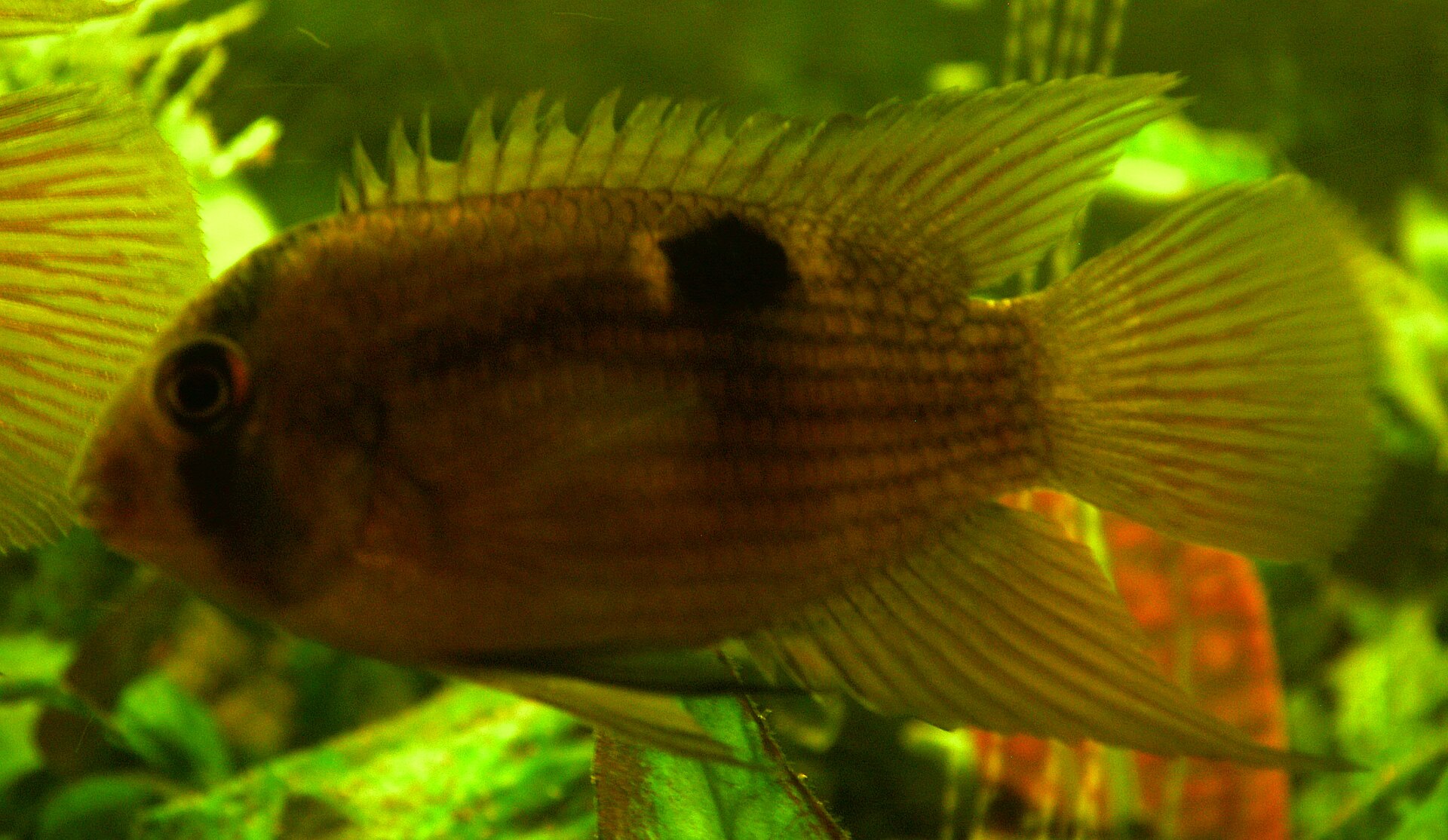
The keyhole is a dark ring or smudge on the tail wrist, sometimes open, sometimes filled, always the thing you use to identify a washed-out fish in a shop. The body is beige to golden-olive. Stress fades them to parchment and pulls the bars forward. Comfort warms the gold and can put a steely sheen on the flanks. Fins are plain until spawning, when the pair may show more colour and a lot more purpose.
Males grow a little larger and may develop a slightly more pointed dorsal. Females can be just as colourful in the moment of a spawn. Many pairs are identified after the fact, when two fish have decided a cave is theirs and the rest of the tank is a rumour.
Leaf litter is furniture
A 100 litre tank can house a pair with room to hide. Bigger is easier if you want a community of similarly gentle fishes. Use sand, botanicals, wood, and real caves — coconut shells, pipes, rock overhangs. Plant the back and the corners. Let the light be modest. Floating plants are a kindness. These cichlids do not want a white, open, high-tech scape with nowhere to vanish. In too much exposure they stay in the corner and the keyhole is all you ever see, if that.
Temperature 22 to 28°C, pH 6.0 to 7.5, softness preferred but not fanatical. They come from waters that can be tea-stained. A little tannin helps the mood more than it “adjusts pH” on a poster. Gentle filtration. They are not river racers. They are quiet backwater fish.
They dig less than many cichlids. They will still fan a spawning site. They will not usually level a Dutch aquascape for fun. That is one of their selling points and it should not be abused by stuffing them under aggressive neighbours.
A shy fish still has a stomach
Frozen bloodworm, brine shrimp, daphnia, quality micro-pellets, and crushed flake will keep them. They are not picky once they feel safe enough to come out at feeding time. The trick is that feeding time has to happen without a crowd of snatchers. If you keep them with fast, greedy midwater fish, the keyholes get the leftovers and slowly thin. Feed after lights-down a notch, or target-feed near the cave. Watch the belly, not the show.

They will take small live foods. They will not usually hunt adult shrimp in a planted tank, though newborns are not guaranteed. They are not herbivores; a spirulina flake is a supplement, not a biography.
Peaceful, until there are eggs, and even then it is a small war
As cichlids go, keyholes are among the more community-tolerant, which is a relative statement. They still become brave when spawning. A pair will hold a cave and warn off approachers. In a 100 litre tank that can mean the community has a bad week. In a 200 litre planted tank with lots of sight-breaks, it can mean a corner is off-limits and everyone else muddles through. Do not house them with fin-nippers, with large aggressive cichlids, or with anything that occupies the same cave economy and will not share. Good company: other gentle South American dwarfs of similar size, small to medium peaceful characins that will not eat fry and will not starve the keyholes, and quiet bottom dwellers. Avoid packing the tank with territorial species that all want the same woodpile.
A single keyhole in a busy community may never come out. A pair with a cave often will, at least at dusk. Buy two or a small group of juveniles and let a pair form; move extras if aggression appears.
Caves, eggs, and parents who mean it
They spawn on a pre-cleaned surface inside a cave or on a sheltered stone. Both parents guard. Broods are not the thousands of a big substrate spawner; they are still plenty. The adults are generally diligent. If they eat the first spawn, it is often inexperience or a tank that feels too exposed. Dim the lights, add botanicals, reduce traffic in the room. Fry can be fed baby brine and powdered foods. The parents may allow you to watch. They may also charge the glass. Believe them.
Raising fry in the display only works if tank-mates are few and gentle. A dedicated pair tank is simpler.
Fear is a water-quality instrument
A keyhole that stays parchment-white for weeks is telling you the layout is too open, the neighbours are too bold, or the chemistry is swinging. Ich hits shy fish that hide and do not eat. Treat in a covered hospital with places to hide or they will die of panic before the parasite finishes the job. New arrivals should be quarantined in a planted or at least decorated box, not a bare white bucket.
They can live many years — five to eight is reasonable — in a calm tank. That is a long relationship with a fish that will never be a clown. The reward is a golden, keyhole-marked cichlid that comes out for food, patrols a small territory, and spawns like a secret. If you need a fish that fills the front glass at noon, this is the wrong cichlid. If you can enjoy a tank that has a backstage, Cleithracara maronii will use it, and the keyhole will be there when you look for it, which is the entire aesthetic.
Do not confuse them with larger, bolder acaras that share a vaguely round spot. The keyhole is a small, specific animal with a small, specific courage. Build the tank around the hiding, and the colour shows up as a side effect of safety.
Explore other topics
Dive into more aquarium guides across the site.