

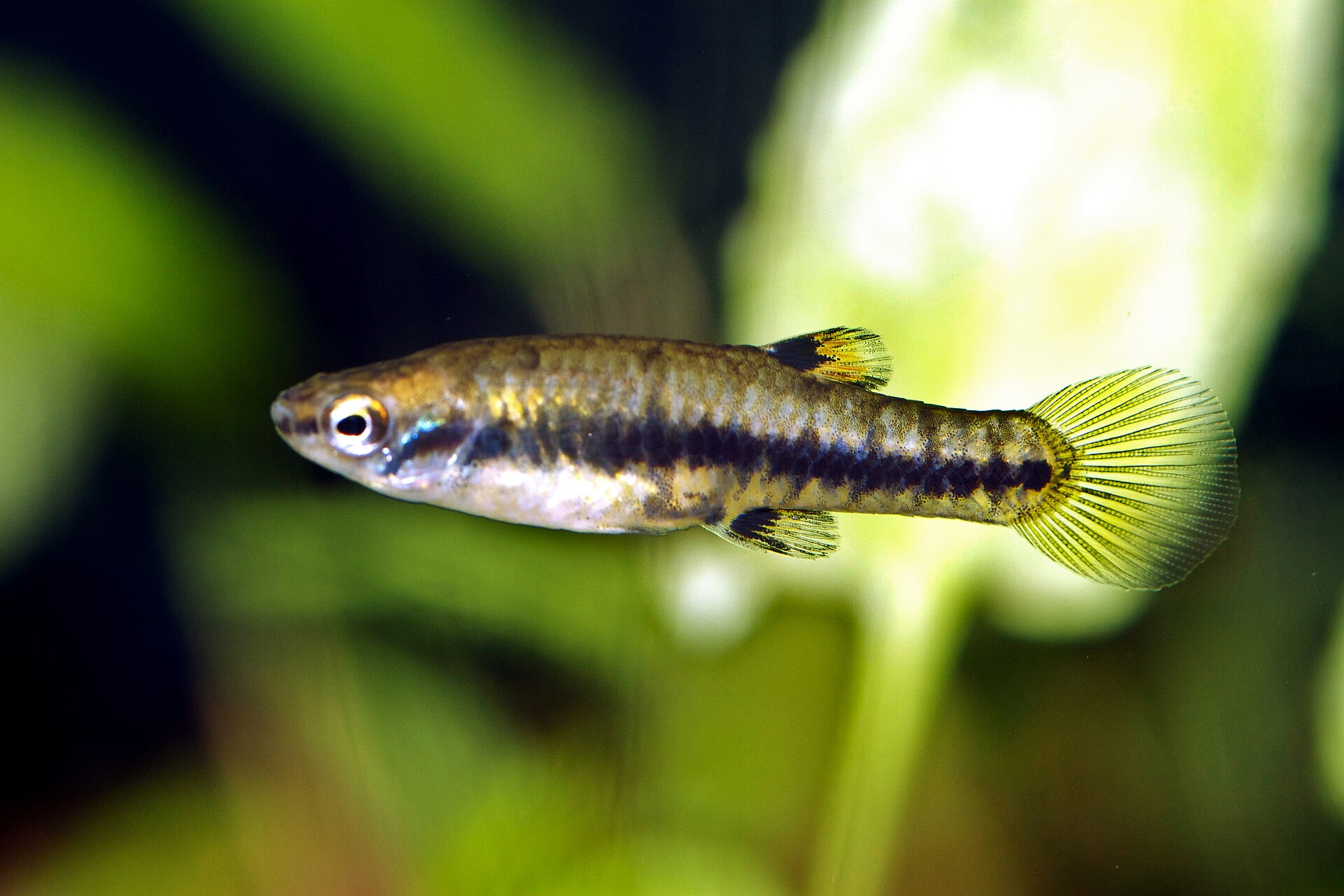
In a Florida ditch, at the edge of a sawgrass marsh, the smallest livebearing fish in North America is doing something the textbooks still find slightly outrageous. A female Heterandria formosa — least killifish, dwarf livebearer, midget livebearer, pick your old trade name — can carry several broods at different stages at the same time. Superfetation. She does not dump forty fry on a full moon and rest. She dribbles one or two or three miniature copies of herself, over and over, for months. The fish is not a killifish in the Nothobranchius sense at all. It is a poeciliid, a cousin of mollies and platies, that happens to wear a killifish common name because early collectors had a loose vocabulary.
The range is the coastal plain of the southeastern United States: Florida throughout much of the peninsula, and patches into Georgia, the Carolinas and west toward Louisiana in vegetated, slow, often slightly brackish-tinged waters. It is a native, not an exotic, and it is a reminder that “tropical fish” is a shop category, not a climate. Least killifish take temperatures down into the high teens Celsius without the drama you would get from a truly equatorial species. That is one reason they make sense for unheated rooms and outdoor tubs in mild climates, and one reason a 28°C community tank is not their best advertisement.
Two centimetres is not a rounding error
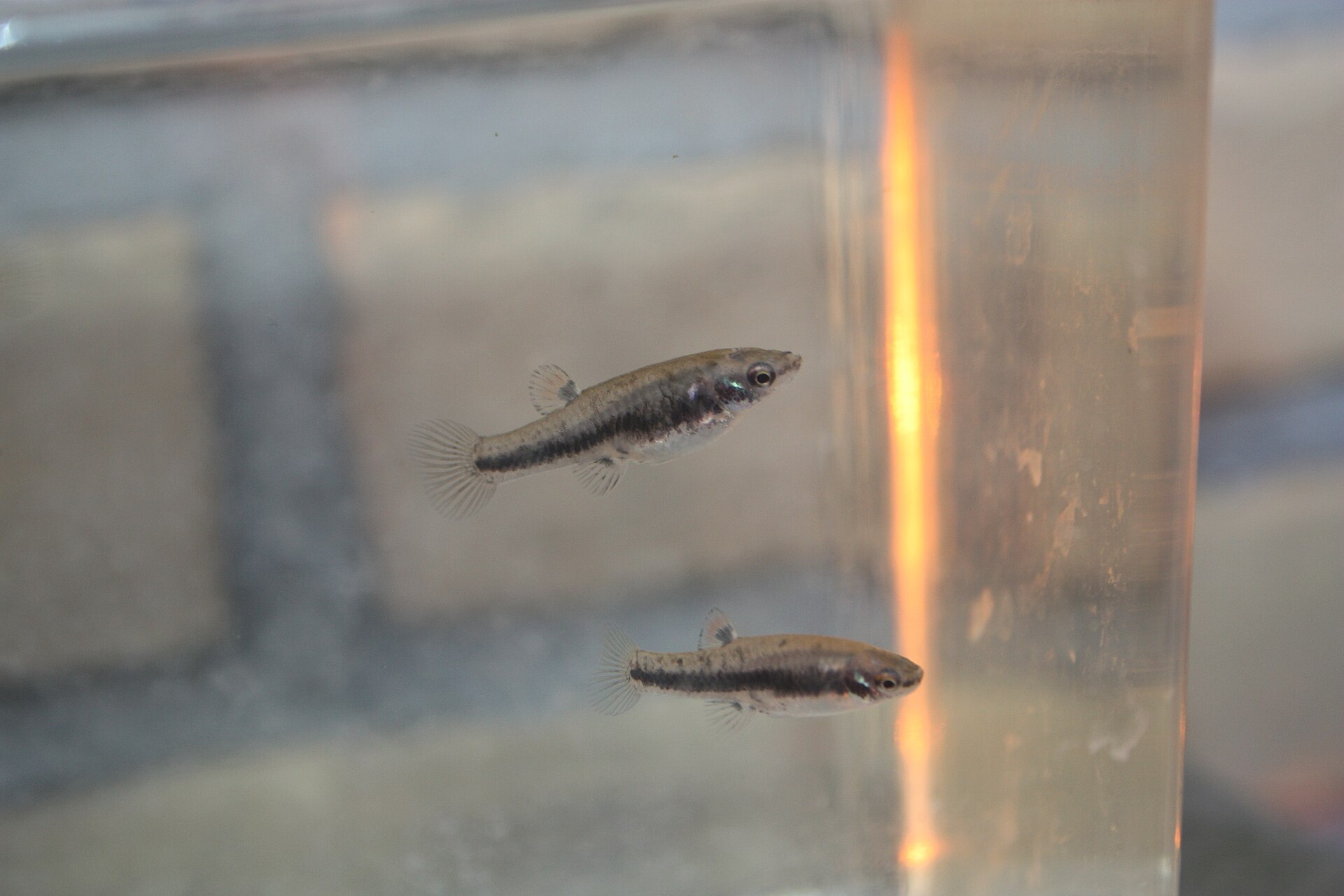
Males top out around 2 cm. Females reach about 3 cm, occasionally a hair more. The male has a gonopodium, the modified anal fin of livebearers, and a dark spot near the dorsal. Both sexes are olive to amber with a dark lateral line that can look like a stitch. They are not colourful in the poster sense. They are colourful in the sense that a living animal that small, complete, and busy in a moss thicket is hard to stop watching.
Because they are so small, they are also easy to kill with kindness that was meant for bigger mouths. A filter intake without a sponge guard will mill them. A net with a coarse mesh will miss them or tear them. A feeding regime of large pellets will starve them next to greedy tank-mates. This is a species you keep on purpose in a planted box, not a species you add “for interest” to a tank of 15 cm cichlids.
A ditch in glass
Twenty to forty litres of heavily planted water will house a breeding colony. You can go larger; you should not go much smaller unless you are an experienced nano keeper who understands how fast ammonia moves in 10 litres. Java moss, floating plants, hairgrass, and leaf litter create the visual clutter they use as both restaurant and nursery. Flow should be low. A sponge filter is the correct tool, not a canister on full bore.
Temperature of 18 to 26°C covers a working year. They can spawn through much of that range. pH 6.5 to 8.0 and a wide hardness band are tolerated; wild fish sometimes see a hint of salt from coastal influence, but they are freshwater animals, not marine. A teaspoon of salt per litre is not required and will limit your plant choices. Clean water is required. Tiny fish have tiny gills, and tiny gills do not enjoy a nitrate swamp.
Lighting can be moderate. They do not need a stage. They need biofilm, infusoria, and a sense that a bird will not pick them off, which in a tank means cover from above as well as from the sides.
Micro meals, or they vanish while you feed the other fish
Least killifish take crushed flake, powdered fry food, microworms, vinegar eels, baby brine shrimp, and the infusoria that blooms in a dirty-looking moss clump. That last item is why a sterile, over-filtered, over-changed nano tank can fail them even when the test kit looks pretty. They graze constantly. A single daily dump of food sized for platies will miss them. Feed small, feed often, and let some of the tank stay biologically messy in the moss while the open water stays clean.
They will eat their own newborns if cover is thin and they are hungry, but superfetation plus dense plants usually means the colony grows anyway. If you want numbers, add more moss, not more theory.

Sex, fry, and the slow drip of a population
Males are obvious once you know to look for the gonopodium and the smaller size. Females are deeper-bodied. There is no need for a breeding trap. Traps designed for guppies will batter a 2 cm fish. Leave them in the planted tank. A female may produce one to three fry every few days rather than a single large drop. The fry are among the smallest livebearer babies you will ever see. They need the same micro-foods as the adults, only more so. Do not add adult guppies or platies to “fill out” the tank; those species will outcompete and may eat the least killifish fry.
A colony can become dense. That is success. When you have dozens, you can share them with other keepers or set up a second box. You should not “thin them” with a predatory fish unless you are comfortable watching the species you came here to keep disappear.
Who belongs in a 3 cm fish’s world
Best: a species tank. Next best: similarly tiny, peaceful companions that will not eat fry — small shrimp if you accept some losses, snails, perhaps other minute native livebearers if you know what you are mixing. Worst: anything with a mouth that fits a least killifish, which is most of the shop. They are not a dither fish. They are not a cleaner crew. They are the main event, or they should not be in the tank.
Outdoor tubs in frost-free or carefully managed seasonal climates can work, with the caveat that dragonfly nymphs and birds read them as food, which is historically accurate and emotionally unhelpful.
Health at a scale where a flake is a log
Ich and velvet can still kill them. Dose is difficult because the fish are tiny and the water volume is small; follow product instructions for nano tanks and do not “round up.” New fish should be quarantined, but a quarantine tank for a 2 cm livebearer must be planted and filtered as carefully as the display or they will not eat. Watch for fungus on scraped noses after they hit the glass, which they do when spooked in a bare box. Give them plants and they stop acting like trapped insects.
Wild-collected Florida fish can carry parasites and, more importantly, can be illegal or unethical to take depending on season and location. Buy captive-bred. This species breeds in a bucket if you let it. There is no excuse for stripping a ditch.
Why a native micro-livebearer is worth a whole article
Because almost every care sheet will try to file Heterandria formosa under “easy livebearer, same as a guppy.” It is easier than a discus and harder than a guppy in the specific way that scale changes everything: food size, filter safety, tank-mate mouths, and the fact that reproduction is a drip, not a flood. Keep a planted, gentle, slightly untidy nano world at a temperature a Florida marsh would recognise, and the smallest livebearer on the continent will run a civilisation in the moss. Keep it as a throw-in with big, bright, hungry fish, and you will own an empty tank that still tests perfect.
Look at them with a magnifying glass once. The gonopodium, the stitch of a lateral line, the fry hanging in the roots of a floater — that is the whole argument for nano tanks, and it does not require an imported rarity. It requires noticing that North America already had a miniature livebearer, and that it never needed a tropical stereotype to be interesting.
Explore other topics
Dive into more aquarium guides across the site.