

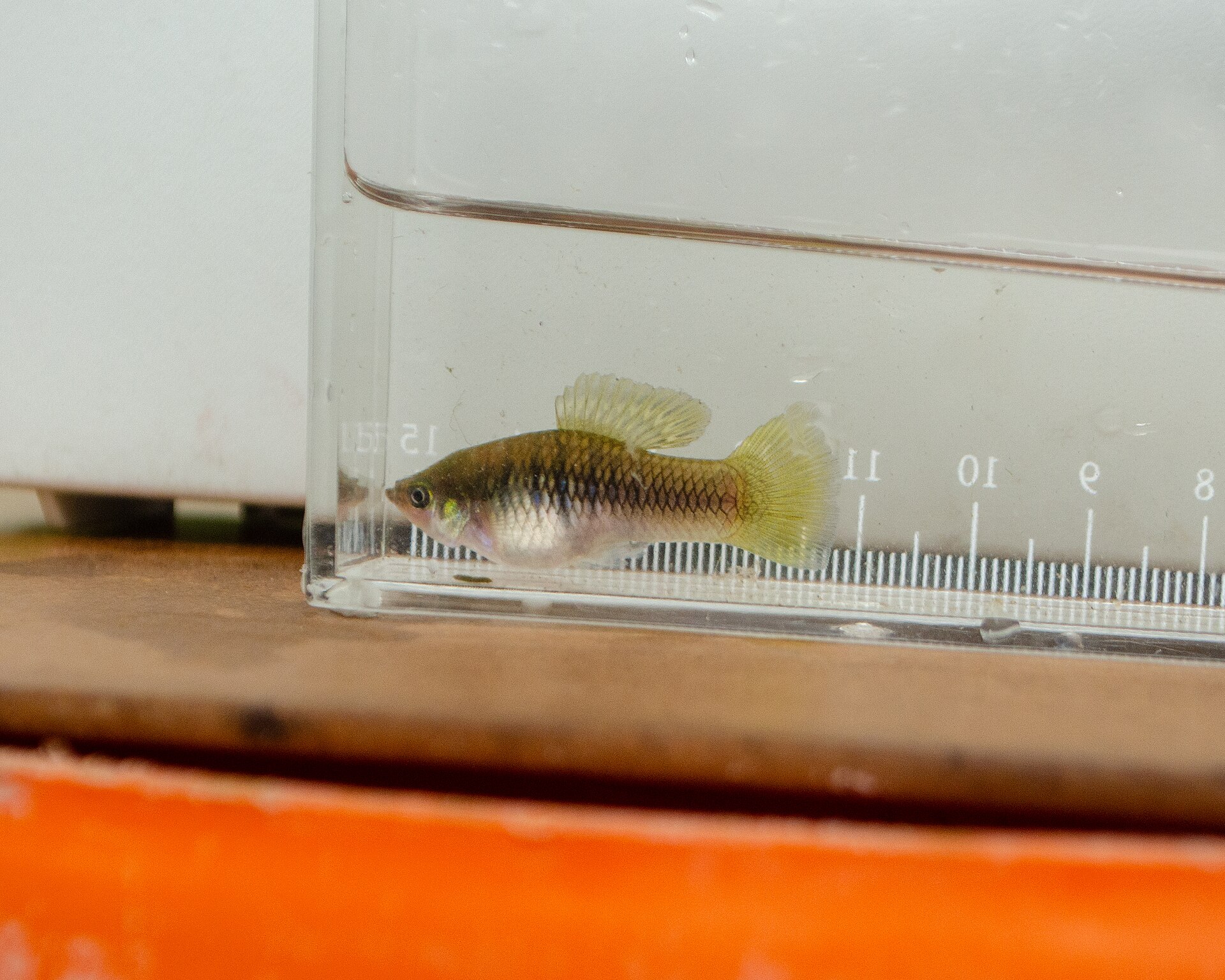
Platies in shops are often a blur of orange. Xiphophorus variatus, the variatus platy, is the species underneath a lot of that blur, and in the wild it is a fish that changes its mind about colour with the season. Atlantic-slope streams of Mexico — Veracruz, San Luis Potosí, adjacent drainages — run cooler than a stereotypical “tropical” tank in winter. Males that were modest in the warm months put on yellows, blacks and rusty reds when the water drops and breeding peaks. The trade noticed, then painted over the biology with sunset, marigold, high-fin and tuxedo lines. Those lines are still X. variatus, or hybrids with it. They still do better if you remember the river was not a heater stuck on 28°C.
Compared with the common southern platy Xiphophorus maculatus, variatus tends to be a little slimmer, a little more pike-like in the snout, and more willing to use the whole water column. It still has the livebearer kit: a gonopodium on the male, no sword on the tail (that is the swordtail’s joke), and a talent for filling a planted tank with copies of itself if you let it.
A wardrobe that answers to temperature
Wild-type males may show a yellowish body, dark markings, and a variable wash of red or orange that intensifies in cooler, well-fed condition. Females are plainer, rounder, and silver-olive. Farmed strains explode that palette: sunset variatus with a yellow front and red back, peppered fish, high-fin animals that swim as if their dorsal were a sail with a cost. High-fin and balloon morphs are the same species with a welfare asterisk. They need calmer water and more honest feeding, because the body plan is worse at being a fish.
Adults typically reach 5 to 7 cm. They are not the largest livebearer and not the smallest. They are a proper mid-sized community animal if — and only if — the water is hard enough and the tank is not a 20 litre vase.
Mexican stream chemistry, not Amazon tea
Hard, alkaline water is the hill to die on. pH 7.0 to 8.2, moderate to high GH and KH, and a temperature band of 18 to 25°C will keep variatus platies in the colour and health they are capable of. Many homes can run them cooler than their mollies-in-a-heater tank. Chronic 28 to 30°C shortens life, flattens colour, and pushes metabolic disease. If your tap is very soft, add mineral salts formulated for livebearers or mix in a hard tap source. If your tap is already liquid limestone, you are halfway there. Do not put them in a blackwater tank “because plants look nicer that way.” The plants can go in hard water too; choose them accordingly: Java fern, Vallisneria, Anubias, some crypts.
Eighty litres is a comfortable community floor for a group. They are active. They occupy midwater and pick at algae on leaves. A sponge or hang-on filter, a heater only as a winter floor, and a lid (livebearers jump when chased) complete the box. Gravel or sand both work. They will graze the film on either.
Omnivores that should still see green
Flake and micro-pellets designed for omnivores are fine as a base. Frozen bloodworm and brine shrimp are treats, not the entire week. Algae, blanched spinach, spirulina, and the biofilm on plant leaves are part of how wild X. variatus actually eats. A platy that only ever swallows protein paste gets fat, constipated, and dull. Feed what they clear. Livebearers will eat until you stop, which is not the same as until they should stop.
They will nibble soft plants if they are underfed. They will ignore tough plants if they are not. Feed the fish; do not punish the aquascape for your feeding schedule.
The tank will become a nursery whether you vote or not

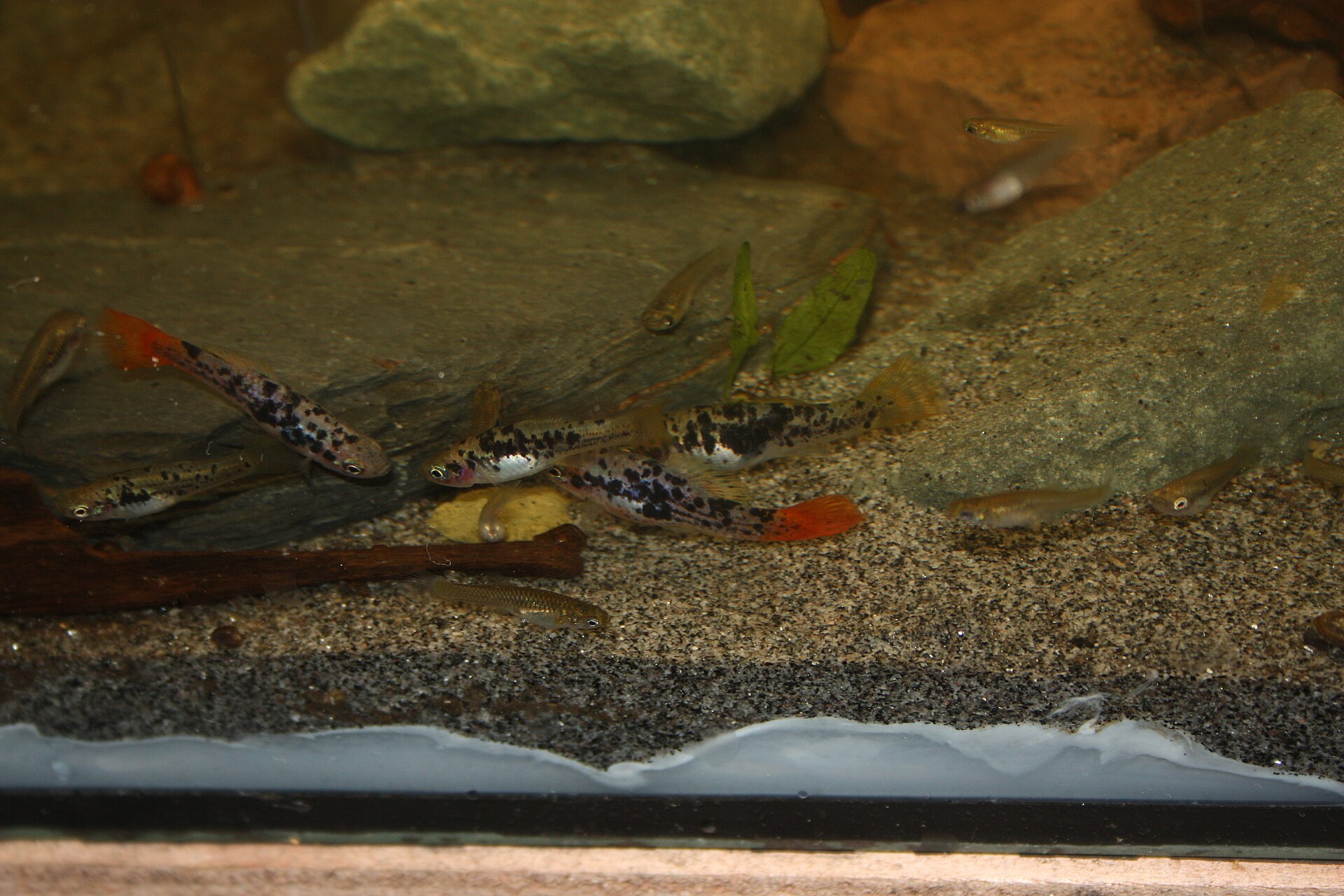
Males chase. That is the species. A ratio of two or three females per male turns the chase into a pattern instead of a siege. Gestation is roughly four weeks depending on temperature. A drop of 20 to 40 fry is common. The parents will eat fry they can catch. Dense plants at the back and floating cover at the surface are how you keep a population without a breeding trap. Traps stress the female and are unnecessary if the tank is planted.
Fry take crushed flake, powder, and baby brine. They grow fast in hard water with frequent small feeds. You will need a plan for extras: friends, a second tank, or a well-fed adult population that eats most of the babies. Letting a 80 litre tank go to 200 platies is how water quality collapses and everyone gets velvet.
They can hybridise with other Xiphophorus if you mix species. If you care about keeping a strain or a wild-type look, do not mix them with swordtails and maculatus platies and then act surprised at the grandchildren.
Peaceful, with the usual livebearer footnotes
Variatus platies are not fighters in the cichlid sense. They may nip if they are crowded, underfed, or stuck with trailing fins that look like food. They do well with other hard-water, similarly sized peaceful fish: other livebearers of comparable size, robust barbs that share the temperature, larger rasboras, and bottom dwellers that like mineral water. They do poorly with anything that considers a 6 cm fish a mouthful, and they do poorly in a tank of delicate, long-finned, slow show fish if the platies are many and the tank is small.
Shrimp colonies will lose babies. Adult shrimp often persist. Snails will persist whether you like it or not, because livebearer tanks are messy.
When the colour goes wrong
A faded male in warm, dirty, soft water is not a “bad strain.” Fix temperature, minerals, and nitrate. Black markings that look like pepper can be strain; black markings that look like speckled disease can be parasites — learn the difference with a magnifying glass and a quarantine tank. Cottony mouth is columnaris territory, often after a chill or a shipping nightmare; it is an emergency, not a colour morph. Ich is the usual dotted villain after a temperature crash. Raise temperature only into the mid-twenties for this species, not into discus range, and medicate as needed.
Quarantine new platies. Livebearer farms are crowded. You do not want camallanus or velvet as a house-warming gift. Watch faeces, appetite, and whether the gonopodium looks intact. A male that cannot close his fins may have a fight injury or a fin-rot problem.
The species under the morph
If you keep sunset variatus, you are still keeping a Mexican stream livebearer that colours with a cool season and a mineral-rich river. Offer hard water, a temperature that does not impersonate a jungle swamp, greens in the diet, plants for the fry, and more females than males. The fish will do the rest, which is both the joy and the logistics problem of Xiphophorus variatus. It is not a rare fish. It is a common fish that looks rare when someone finally turns the heater down and stops treating every livebearer like a molly in a heated pet-store window.
Wild-type lines from named Mexican localities exist in specialist circles. They are worth seeking if the painted strains feel like too much costume. Either way, the care is the same river: alkaline, oxygenated, not too hot, and full of things to pick at. That is the fish. The poster is just the season talking.
Explore other topics
Dive into more aquarium guides across the site.