

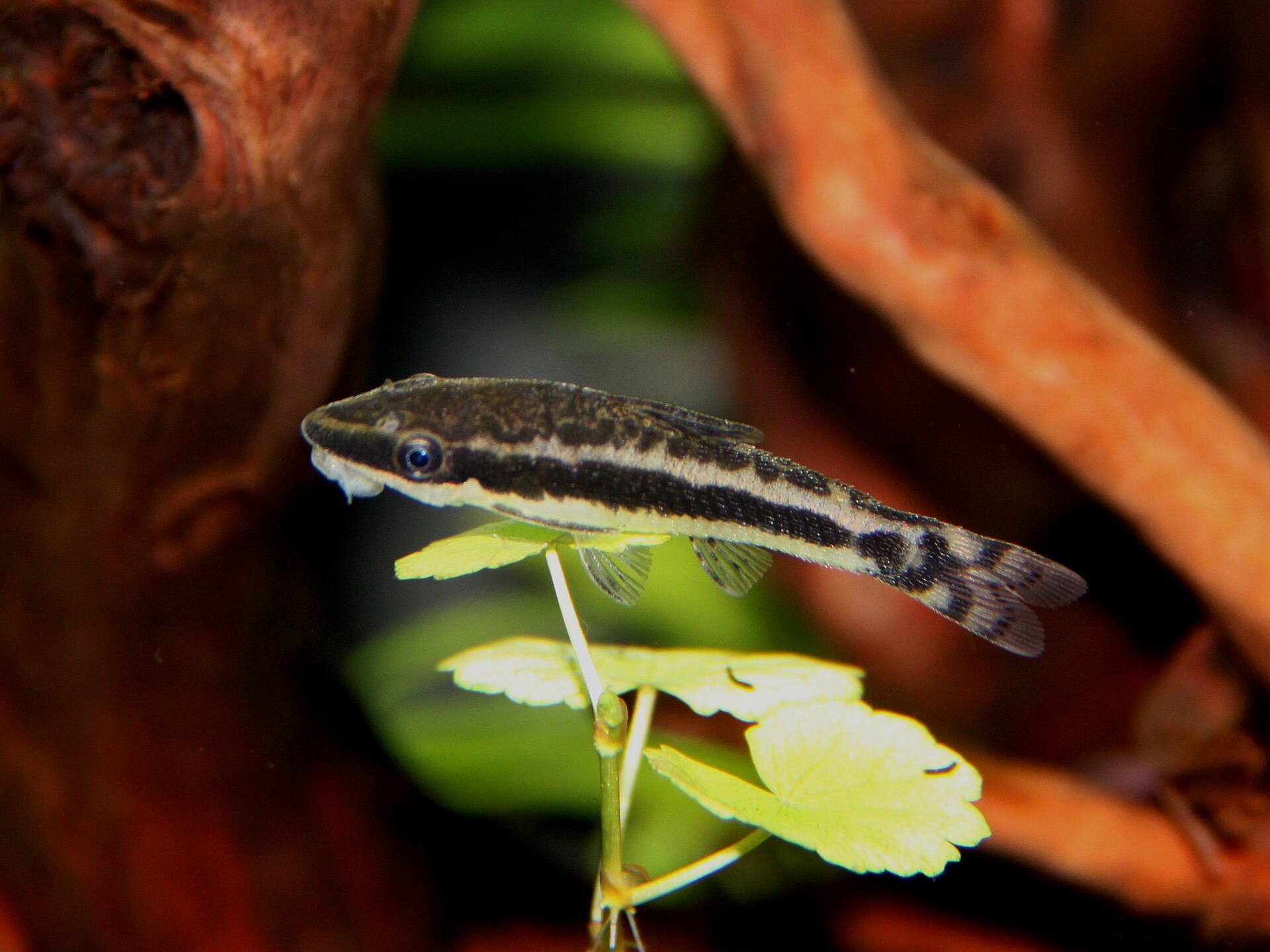
For decades the golden dwarf suckermouth of southeastern Brazil sat in Otocinclus. It now sits in Macrotocinclus as Macrotocinclus affinis. That is not a trivia flex. It flags a different fish from the Peruvian Otocinclus macrospilus: a coastal Atlantic forest species with a warmer gold or brass sheen, a slightly different body, and a range around Rio de Janeiro drainages rather than the western Amazon. Care still centres on biofilm and groups, but the water, the look, and the conservation context of a southeastern Brazilian endemic are not interchangeable with a mass-exported Amazon oto.
Atlantic forest streams, not the western Amazon
M. affinis comes from coastal river systems in Rio de Janeiro state and nearby southeastern Brazil — clear to slightly stained forest streams, often with sand, leaf litter, and aquatic plants, in a densely populated region where habitat is fragmented. That geography matters. You are not copying a Peruvian tributary of the Marañón. You are copying a small Brazilian coastal drainage that can run a little cooler at times and that is under urban pressure.
Wild fish graze periphyton on plants, wood, and stones in modest current. Groups move together. The Atlantic forest is not a blackwater Amazonian flooded forest in the classic hobby sense, and it is not an Andean torrent. It is a coastal rainforest stream with a floor of sand and organic bits.
Because the range is small and close to cities, wild collection is a conservation conversation. Captive-bred golden otos exist in the hobby; they are the ethical preference. A bag labelled “Otocinclus affinis” may still be this species, or it may be a mixed oto lot. Look at the gold wash and ask about origin.
Brass light on a tiny loricariid
Adults remain in the 4 cm class. Compared with many grey Otocinclus, good M. affinis show a golden, brassy, or olive-gold cast on the flanks, with a dark lateral mark that can be less stark than the black stripe of O. macrospilus. The caudal spot, if present, is not the same branding as the Peruvian macro-spot. The mouth is still a miniature rasping disc. There are no male bristles. There is no wood-eating spoon tooth of a panaque.
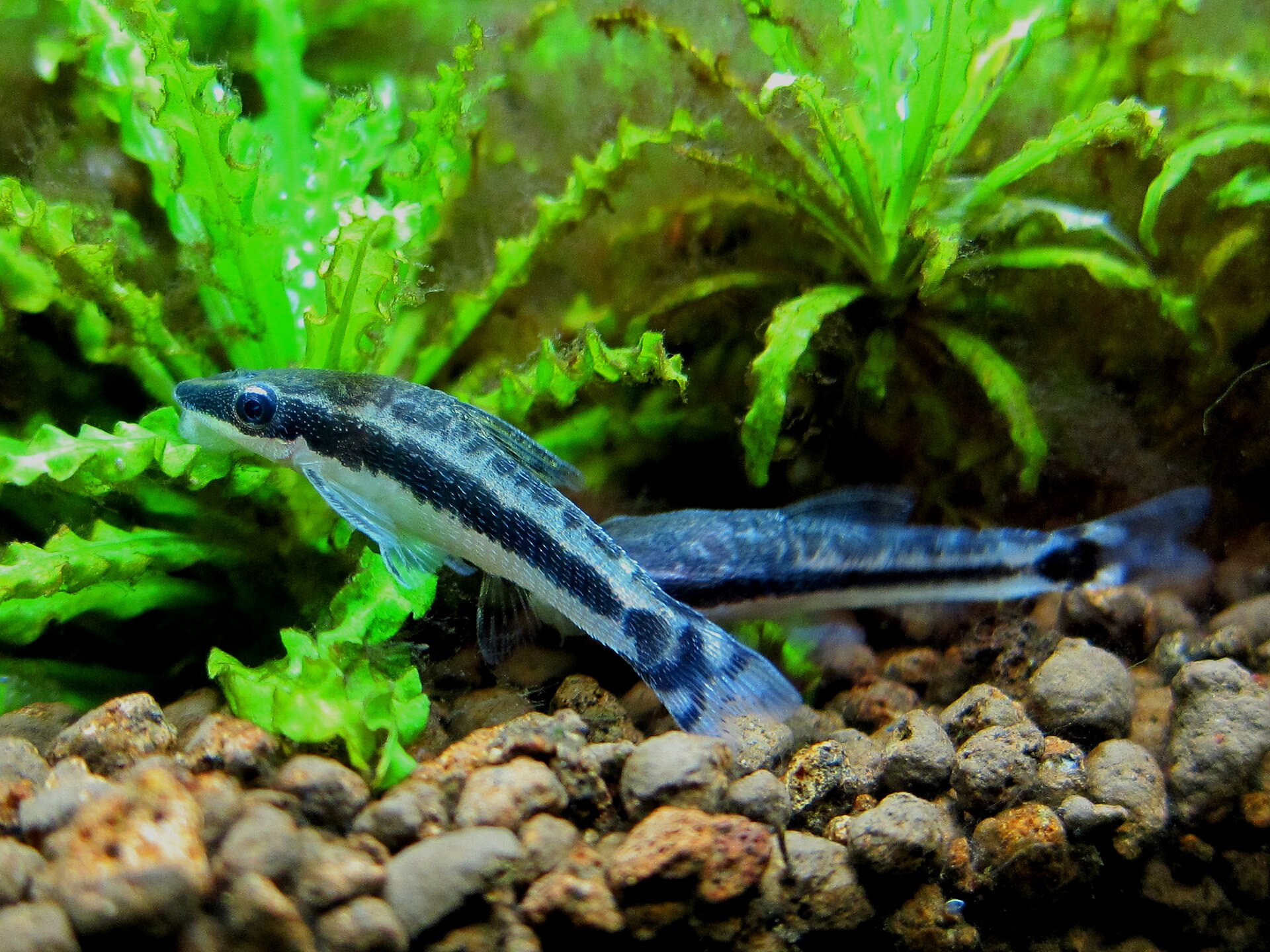 Macrotocinclus affinis. Photo: Cisamarc / Wikimedia Commons (CC BY-SA 3.0)
Belly fullness is the health check. Golden otos that are all head and keel have been starved. Colour washes out in poor water and in fear. A settled group on plant leaves in a mature tank looks like moving brass flakes, not like desperate glass-cleaners in a new cube.
Females fill with eggs and look rounder from above. Males stay slimmer. Buy six or more; sexing a single fish in a shop bag is a waste of time.
A planted coastal stream in miniature
Give a group a mature planted aquarium of 60 litres or more with sand, botanicals, wood, and real leaf surfaces. Gentle current — more than a stagnant swamp, less than a Chaetostoma riffle — suits a coastal stream. Temperature can sit around 20–25 °C; they often look better a degree or two cooler than a 28 °C Amazon community. That cooler preference is one reason dumping them into a heated discus tank is unwise.
Let the tank age. Film on Anubias, on moss, on the glass at the back, is the furniture. Floating plants cut harsh light if the fish hide, but they still need enough light to grow the film. A bare quarantine box without food is a death row for this genus as much as for Otocinclus.
Filter intakes need sponges. These fish are tiny. A lid is wise.

Soft, clean, slightly cooler
pH 6.0–7.2, low to moderate hardness, zero ammonia. They are as intolerant of a new cycle as any dwarf suckermouth. Water changes should be small, frequent, and temperature-matched — including that slightly cooler target. Do not acclimate a 22 °C fish into 28 °C in ten minutes.
Southeast Brazilian streams can be clear. That does not mean sterile. Tannins in modest amounts are fine. Heavy pollution is not; remember the wild range sits near cities. Your tap’s copper and nitrate still matter.
The same grazing law, a different gold fish
Biofilm first. Tiny vegetarian wafers, blanched greens, and a rotation of rocks grown green in a window all help. They will not thrive on leftover flakes. They will not replace a rubberlip in a torrent, and they will not replace a bristlenose in a cave. They will pick a leaf clean of a soft green haze if the haze exists.
Watch the group at lights-on and at dusk. If they ignore surfaces and sit on sand, the pantry is empty or the fish are dying. Act on film and water, not on a random medication.
A gentle community of small fish
Small, peaceful South American or similarly soft-water fishes that tolerate the cooler end of tropical are better matches than African cichlids or large barbs. Shrimp can coexist in a well-fed tank; hungry otos and hungry shrimp compete for the same film. Large plecos are bullies by accident of size.
Keep them in a school. A pair of golden otos in a 200 litre tank full of aggressive fish is a disappearing act.
Spawning on plants in a crowded city species’ shadow
Like other dwarf Hypoptopomatinae, they may deposit eggs on plants. Fry need infusoria-scale film. Captive breeding is how the hobby should exist for a range-restricted Atlantic forest fish. If you spawn them, you are doing more useful work than buying another wild-caught bag.
Buying gold without buying a lie
Hold a bag to the light. A true golden oto should show brass on the flank, not just a sickly yellow from jaundice or poor diet. Watch whether the group is rasping the bag wall or lying on the corner seam. Lying on the seam in a heap is a shipping red flag. Ask what they have eaten in the shop. If the answer is silence, assume they have been starving on a clean vat. Take them only to a tank that already has film, and drip-acclimate as if they were wild tetras from a soft coastal stream.
Name, gold, and not mixing the dwarfs
Macrotocinclus affinis is the golden oto of Rio’s forests. Otocinclus macrospilus is a Peruvian spotted-tail dwarf. Parotocinclus maculicauda is a different, more stream-bodied fish with a spotted tail. Three small raspers, three articles, three habitats. For this one: mature plants, a little coolness, a group, and biofilm. See O. macrospilus, chemistry, cycling.
Explore other topics
Dive into more aquarium guides across the site.