

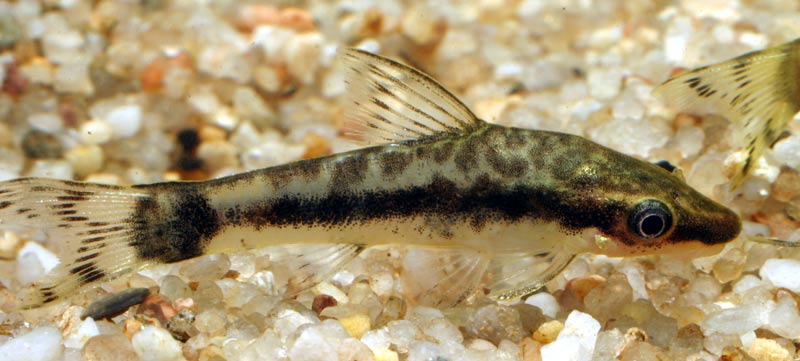
An Otocinclus macrospilus is a four-to-five-centimetre loricariid with a dark lateral stripe and a conspicuous caudal peduncle spot that helps separate it from some other otos. It is a schooling grazer from western Amazon tributaries, especially Peruvian systems. It lives on the film that grows on leaves, wood, and glass in mature, clean, oxygenated water. It does not live on the reputation of “algae eater.” Shipments of otos are infamous for arriving starved, and a sterile new tank finishes the job. This is not Ancistrus, not Chaetostoma, and not a 40 cm common pleco. It is a tiny, social rasper that needs a crowd of its own kind and a pantry that already exists.
Peruvian tributaries and the film on everything
O. macrospilus is associated with the upper Amazon in Peru — drainages where clear or slightly stained water moves through vegetation, roots, and submerged wood. The fish does not occupy a single boulder in a torrent like a rubberlip. It occupies surfaces: the undersides of leaves, the faces of sunken branches, the quiet edges of flow. Groups work a patch of aufwuchs together. A lone oto in a bare tank is a fish out of its social and feeding context.
Water in those streams is typically soft to moderately soft, warm without being a discus vat, and low in pollutants. It is also full of life at the microscopic level. That last point is the one shops skip. An oto’s gut is built for constant small intakes of biofilm, not for a weekly wafer in a bleached scape.
The species name macrospilus points at the large spot at the tail base. Other otos in the trade — O. vittatus, O. vestitus, and mislabelled mixed lots — get bagged together. If you care about the name on this article, buy from a source that does not treat all dwarf suckermouths as one SKU.
A pencil with a sucker, a stripe, and a tail spot
Adults stay around 3.5–5 cm. The body is slender, the belly pale, the back olive to grey, with a dark band from snout to tail and a clear ocellus-like spot on the caudal peduncle. The mouth is a tiny disc for rasping, not for chewing wood into sawdust. There are no snout tentacles. There is no sailfin. Sexing is subtle: males slimmer, females fuller when gravid. You buy a group, not a pair, if you want natural behaviour.
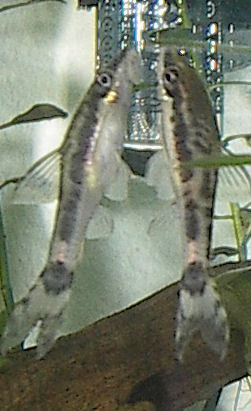
A healthy oto has a rounded belly that you can see from the side, active rasping, and no hollow cheeks. Sunken bellies in the shop are a no-buy. White fungus on the mouth, clamped fins, and fish resting on the sand instead of on surfaces are import damage. These fish are delicate in transit because they have little reserve fat.
A mature planted box, not a brand-new cube
A group of six or more wants a planted tank of about 60 litres or larger that has been running long enough to show green film on glass and leaves. Length helps. Soft sand, wood, broad leaves (real or the undersides of Anubias and similar), and gentle flow recreate grazing paths. Bright light that grows algae is useful; a sterile high-tech tank with no film and aggressive algae-eating crew is a desert.
Do not add otos to a tank that cycled last week. Do not add one oto “to control algae.” A single oto is a stressed, often fasting fish. A group in a mature scape is the species.
Filtration should be kind: sponge or baffled output so tiny fish are not plastered to an intake. Heater in the mid-20s. Open swimming in midwater is limited; they will still dart between surfaces. Cover the tank; they are small enough to ride a splash.

Clean, oxygenated, and never ammonia
Temperature 22–26 °C is a comfortable band. pH 6.0–7.4. Soft to moderately hard water is fine if stable. They have almost no tolerance for ammonia or nitrite. They also dislike sudden nitrate spikes and dirty sand. Small, frequent water changes beat rare huge ones. Match temperature to the degree; otos shock easily.
If you use CO2 for plants, ramp it slowly and watch the otos. They sit in the leaf zone where gas can linger. Gasping at the surface in a high-tech tank is a CO2 or oxygen problem, not a request for more wafers.
Biofilm or bust
The core diet is aufwuchs. Support it with high-quality tiny wafers, blanched spinach or zucchini in amounts the group can rasp in hours, and botanicals that grow film. Remove mushy vegetables before they foul. Protein is a garnish, not a staple; too much can disorder a grazer’s gut.
A tank with no visible film will not be saved by dropping a jumbo pleco wafer in at night. The wafer may be ignored or may foul. Grow the pantry first. Some keepers maintain a spare bucket of rocks in light as a “grazing station” to rotate in. That is more like oto keeping than hoping the glass stays dirty enough.
A school among gentle neighbours
Keep O. macrospilus in a group of six, eight, or more. Peaceful small characins, rasboras, and shrimp can share a mature planted tank if nobody is a fin-nipper and nobody is a large cichlid. Avoid large plecos that will outcompete them for wafers and graze the same film down to nothing. Avoid loaches that treat tiny loricariids as worms.
They are not territorial like male bristlenoses. They are not current-locked like rubberlips. They are a flock of raspers. Incoming groups should be drip-acclimated and offered a holding tank that already has film, not a bare hospital with nothing to eat. Fasting an oto for a week of “observation” without biofilm is how observation becomes a necropsy.
Eggs on leaves, if you are lucky
Otocinclus scatter or place small eggs on plants and glass. Males do not guard a bristlenose cave. Spawning in a well-fed, mature group happens; raising fry that need still finer film is the hard part. Do not buy otos as a breeding project unless you already keep them well as adults.
The import lottery
Ask to see them eat. Reject hollow fish. Quarantine with food, not without it. A Peruvian dwarf suckermouth is a specialist grazer of a living tank. Treat it that way and the tail spot stays on a living fish. Treat it as a cheap algae tool and you will buy another bag next month. See Macrotocinclus affinis for a different dwarf, plus chemistry and cycling.
Explore other topics
Dive into more aquarium guides across the site.