

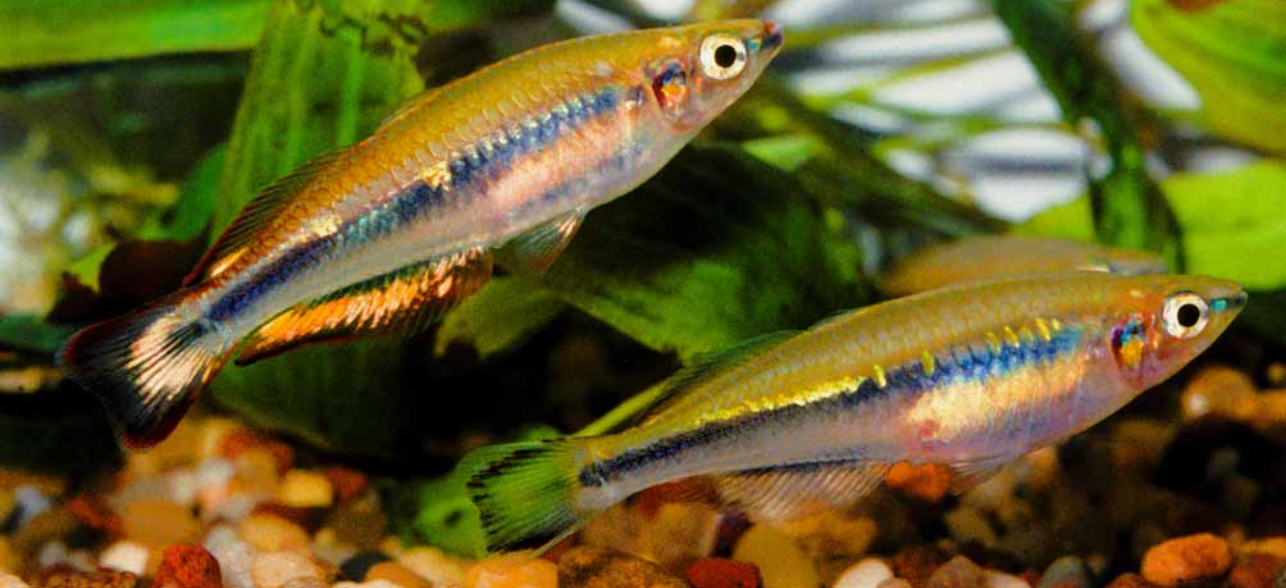
Madagascar’s forests are famous. Its rainbowfish should be. Bedotia madagascariensis, the zona or Madagascar rainbowfish, is an atheriniform from eastern rainforest streams on the island, and it is not a Melanotaenia. Different family, different face, a black-and-gold lateral story with a red tail in males, and a conservation shadow: wild populations have been squeezed by habitat loss and introduced fish. When you keep this species you are keeping an island endemic, not a generic “rainbow” from a New Guinea river. Treat the water, the school, and the lid with that in mind.
They live at the surface and just below it, in a tight, nervous school that calms when the group is large and the tank is covered. Six is a minimum; ten is better. A pair in a nano cube is how you get jumpers and faded fish. Adult size is about 8–10 cm — bigger than a dwarf neon rainbow, smaller than a full Melanotaenia splendida. Plan the tank for the adult, not for the 4 cm shop fish.
Rainforest streams on an island that is not Australia
Bedotia madagascariensis comes from clear, flowing, vegetated streams on Madagascar’s east side. The water is typically soft to moderate, warm-temperate to tropical depending on elevation, oxygen-rich, with overhead cover. It is not a swamp. It is not a rift lake. Tannins may be present; extreme blackwater is not the default story. Flow and oxygen are.
In captivity they have been maintained for decades, which is fortunate, because relying on wild collection would be the wrong instinct. Tank-bred fish are what you should buy. If a seller brags about wild zona, ask why.
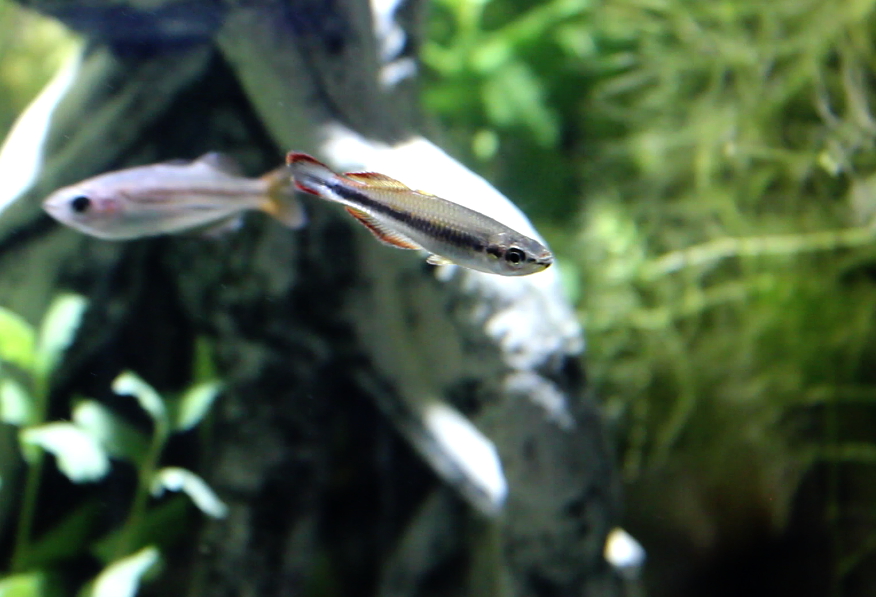
A red tail is a male in the conversation
Males show more red in the caudal and a stronger black longitudinal pattern; they are also the ones doing the displaying. Females are paler, a bit rounder in the belly when gravid, with less drama in the tail. The eye is large. The snout is more pointed than a melanotaeniid’s. Once you see a Bedotia beside a Melanotaenia you will not confuse them again except on a bad shop label.
Colour is school-dependent. A lonely male goes drab. A group in motion throws gold and black and that red punctuation at the tail. Light from the front or side shows it; light from above on a dark room often does not.
Surface lane, tight glass, moving water
A hundred litres and a long shape. Plants along the back, open water at the top, floating plants if you want shade but not a full mat that blocks the swimming they do at the surface. They are accomplished jumpers. Gaps at the filter, at the cords, at the rim — they will find them. Cover every slot.
Flow should be noticeable at the surface. A spray bar along the back suits them. They are not hillstream fish, but stale water and no ripple makes them hang and breathe hard. Substrate is their least concern; they rarely visit the sand except to inspect a fallen morsel. A heater with a guard; a school can panic and hit equipment.

Softer than a splendida, warmer than a trout
Temperature 22–26°C is a comfortable band; they do not need 30°C. pH 6.5–7.5, soft to moderately hard. If your tap is already there, good. If you keep Amazon blackwater at pH 5.5, this is the wrong roommate for rummynoses that demand that extreme — you can compromise in the mid-sixes for a mixed tank, or you can give the zona their own slightly more neutral, oxygen-rich setup. Weekly changes. They show dirty water as clamped fins and a school that will not leave the back corner.
They are active metabolically. Do not overstock the rest of the tank until the school has room. Nitrate control is ordinary husbandry, not a special Madagascar ritual.
Small mouths, frequent meals
Flake, micro pellets, frozen daphnia, brine shrimp, chopped mysis, and flying insects if you are theatrical — they will take food at the surface with a splash. Feed twice a day. They can be shy at first and miss food that sinks past them. Drop food where the school is. Vegetable matter in a good flake is enough; they are not algae eaters. Underfed zona stay thin and pale and still jump.
A school that startles as one
Keep them with other peaceful, similarly sized fish that will not outcompete them at the surface or terrorise them: small rainbows of compatible water, some tetras, Corydoras below. Avoid large cichlids, avoid fin-nippers, avoid a tank that is all bottom dwellers and two zona. They are peaceful to others. They will eat tiny fry. Males display; damage is usually minor if the school is large enough that no one is trapped.
Shrimp in a planted tank may persist; nauplii will not.
Mops work if you steal the eggs
Egg scatterers. Fine-leaved plants or mops. Adults eat eggs. Breeders pull mops or use a tank with marbles or mesh. Fry need infusoria and baby brine. This is how captive stocks persist, and it is worth doing if you have extra tanks — island endemics should not exist only as a single ageing school in one living room. If you do not breed, keep them well and buy tank-bred fish when you restock. That is still conservation-minded keeping.
Do not let the last school be yours by accident
Quarantine the group together. They ship nervously; dim lights, a cover, food at the surface once they are swimming. Ich after temperature shock. Give them two weeks. Then a long, closed, oxygenated tank. If a fish is missing, look on the floor before you assume it dissolved. Bedotia madagascariensis is a surface fish from a threatened island fauna. The care is not mystical: school, lid, flow, modest warmth, frequent small meals. The meaning is that this is not another blue rainbow from a different ocean. It is Madagascar, in motion, under glass — but only if the glass has a lid.
Explore other topics
Dive into more aquarium guides across the site.