

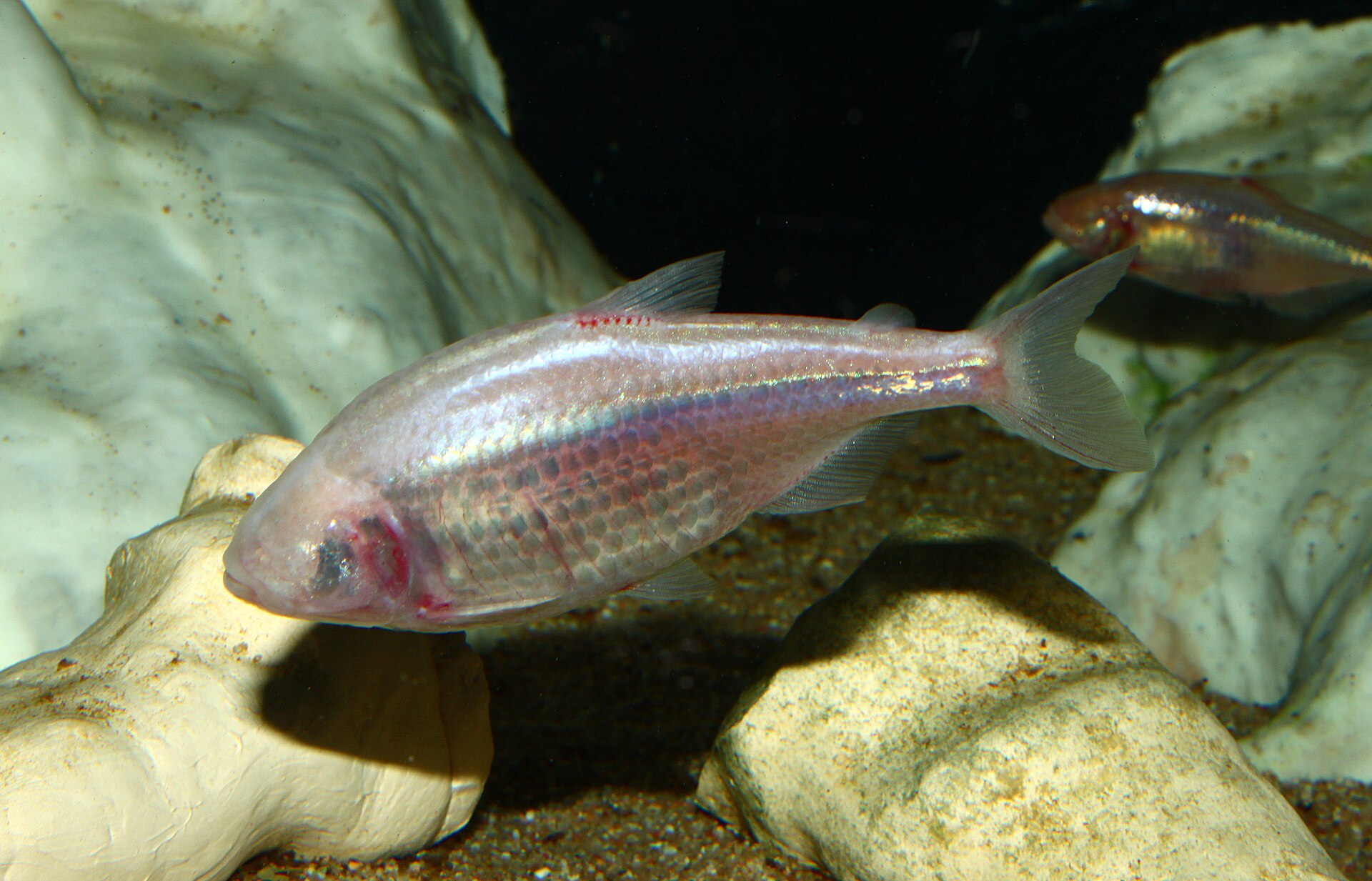
Shop bags labelled Mexican tetra almost always hold the silver, eyed river fish Astyanax mexicanus. Another bag on the same rack, often sold as a “blind cave tetra,” is the same species in a cave morph: no functional eyes, no pigment, and a husbandry story that does not match the surface fish. Treating those two as interchangeable community tetras is how both end up in the wrong tank.
Two morphs, one Latin name
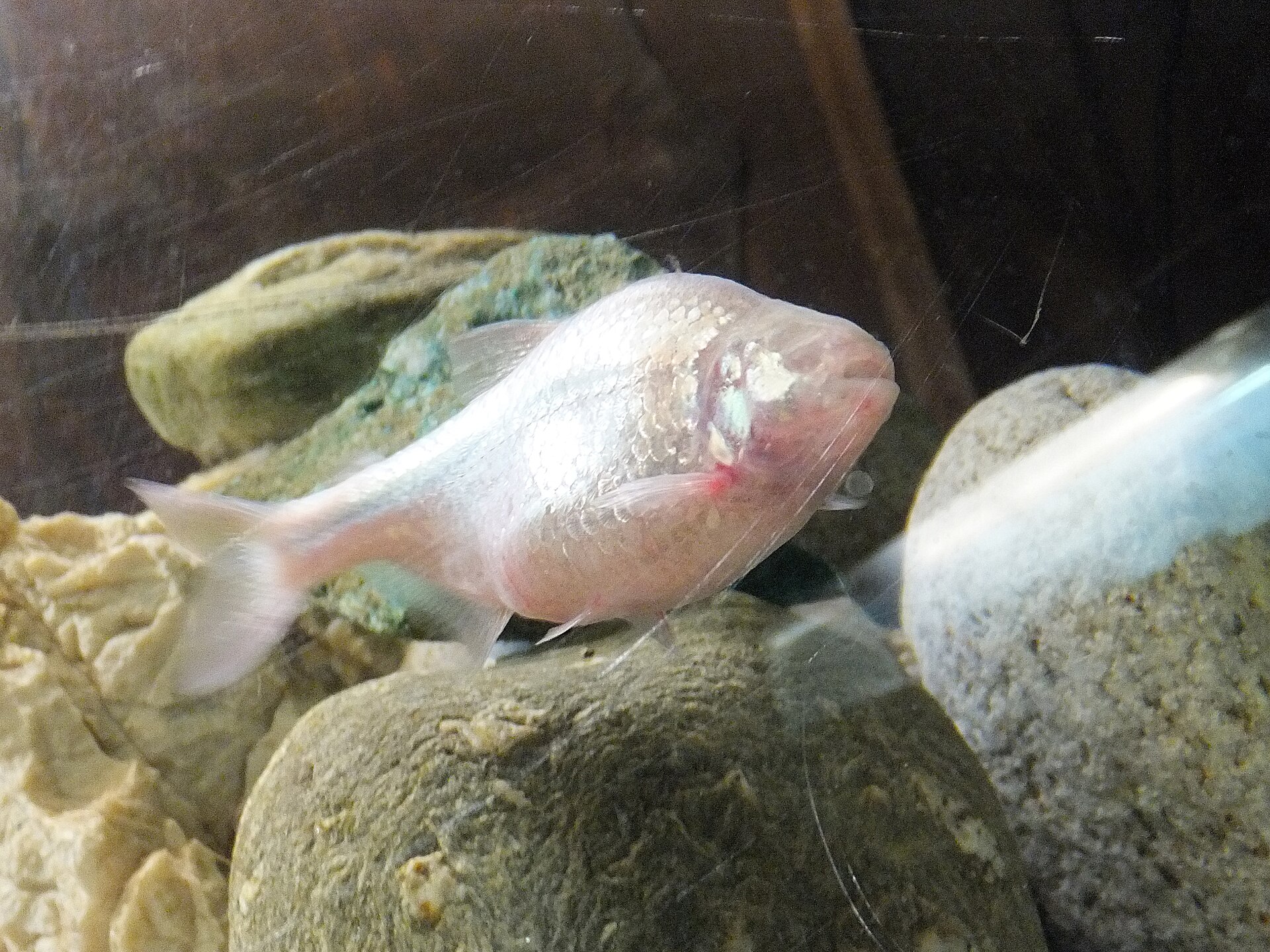
Surface A. mexicanus lives in rivers, springs, and creeks of eastern Mexico and the southern tip of Texas. It is a silvery characin with a dark caudal peduncle spot, a forked tail, and a school that uses open water. The cave morphs — the ones from limestone systems in San Luis Potosí and neighbouring states — lost eyes and melanin over many generations in darkness. Genetically they are still Mexican tetras. In the aquarium they are not “a paler Mexican tetra.” They need dimmer light, less visual schooling, and tankmates that will not pick at an animal that cannot see a threat coming.
If you want the classic silver school, buy the eyed form and keep a group. If you want the cave form, set up for it on purpose: subdued lighting, smooth décor, food that reaches the fish by smell and current, and companions that will not steal every meal. Mixing six silver fish with two cave fish in a bright planted display is a compromise that serves neither morph.
Where the river form actually lives
Eyed Mexican tetras are not blackwater Amazon fish. They come from a wide band of subtropical and tropical drainages that can run clear, slightly stained, or spring-fed. Temperatures swing more than they do on the Rio Negro. Hardness and pH sit nearer to neutral or even mildly alkaline in many collecting sites. That is why this species often thrives in ordinary municipal tap water once chlorine is gone, while a cardinal tetra in the same tap looks washed out.
In the wild the school uses snags, undercut banks, and open runs. It is a midwater-to-upper fish, not a cave specialist in this morph. Copy structure and a swimming lane, not a pile of rockwork meant for a rift cichlid. A long tank with plants or wood at the sides and a clear centre matches how the river form uses space.
Silver fish at adult size
Adults of the surface form commonly reach 8–12 cm total length. That is a genuine tetra, not a neon. A school of eight adults needs the footprint of a 120 litre tank at minimum; 150 litres is more honest if you also keep other midwater fish. Juveniles in shops look compact. They do not stay that way.
Colour is silver with a faint lateral sheen and that caudal spot. Stress shows as a dull grey cast, clamped fins, and a school that hugs a back corner. The cave morph is pinkish-white with a visible skull and no dark pigment. Do not expect the cave fish to “colour up” in blackwater extract. It has no pigment to colour.
Water the river form will accept
Temperature for the eyed form can sit anywhere from the high teens to the high twenties Celsius. 20–26°C is a practical display range. They are more tolerant of a cool spell than a rummynose tetra, which is why they historically appeared in unheated rooms in parts of North America. pH from about 6.5 to 8.0 is usable; wild fish see a lot of that spread. Hardness is similarly flexible. Ammonia and nitrite must still be zero. Nitrate is best kept modest with regular water changes, not by hoping a big tetra is “hardy enough to ignore a dirty tank.”
The cave morph prefers the cooler, stable end of that range and does poorly under intense light that offers no shade. Both morphs dislike sudden chemistry swings more than they dislike a particular number on a test kit.

A school that is large enough to be a school
Six is the usual minimum quoted for characins. For Mexican tetras, eight to twelve of the surface form looks and behaves better. In a tiny group they chase each other harder and look more nervous. They are not vicious, but they are active, and a pair in a 60 litre cube will look like a mistake.
Tankmates should match size and water. Other robust tetras, peaceful barbs that are not fin-shredders, Corydoras, and larger rasboras can work. Long-finned guppies and slow angelfish are a gamble: Mexican tetras can nip when understocked or bored. Do not house the cave morph with anything that hunts by sight and speed. Do not put either morph in a mbuna tank because “they both like hard water.” The cichlids will own the rockwork and the tetras will lose.
What they eat when they are not a lab strain
A. mexicanus is an omnivore. In rivers it takes insects, crustaceans, plant fragments, and whatever the current delivers. In the tank, quality flakes or small pellets are a base. Frozen bloodworm, daphnia, and brine shrimp keep condition up. They will also graze some algae and blanched vegetable. Feed in the water column; they are not dedicated surface specialists like hatchetfish, and they are not sand-sifters. Two modest meals beat one heavy dump. Cave fish need food that drifts into their path. Watch them eat. If midwater tetras intercept everything, the blind fish starve while the bag still looks “stocked.”
Spawning the eyed form
Sexing is easiest in adults: males are slimmer; females round out when full of eggs. They are egg scatterers. A separate breeding tank with a mesh or a mop, slightly warmer water, and a water change that mimics a rain pulse will often trigger a spawn. Adults eat eggs. Remove the parents if you want fry. The eggs are adhesive enough to catch on plants. Fry take infusoria then newly hatched brine shrimp.
Cave morphs also spawn in captivity and are a research animal as much as a pet. Hybridising cave and surface fish in a home tank is possible; it is not a project to run by accident in a community display.
Illness and the “hardy tetra” trap
Mexican tetras shrug off a wider temperature band than Amazon specialists, which leads people to skip quarantine. Shipping stress, ich, and bacterial infections still happen. Isolate new fish. Watch for flashing, white specks, rapid breathing, and weight loss. The cave morph can pick up injuries it cannot see coming; inspect body and fins, not just “whether they school.”
Because the species is used in laboratories, some strains in the trade are tank-bred and relatively tough. Wild-caught surface fish still need the same slow acclimation you would give any wild characin. Do not dump them from a 24°C bag into 18°C display water because a care sheet said the range is wide.
A display that admits which morph you bought
For the silver river form: length, a lid (they can jump when startled), a school, and lighting that shows silver without bleaching the tank. For the cave form: shade, gentle flow, food delivery that does not rely on vision, and no décor with sharp edges. Keep the Latin name in mind so you do not “upgrade” a cave tank by adding neon tetras that want soft, warm, stained water the cave fish does not need.
Related reading on this site: the cardinal tetra if you want a true blackwater schooler instead, and aquarium water chemistry if you are deciding whether your tap already suits the river morph.
Explore other topics
Dive into more aquarium guides across the site.