

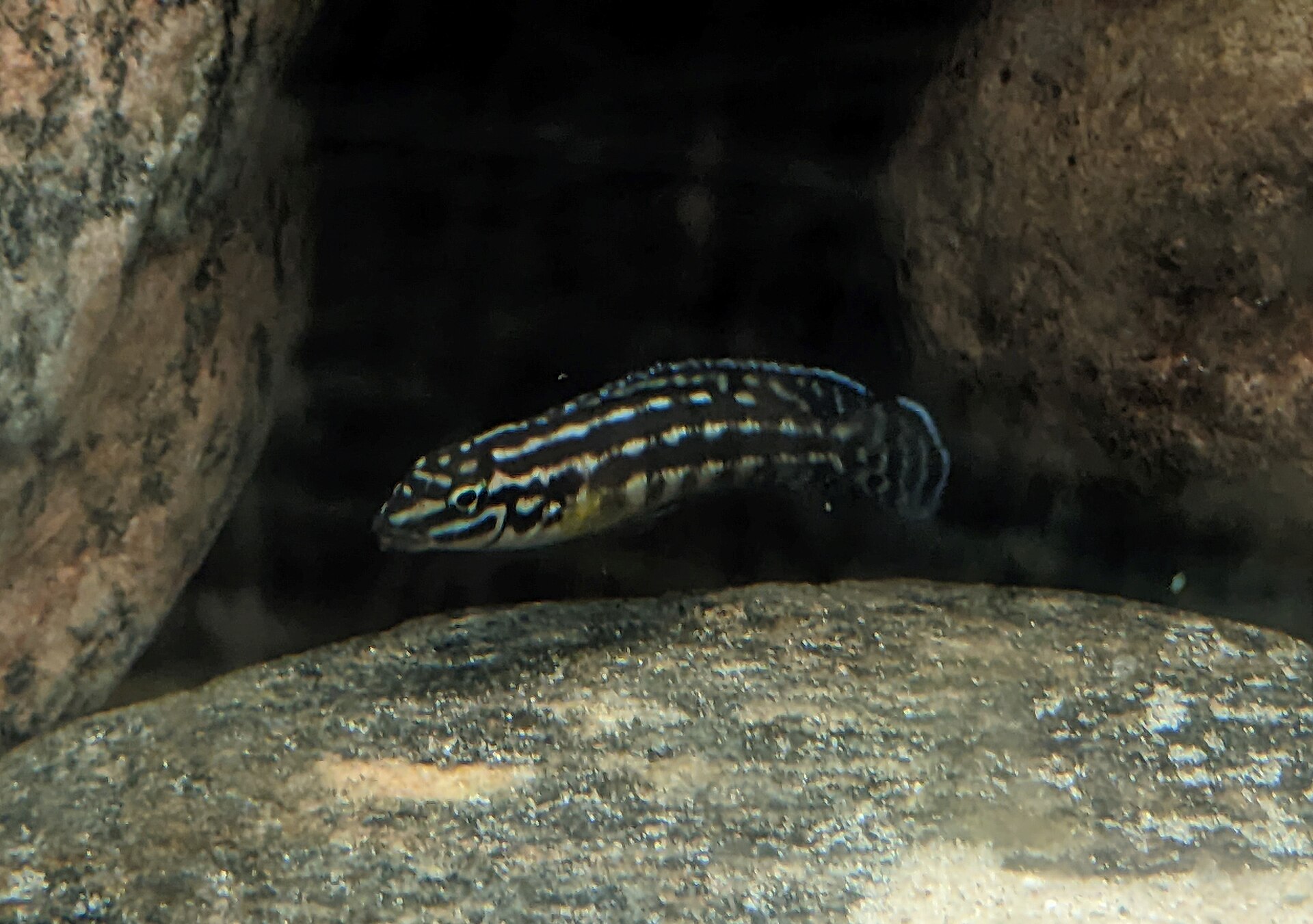
An ornate Julie is a fish of cracks. Julidochromis ornatus is elongate, barred in gold and brown-black, and spends its life sliding through rock slits along Tanganyika’s shore. It does not reverse into a snail shell. It does not mill in midwater like a Paracyprichromis. It does not school like a rasbora. You keep a pair (or a settled pair plus grown fry you failed to remove) on a rock pile with alkaline water, and you let them own a crevice.
Adults are about 7–9 cm, slimmer than their length suggests. The temperament is pair-territorial, not colony-on-sand. If you build a shell bed and wait, they will ignore it and fight in the open. If you build a maze of slate and cobble, they will vanish into it and look like the lake.
Rocky littoral, alkaline and bright
Wild ornate Julies occupy rocky habitat in Lake Tanganyika. The water is hard and alkaline, well buffered, typically 24–27°C. The structure is jumbled rock with narrow gaps — not a sandy Neothauma field, not a vegetated Amazon. Light in the shallows can be strong; the fish use the rock shadow more than floating plants.
Copy the rock. Copy the water. Do not copy a mbuna tank’s crowded herbivore politics if you cannot house the aggression, and do not copy a Malawi peacock layout just because both lakes are African. Tanganyika mineral mix is the chemistry language; stacked rock with tight slits is the furniture.
Four stripes and a needle body
The ornate Julie is among the smaller, more delicately marked Julidochromis. Horizontal dark stripes on a yellow-gold ground are the usual picture; intensity varies with mood and population. The body is cylindrical-elongate — made for entering a crack sideways. Marlier’s Julie (J. marlieri) is a heavier, more checkerboard-looking fish that grows larger and often needs more room. Do not stock them together to “compare stripes.” They will compare territories.
Sexing is difficult. Behaviour in a pair is easier than fin shape: a bonded pair holds a crevice, spawns on the rock face or in a slit, and both guard. Random groups of six juveniles will end as one pair and a lot of damage.
A hundred litres of rock, not a hundred litres of sand
Build 100 litres or more, with rockwork that creates multiple slits and a few visual breaks. Fine sand at the base is fine — they are not dedicated shell-dwellers, but they will use the bottom. Do not make the sand the feature with a dozen empty snail shells as the only décor. That is an ocellatus tank. Julies need the vertical maze.
Build rock so it cannot collapse. Use aquarium-safe stone. Leave swimming space in front so you can see them when they emerge to feed. Plants are optional and usually unhappy in this water; hardy anubias tied to rock sometimes survives. Filtration should be strong; rock tanks trap detritus. Aim the flow along the rock face, not into a sandstorm.
The same lake chemistry as a shell-dweller — different furniture
Temperature 24–27°C. pH 7.8–9.0. High hardness. Zero ammonia. This matches L. ocellatus on paper and diverges in aquascape. Do not mix peat. Do not mix them with apistos. Do not use a tetra community recipe. If your tap is soft, mineralise for Tanganyika. If you already run a shell-dweller tank, you could in theory share water chemistry in a large enough lake-style setup with shells on one side and rock on the other — only if you understand territorial overlap. Most people should pick one habitat.

Water changes must match KH. Chemistry basics and a completed cycle are non-negotiable.
Picking food off the rock
Micropredator / omnivore: small sinking pellets, frozen mysis, brine, cyclops, finely chopped invertebrate foods. They hunt along rock, not at the surface. Hatchet-style floating food is a poor match. They will take food from the water column when hungry. Feed the pair; watch that fry (if present) get dust-sized foods. They are not algae-grazing mbuna. They are not sand-sifting geophagines.
A pair, not a shoal, not a shell colony
The honest stocking is a pair in a rock tank. Dither fish, if any, should be Tanganyika open-water species in a large tank that can stay off the rock. Fairy cichlids (N. brichardi) and Julies can conflict over rock. Shell-dwellers will be raided if the shells sit in Julie territory. South American dwarfs are a chemistry crime. Rasboras are food or at least victims.
Do not add Corydoras. Do not add a bristlenose “for algae” in 8.5 pH without accepting it is a compromise fish in the wrong biotope.
Eggs on stone, fry in the crack
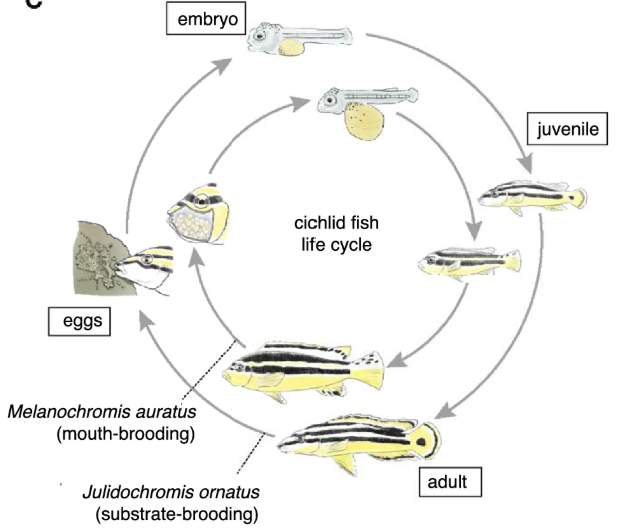
They spawn on rock, often in a slit you cannot see. Both parents guard. Fry appear as tiny replicas in the crevice. You can leave them until the pair spawns again and grows less tolerant, then pull juveniles. This is substrate spawning on rock, not shell spawning, not leaf-cave spawning, not mouthbrooding. If you never see eggs, look harder in the dark gaps before you assume they are infertile.
Torn fins and empty slits
Multiple adults without a pair bond produce shredded Julies. Collapsing rock produces dead Julies. Soft water produces sick Julies. New fish should be quarantined in hard, alkaline water with a few pieces of PVC or rock — not in a planted soft-water hospital that “worked for tetras.” Watch them eat along the bottom of a stone. A Julie that never leaves a corner of glass, with no rock, is a Julie you have not housed.
For a larger, more checkered Julie, see Marlier’s Julie. For a shell alternative in the same lake chemistry, L. ocellatus. For a rock cichlid that is not a Julie, the fairy cichlid is a different social system. Those are still rift cichlids, not Amazon tetras, and they want the same hard alkaline water.
Fry you cannot see until they are a problem
Ornate Julie fry stay in the slit. You will think the pair is infertile for weeks, then a dozen striped splinters will appear at the crack mouth. That is success. It is also the start of crowding. In 100 litres, pull juveniles when they are large enough to catch without destroying the rockwork, or accept that the pair will do the thinning. Do not add a second Julie species “for the fry to school with.” Fry of J. ornatus are still slit fish, not a rasbora school, and extra adults are still enemies.
Explore other topics
Dive into more aquarium guides across the site.