

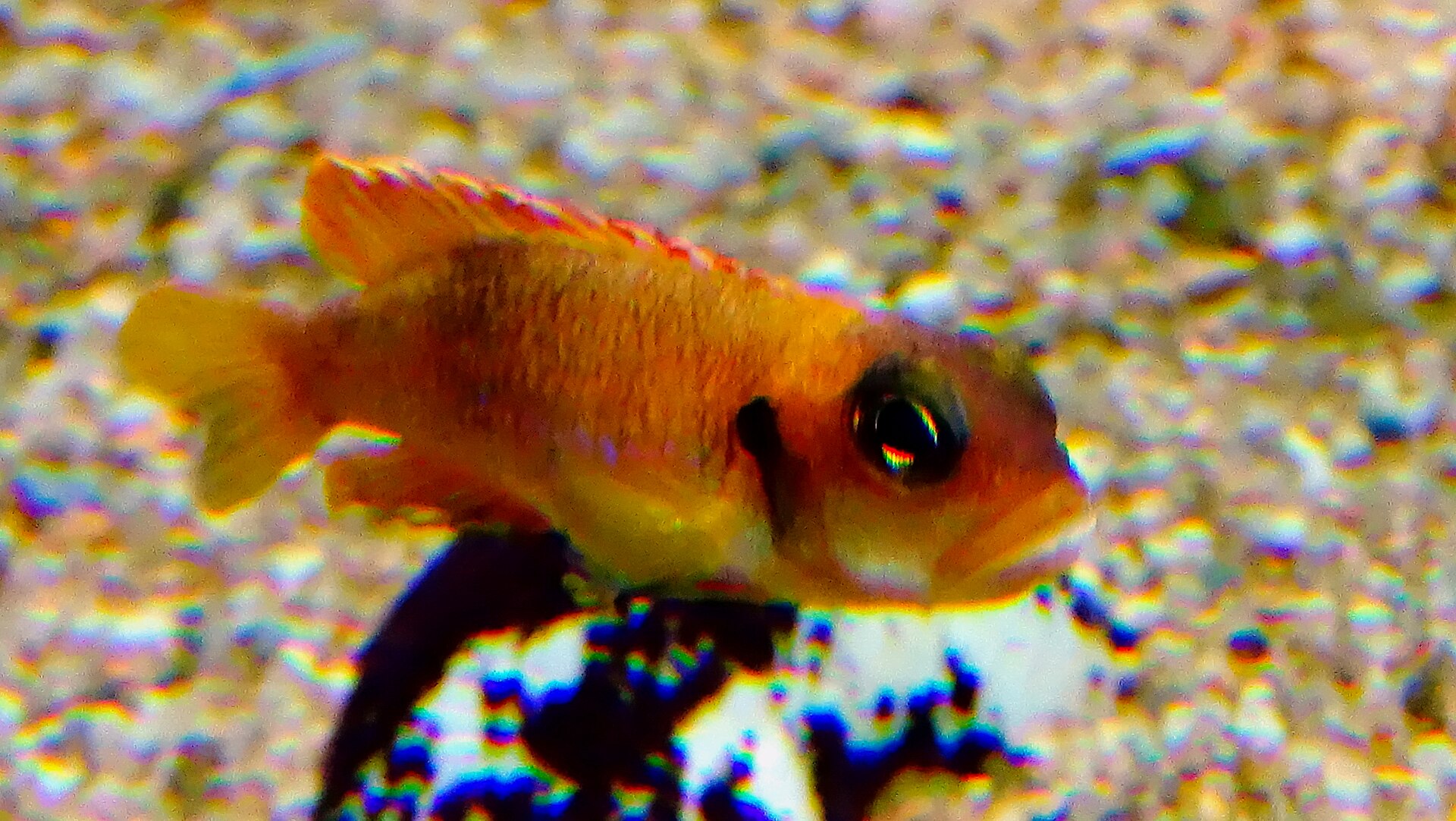
Lamprologus ocellatus does not school. It does not graze plants. It does not live in leaf litter. Each adult claims an empty snail shell on a sand flat in Lake Tanganyika, shovels sand with its mouth, and defends that shell like a house. If you take away the shells, you do not have a slightly unhappy cichlid. You have an animal that cannot complete its behaviour. That is the species. The rest of the husbandry follows from that: shells, sand, and Tanganyika water, not a planted community.
Males reach about 5–6 cm, females smaller, often in the 3–4 cm range. They are not nano community fish. They are small predators with a property portfolio of Neothauma-type shells (or suitable empty apple-snail shells in captivity). The gold and wild-type colour forms you see in shops are still shell-dwellers. The colour does not change the chemistry.
Sand beaches of Tanganyika, not a planted Amazon
In the lake they occupy sandy shores and intermediate zones where empty snail shells collect. The water is hard, alkaline, mineral-rich, and stable: think pH 8–9, high KH and GH, temperature in the mid-twenties. There is no peat. There is no oak leaf bed. There is no driftwood theme required. Rock can exist at the edge of a biotope, but the fish’s world is the sand and the shells on it.
A “Tanganyika community” that is actually a Malawi mbuna tank is also wrong. Mbuna are rock grazers from a different lake. L. ocellatus is a shell specialist from Tanganyika. Mixing them because both are “African cichlids” is how you get dead shell-dwellers and shredded mbuna.
The ocellus, the shovel, the house
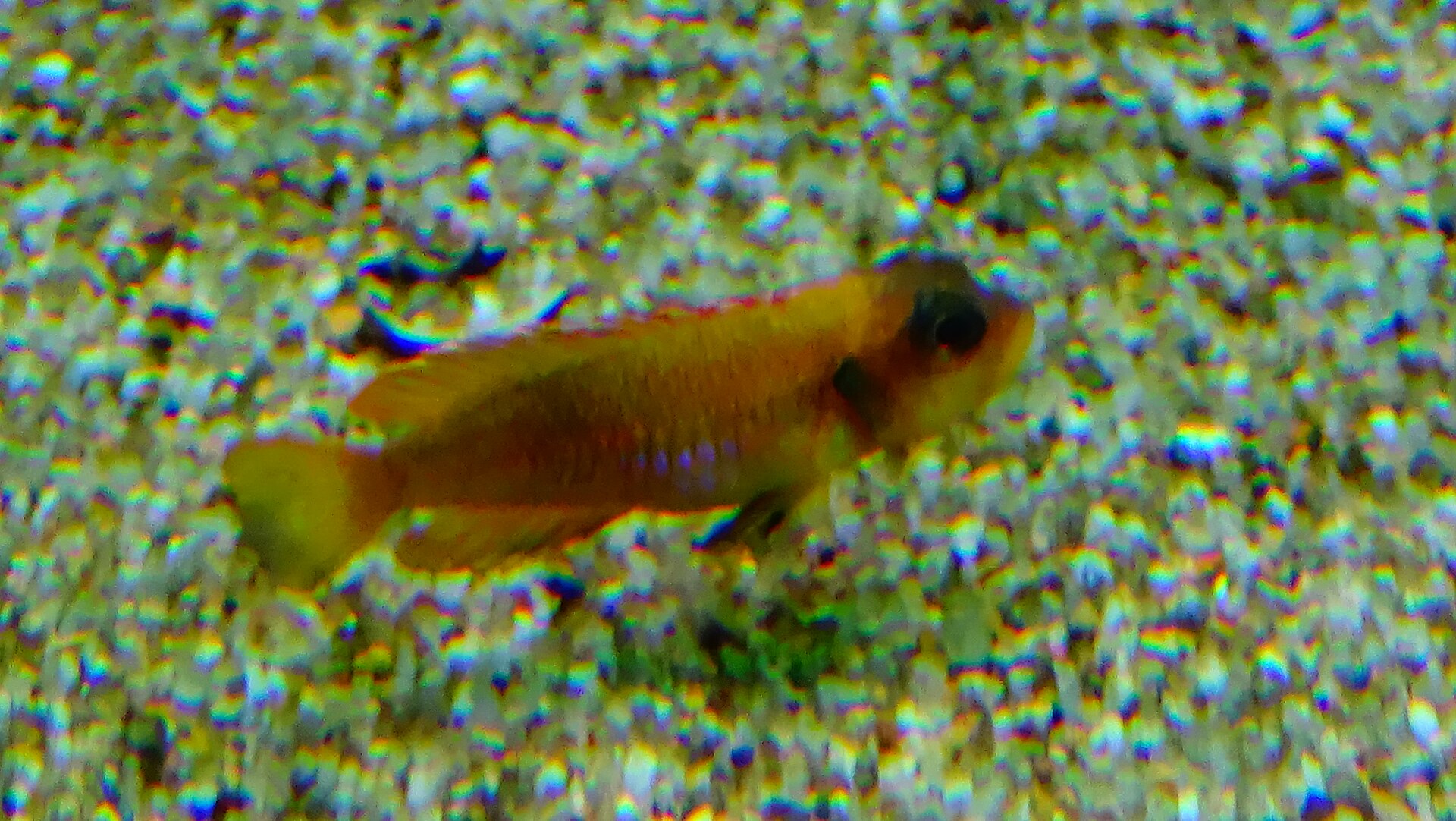
The body is stocky for a small cichlid, beige to gold, with a dark spot (ocellus) associated with the gill region that gives the species its name. They flare, sand-dig, and reverse into shells tail-first. Males are larger and hold a territory covering several shells; females may occupy a shell within or near that territory. You will see them move shells, bury the entrance until only a hole remains, and spit sand in a cloud. That cloud is not a disease. It is housekeeping.
Compare that to a Julie, which is a long fish that wedges into rock cracks. Compare it to Neolamprologus multifasciatus, another shell-dweller but a colonial, more social species that packs many fish into a shell field. Ocellatus is more of a spaced-out territorial shell owner. Do not stock it like either of those animals.
Shells first, then gallons
An 80 litre tank can work for a small colony if the footprint is wide and the sand is deep enough to bury and arrange shells — several centimetres of fine, smooth sand, not sharp gravel, not laterite, not plant substrate full of nutrients that will fuel algae while the fish dig. Provide many more shells than fish. A 1:1 shell ratio causes war. A 3:1 or better ratio lets territories spread.
Layout: open sand. Shells scattered, not piled in one corner. Maybe a rock wall at the back if you want a visual break, but do not turn the tank into a pile of slate slits and hope they “use caves instead.” They will not become Julies. Plants are usually a waste; they will uproot them, and most plants hate pH 8.5. If you want green, use species that tolerate hard water and accept that sand will land on the leaves.
Filtration should be robust — they dig, so you want mechanical capacity — but the outflow should not blast shells across the tank. Heater guard is wise; they will wedge under equipment.
Alkaline, mineral, boringly stable
Temperature 24–27°C. pH 7.8–9.0. Hardness high. This is the opposite of Boraras advice and the opposite of apisto advice. If your tap is already hard and alkaline, you may be lucky. If your tap is soft, you add Tanganyika or Rift Lake mineral mixes, or you mix RO with a proper salt recipe — you do not add peat. You do not add catappa until the pH crashes. You do not keep them in the same water as a checkerboard cichlid.
Ammonia and nitrite stay at zero. Nitrate control still matters; small cichlids in a sand bed produce waste, and buried detritus in shells can rot. Siphon the open sand gently. Do not vacuum the shells out of the tank if there are eggs or fry inside. Match water chemistry on every change. A sudden dump of soft tap is a massacre.

Cycle the tank with the sand and shells in place. Cycling still applies. For why KH matters here, water chemistry basics is worth reading even if you already keep tetras — the numbers are just pointing the other direction.
Hunting around the doorstep
They are micropredators. In the lake they take invertebrates. In the tank they take small sinking pellets, frozen cyclops, daphnia, brine shrimp, and similar. Food should fall near the sand and shells. Surface flakes for hatchetfish will be ignored. Tablets for plecos are the wrong shape and the wrong tank. Feed modestly; they are small, but a colony still dirties water, and uneaten food in a shell becomes a death trap for fry.
They will eat shrimp. They will eat tiny fish. They are not a cleanup crew.
Who may share the sand — almost nobody from South America
Best: a species tank. Possible: other Tanganyika fish that use different space, such as open-water Cyprichromis or Paracyprichromis in a large tank, or rock-dwelling species that stay off the shell field. Risky: other shell-dwellers if the shell supply and footprint are not enormous. Wrong: tetras, Corydoras, bristlenose plecos in a planted community, apistos, rams, and anything that needs soft water.
Corydoras on sand sounds logical until you remember they need different chemistry and they will be harassed at every shell. Tetras will be hunted or at least shredded. Do not “dither” ocellatus with glowlight rasboras.
Spawning inside the architecture
The female lays in the shell. The male defends. Fry stay in and around the shell mouth. You will see tiny faces in the aperture. Do not siphon them. Do not add a cleaning crew of shrimp. Colony breeding is the normal long-term state if shells and sand are right. Sexing is largely size and behaviour: big sand-movers with a wide territory are males.
This is not a scatter spawn. This is not a leaf-litter cave like an Apistogramma. This is not a rock-slit spawn like Julidochromis. If you remove every shell to “clean the tank,” you removed the nursery.
When the colony looks wrong
Fish that never leave a corner: not enough shells, or a male so despotic the others cannot hold a house. Fish that gasp: temperature too high, oxygen too low, or a filter clogged with sand. White slime on bodies: often water quality, sometimes ich in a stressed import. New fish should be watched in a small tank with sand, a heater, a sponge, and two shells each — still alkaline water, still not a tetra hospital.
Bloat and Malawi-style “bloat” treatments get overused; start with water, sand cleanliness, and diet variety. Copper in a tank you might later put shrimp in is a separate issue; this species should not be with shrimp anyway.
Long-term, the work is mineral stability, shell surplus, and resisting the urge to aquascape an Amazon. If you want a related Tanganyika project with more fish in less space, read up on the multifasciatus shell-dweller. If you wanted rock slits instead of shells, that is a Julie. If you wanted a planted community, you wanted a different lake and a different article.
Amazon blackwater tetras belong in Amazon water. Lamprologus ocellatus would kill them with chemistry before it ate them, and it would eat them too.
Explore other topics
Dive into more aquarium guides across the site.