

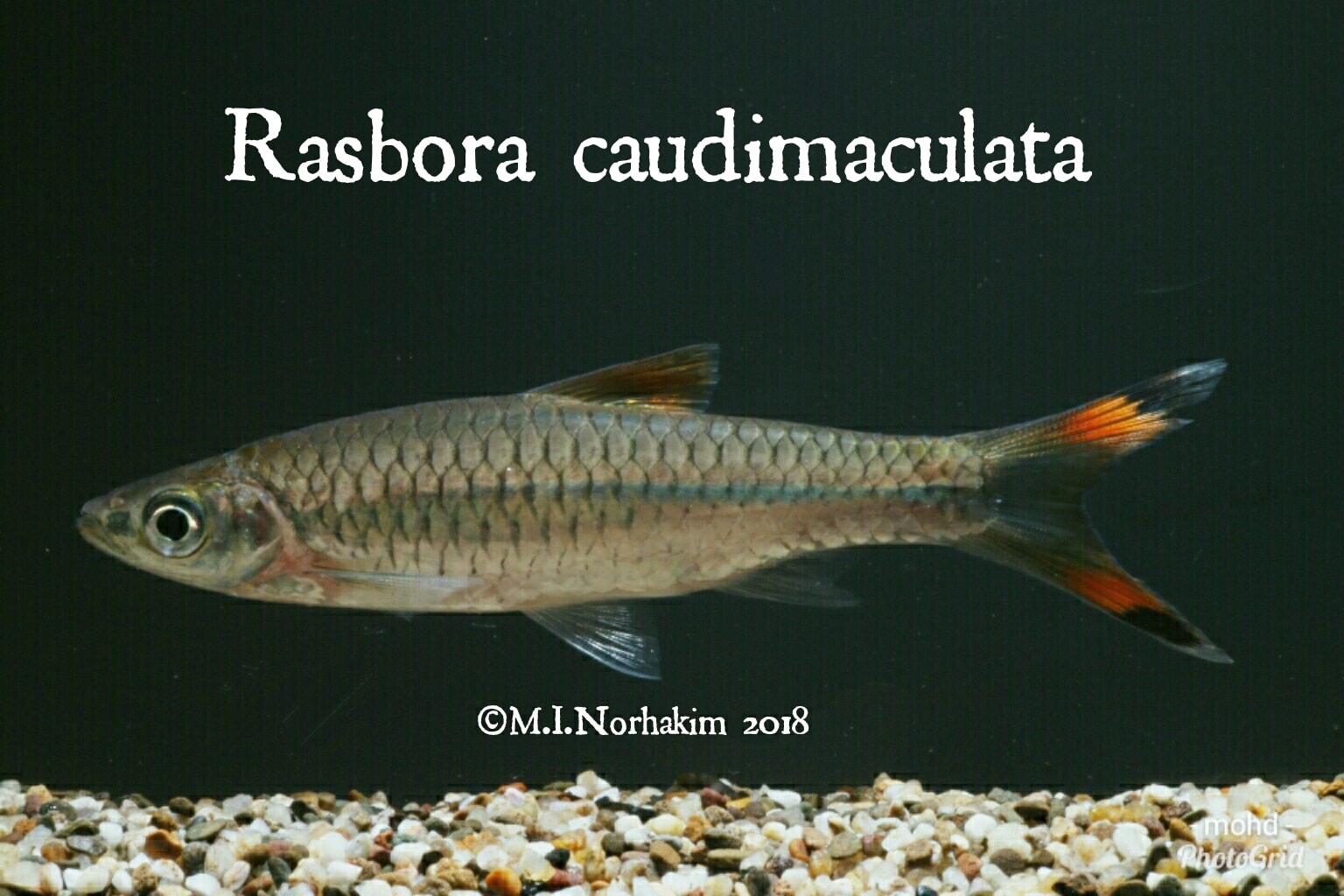
The greater scissortail is the rasbora that makes people underestimate lids. Rasbora caudimaculata reaches 10–15 cm, patrols open water like a small salmonid, and advertises with a deeply forked tail marked with dark spots — a larger, more athletic cousin of the familiar Rasbora trilineata. It is a river fish. It is a jumper. It is not a 4 cm community “rasbora mix” and it will not colour or settle in a 60 litre planted box full of glowlights.
If you liked the scissor motion of the smaller species and assumed this one was the same fish with a longer name, look at adult length again. Fifteen centimetres of cyprinid in a school of eight is a different piece of furniture.
Open Southeast Asian rivers
Native to Southeast Asian freshwater rivers, R. caudimaculata uses channels with room to cruise. Water is typically tropical but not swamp-still, on the soft to moderately hard side, never alkaline like Tanganyika. The fish are pelagic in the sense that they live in the water column, not in shells, not in rock slits, not in leaf litter like an apisto.
Your impression of the wild habitat should be distance, oxygen, and a surface they can break if they want to — which is why they also end up on the floor when the lid is loose.
The tail is the identification, the body is the engine
Silver, elongate, fast. The caudal fin is the field mark: forked, with dark spots or blotches that read as a scissor when the fish kicks. The smaller scissortail (R. trilineata) plays a similar game at a more community-friendly size. Greater scissortails look like they mean it. Males slimmer, females heavier in the belly when feeding well. There is no red nano morph. There is no cave colour form.
Juveniles in shops look harmless. They grow. Record the adult size before money changes hands. A “schooling rasbora” label has hidden a lot of oversized fish in small tanks.
Two hundred litres, long, with a lockable lid
This is a 200 litre-or-more fish, biased to length. The filter should move a lot of water and keep oxygen high. Plants can occupy the ends; the centre is a racetrack. Wood as current break is useful. Sand is fine. Rift rock is wasted space. Shells are clutter. A lid that actually latches is part of the filtration system in the sense that without it you have no fish.
Do not use a rimless open-top aquascape unless you enjoy restocking. These fish jump when startled by lights, shadows, or tankmates. Hatchetfish jump because they live at the surface; greater scissortails jump because they are powerful and nervous. Same lid, different reason.
Cooler tropical, high oxygen
Temperature 22–26°C. pH 5.5–7.5. They dislike the heat of a discus or Uaru tank and they dislike stagnant warmth. Keep the surface moving. Cycle the aquarium; a school this size is a bioload. Water changes should be routine. If you need primers, use chemistry basics and cycling — then size the tank honestly.
Hard alkaline water will not “toughen” them. Soft peat at pH 4.5 is the other wrong end; they are river fish, not Sundadanio.

Feed them like they swam all day
Omnivore with a high energy budget: quality pellets or flakes for larger tetras/barbs, frozen mixes, occasional insect-like foods. They will take food from midwater and the surface. They will outcompete nano fish instantly. Feed enough that the back of the school gets some, not so much that the 200 litres turns into soup.
They do not need algae sheets like a Uaru. They do not need sand-sifting like a Satanoperca. They need calories and oxygen.
A school of athletes, not six leftover tetras
Keep six or more; eight to twelve is the display. Tankmates must be large enough not to be food, fast enough not to be terrified, and peaceful enough not to wreck the tail. Other large rasboras, robust barbs, larger tetras, and similarly sized peaceful fish in a river layout can work. Dwarf cichlids, peat nanos, shrimp, and Tanganyika rock dwellers do not belong here.
Corydoras can work on sand in a big river tank if you feed the bottom. That is still not a reason to add Boraras.
Scatter and leave
Egg scatterer. No parental care. Plants or mops, adults out, fry on small foods. You will not get a colony in shells. You will not get a pair in a rock slit. If breeding is the goal, a dedicated long tank is kinder than hoping the 200 litre display produces survivors among the adults.
Missing fish and split tails
Missing fish: check the floor, the filter weir, the gap in the lid. Split tails: nipping tankmates or poor water. Ich after a cold change. The greater scissortail is hardy when the tank is right and fragile when the tank is a lie.
Compare with Rasbora trilineata if you want the same tail language in a smaller body, or with rosefin rasbora if you wanted river silver without the spotted caudal. Do not compare them to clown rasboras except as a warning about how wide the word “rasbora” has become.
The lid checklist nobody wants to hear
Filter rims, cable cut-outs, feeding flaps, and rimless open tops are how Rasbora caudimaculata leaves the building. Tape the gaps. Weight the lid. Feed through a hole you close. If you keep them in a greenhouse-style paludarium because it looks natural, you will restock. The jump is not a rare accident; it is the species meeting a gap.
Noise and shadows matter more than with a Julie that can vanish into rock. A river schooler in open water startles as a unit. One tap on the glass trains them to rocket. Place the tank where people do not constantly loom. At night, a dim moon light is kinder than slamming the main LEDs off and triggering a panic jump into the lid — or through it. If you find a dried fish, change the lid before you buy a replacement school. The second school will use the same hole.
Explore other topics
Dive into more aquarium guides across the site.