

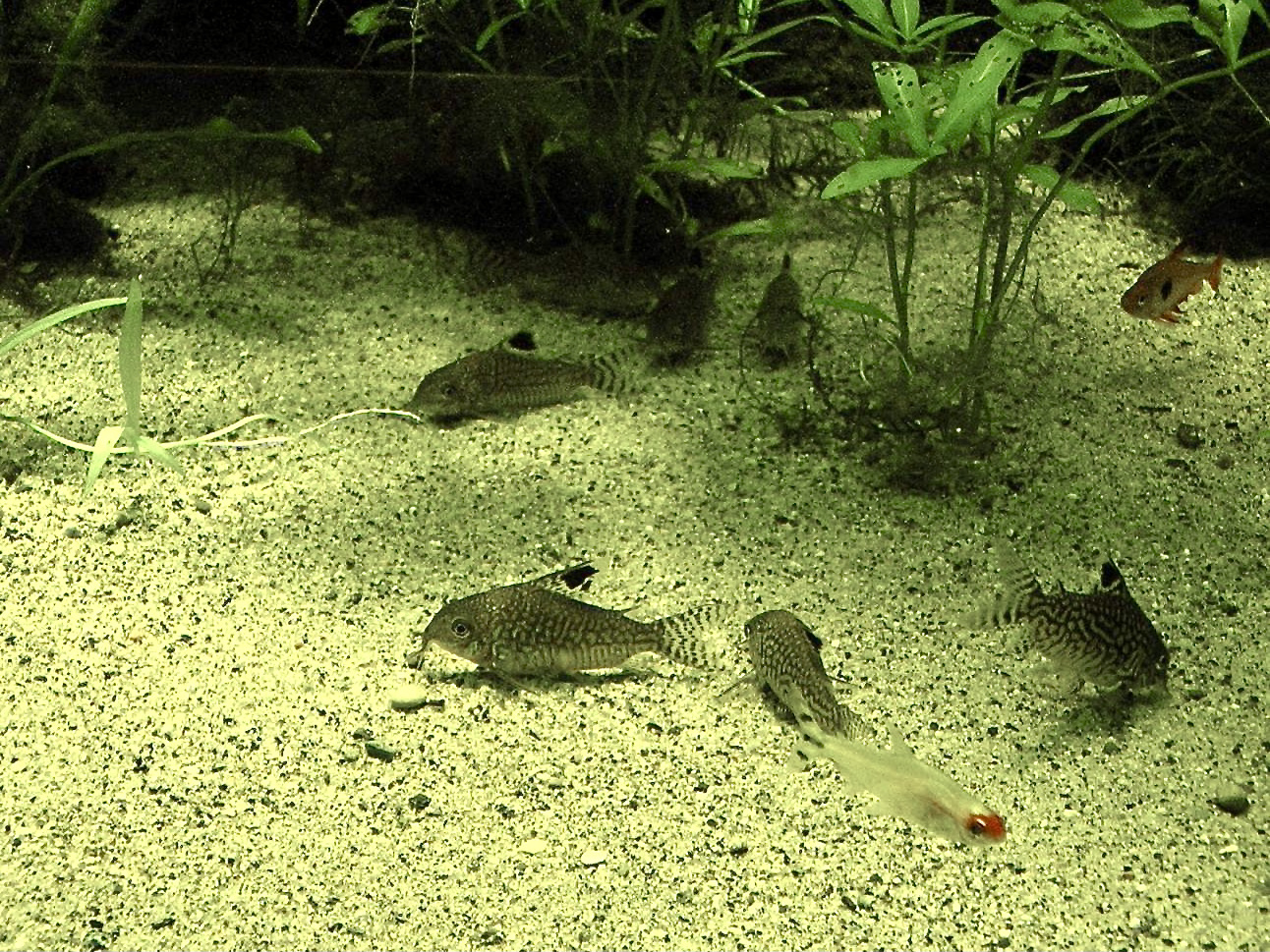
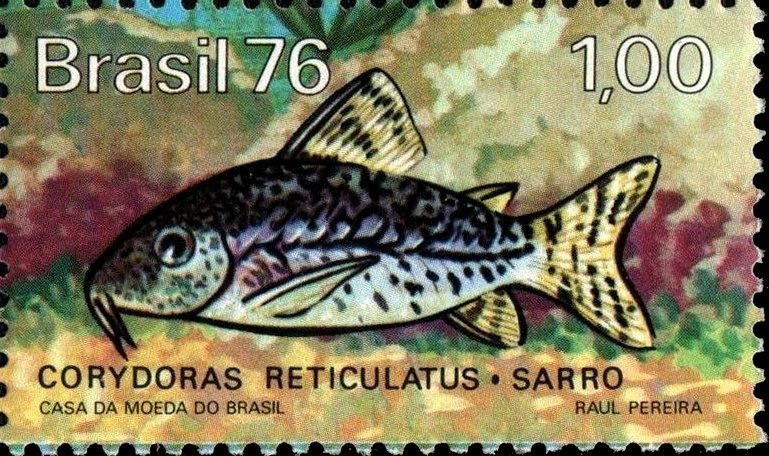
Network, mesh, lace — photographers reach for the same words when they see Reticulated Corydoras (Corydoras reticulatus). The fish is a Peruvian Amazon cory whose dark pigment forms a net over a pale body, with a blotch at the dorsal fin that stops it from being “just a spotted cory.” It is not leopardus, not schwartzi, and not a stamp-catalogue abstraction. (Brazil did put it on a stamp; that does not make it Brazilian in range.)
A net, a dorsal inkblot, a Peruvian passport
C. reticulatus is associated with the Río Ucayali system in Peru. Adults are about 5–6 cm. The pattern is reticulation: dark lines enclosing paler cells, more mesh than leopard blotch, more connected than schwartzi’s rows of spots. A distinct dark mark sits at the base of the dorsal fin. The snout is moderately short. Females fill out; males stay slimmer and sometimes look more sharply inked.
The classic confusion is Corydoras sodalis and various “network cory” trade names. Sodalis typically lacks the same dorsal-blotch emphasis and differs in mesh geometry. If a seller says “reticulatus or sodalis, same thing,” they are selling a pattern, not a species. Do not breed mystery mesh fish and label them reticulatus for the next importer.
Ucayali sand, not a stamp album
In Peru this fish works sandy forest streams and river margins with wood, leaves, and warm, typically soft water. It is a sifting callichthyid, not a loricariid twig. Blackwater influence varies by tributary; you do not need to recreate a Negro pH contest, but you should not swing to alkaline tap and hope the net stays crisp. Dirty water fogs the mesh first — the pattern is a health meter as well as an ID.
Showing the lace
Fine sand, darker wood, and lighting that does not bleach the fish from above. A long 80–100 cm tank for six to ten animals. Open floor so the net is visible from the front glass. Plants are fine if they leave foraging room. Covered intakes, lid, gentle flow. White gravel is a crime against reticulation; you will photograph a ghost.
Water for a mesh-backed catfish
Temperature 22–26°C. pH 6.0–7.4. Soft to moderate hardness. Zero ammonia. Regular small water changes beat heroic monthly dumps. If you use tannins, you will stain the water and slightly mute the contrast; that is a biotope choice, not a requirement. The mesh still needs clean gills underneath the aesthetics.
A school of nets
One reticulatus is a curiosity. Six is a moving textile. They forage together, rest together, and only then does the pattern make sense as camouflage on dappled sand. Mixing one reticulatus with one leopardus with one julii-type gives you “assorted spotted corys,” which is how the names rot. Other corys may share a large tank if each species still has a group.
Feeding so the ink stays wet
Sinking cory foods, frozen bloodworm, daphnia, brine shrimp, crushed flake. Colour and contrast fade on a flake-only diet more obviously than on a bronze cory, because you are staring at a drawing. Split the feed so tetras do not steal it. Omnivore, not algae-only, not a vacuum.
Community

Peruvian tetras, small pencilfish, rams, Apistogramma. No large predators. No gravel. No “one catfish.” Reticulatus is peaceful and will lose contests. If you keep it with sodalis, be honest on the labels.
Spawning a network
Standard T-position, eggs on glass, rain-style trigger. Adults eat eggs. Fry inherit a mesh that develops as they grow; baby reticulatus are not miniature stamps. Soft clean water. Do not cross with sodalis to “improve the net.”
When the network breaks
Breaks in the pattern can be injury, infection, or just a wet fish at a bad angle. Learn the healthy mesh on your group. Barbel loss is still substrate. Ich dots sit on top of the net and look like the pattern went pointillist overnight — that is not a new morph. Quarantine new mesh corys; wild Ucayali fish are not farm bronzes.
Lighting, cameras, and the lie of the stamp
The Brazilian stamp is a flat drawing. Live reticulatus is a three-dimensional net that changes with angle. Side lighting shows the mesh; overhead lighting washes it to grey. If you keep them to look at, give a viewing strip of open sand and a wood backscene, then light from the front-top rather than from a blasting LED bar that turns every cory into a silhouette. The dorsal blotch is your checkpoint: if you cannot see it, the fish is either the wrong species or the wrong lighting.
Do not chase “high contrast” with extreme blackwater until the fish is only a rumour in tea. A little stain is fine. A tank you cannot see into is how you miss ich sitting on the net. The pattern is useful because it is busy; use that. Daily looking is part of keeping a mesh cory, not a luxury.
Settling a Ucayali import
Wild reticulatus often arrive thin and pale. The mesh is there but faint, like a pencil sketch. Feed sinking foods twice a day in a quiet tank with sand. Do not add them to a discus circus on night one. After a fortnight, the drawing should ink in. If it does not, test water, watch feeding, and look at barbels. A mesh that never darkens is usually hunger or hardness shock, not a “silver form.”
Captive-bred fish settle faster and may show a slightly softer pattern. That is still reticulatus if the dorsal blotch and net geometry hold. What is not reticulatus is a leopard-blotch fish with a long snout (leopardus) or a lined-spot Purus fish (schwartzi). Those articles exist. This one is the net.
A working week with the lace
On a normal day the group should be on the sand for hours, not only at dusk. They will investigate new wood, then ignore it. They will dash as a unit if you loom. They will take air at the surface and drop back before you finish saying the name. If nitrate creeps, the first thing you lose is the crispness of the cells in the net. That is your cue for a water change, not for a colour food that promises miracles.
When you vacuum, move slowly. A startled lace cory can wedge under a heater. When you add new tank mates, watch the floor at feeding time for a week. Reticulatus loses quietly. By the time the mesh looks “a bit off,” the tetras have been stealing dinner for ten days.
Keep the name for the net
Corydoras reticulatus is the Ucayali network cory with a dorsal blotch. Keep it for that geometry, on sand, in a group, with food that reaches the floor. It is not schwartzi’s rows, not leopardus’s coarse print, and not a Brazil-only species because a postal service liked the drawing. The mesh is the species. Treat it that way.
Explore other topics
Dive into more aquarium guides across the site.