

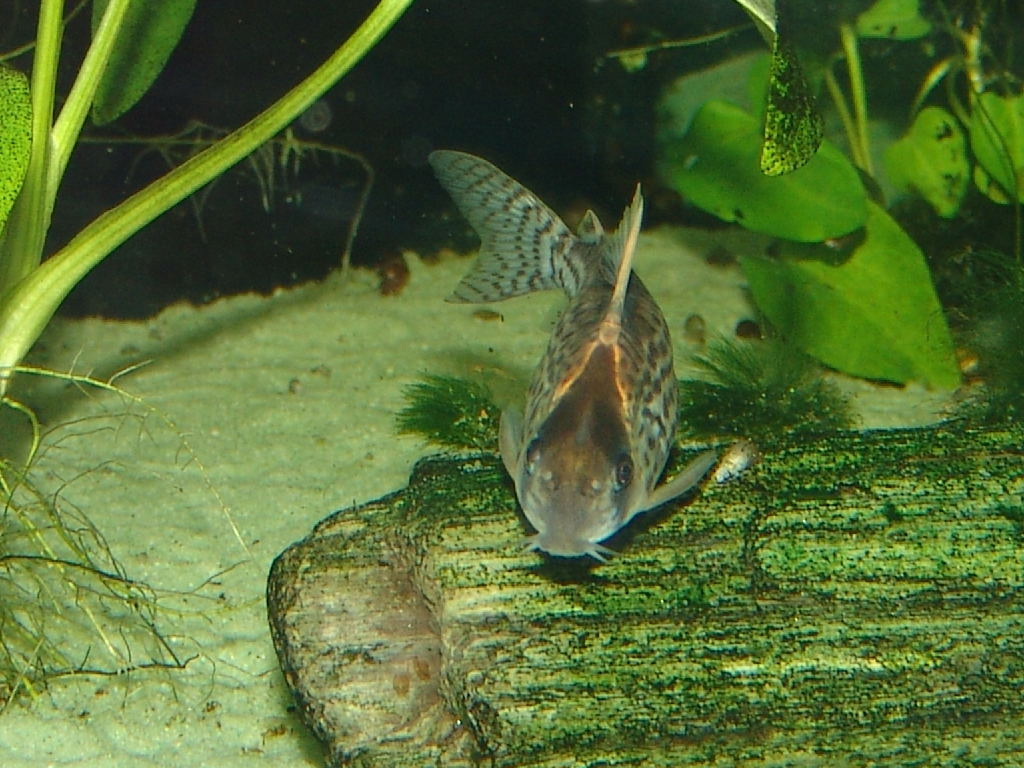
Harald Schwartz’s name sits on a lot of fish, but Schwartzi Corydoras (Corydoras schwartzi) is the Purus-basin cory with the spotted, almost lined flanks that shops actually have in quantity. It is not a Negro blaze fish, not a pygmy midwater cat, and not a “beginner cory” in the sense of a bronze that shrugs at gravel. It is a patterned South American sand-sifter that became common because it ships well and looks busy on camera.
Spots that want to be stripes
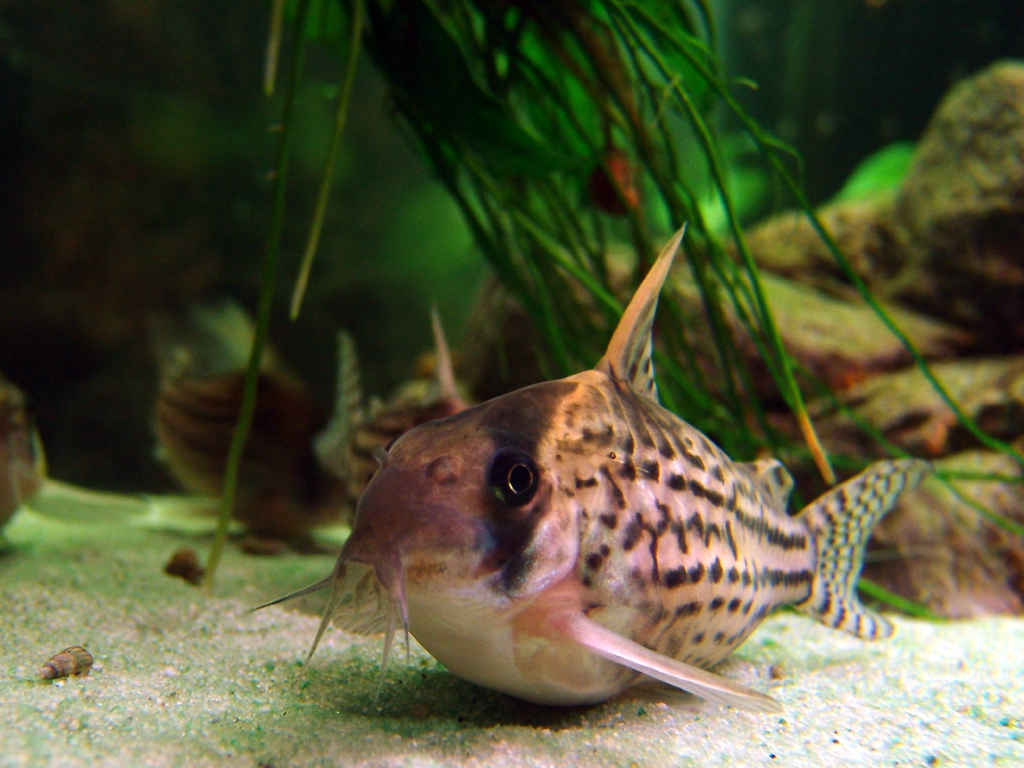
C. schwartzi wears a pale ground colour overlaid with dark spots that often align into longitudinal rows, plus a darker band that can run along the side. The dorsal fin is typically marked rather than plain. The overall effect is busier than similis and less net-like than true reticulatus. Adults are about 5–6 cm. The snout is the short cory type, built for shovelling sand, not for the long conical probe of C. aurofrenatus.
From above, a healthy group looks like moving gravel that happens to have eyes. From the side, you should see full barbels and a rounded ventral profile after a meal. Males stay slimmer. Females thicken when ripe. There is no beard of odontodes like a male Scleromystax barbatus. If someone sold you “schwartzi” that is uniformly rust-coloured, you have the wrong genus of problem: you probably have rabauti or zygatus.
Rio Purus country
The natural range is the Rio Purus drainage in Brazil, a major southern tributary of the Amazon with a mix of forest streams, sand, and seasonal water. It is tropical. It is not the Pantanal’s clear vegetated marsh, and it is not Santa Catarina cool water. In the wild, schwartzi forages in groups over soft substrate. Dissolved mineral content is typically low to moderate. pH sits on the acidic-to-neutral side depending on the tributary and the season.
That geography explains why schwartzi is more forgiving in mixed community tanks than Adolfoi, and why it still fails in tanks with sharp gravel and leftover flake. Forgiveness is not immunity.
Layout for a busy patterned bottom
Schwartzi looks like it is doing something even when it is only sifting. Give it a stage: a long tank, fine sand, wood for waypoints, and plants that do not carpet every square centimetre of the floor. A 80 litre-class aquarium is a floor, not a palace; six fish will live there if you are disciplined about stocking above them. Larger is easier. Flow should be enough to keep water moving, not a river that pins them to the glass.
They appreciate dimmer zones. They do not require a leaf-litter biotope, but a few botanicals will not hurt if you siphon the debris. Skip crushed quartz. Skip “substrate for plants” that is jagged. Root tabs under sand are fine; gravel vacuums that blast the bed into a dust storm every week are not.
Water numbers that match a Purus import
Temperature 22–27°C, with many groups happiest near 24–25°C. pH 6.0–7.5. Soft to moderately hard water. They are not discus-level blackwater prisoners, and they are not Malawi fish. Keep nitrogenous waste at zero. Because schwartzi is often added to “starter communities,” it dies in uncycled tanks more often than rare corys do — not because it is weaker, but because it is the catfish people buy on day one.

A group that looks like a pattern, not a lonely spot
Six is the minimum that makes the spotted flanks read as a school. Ten in a 120 cm tank is the picture you see in good photos. They interact constantly, pausing in contact, then moving on. Single schwartzi become furniture. Two schwartzi still wait for a third. This is not poetry; it is how you get them out in the open instead of under a piece of bogwood.
Diet of a Purus scavenger that is not a vacuum
Sinking pellets, frozen bloodworm, brine shrimp, and quality flake that actually lands. Feed daily, small amounts, more than one dump site. Schwartzi will investigate plant matter but will not replace a pleco or an otocinclus. If you only drop a wafer at the weekend, you have a hungry spotted catfish and a nitrate factory. Watch one feeding: if the tetras win, change the method, not the species.
Community use — where schwartzi earns its popularity
This is the cory people put under tetras, rasboras, gouramis, and ram cichlids. That works when the water is clean and the sand is kind. It fails with tiger barbs that nip, with large cichlids, and with goldfish. Other Corydoras can share a large floor; keep each kind in a meaningful number if you care about seeing schwartzi-typical grouping. Do not use schwartzi as the “one catfish” in a Malawi tank. The pattern will not save it.
Spawning the spotted Purus fish
Standard cory spawn: condition, cooler water change, T-position, eggs on glass. Schwartzi is bred more often than duplicareus, which means fry advice actually exists from hobbyists. Eggs hatch in a few days. Fry need fine foods and clean water. Females are obvious when full. You do not need a species-only tank to get eggs; you need to want the eggs more than the adults do, because the adults will eat them.
When the spots look wrong
Faded pattern is usually poor diet, poor water, or stress, not a new morph. Torn fins are tank-mate or décor problems. Barbel stubs are sand and mulm. Ich is white dots that are not part of the normal spotting — learn the difference on this species, because schwartzi already wears spots. A fish that gasps at the outlet is telling you about oxygen or gill insult, not asking for more decorations.
Why keep schwartzi instead of “any cory”
Keep Corydoras schwartzi because you like the Purus spotted look, because the fish is available as a real group, and because you will give it sand. It is a better first patterned cory than a wild Negro specialist, and a worse first fish than a statement about cycling. The stripes-and-dots flank is the ID. The busy troop on sand is the behaviour. If you wanted a blaze, a leopard, or a stick catfish, you are in the wrong article.
Explore other topics
Dive into more aquarium guides across the site.