

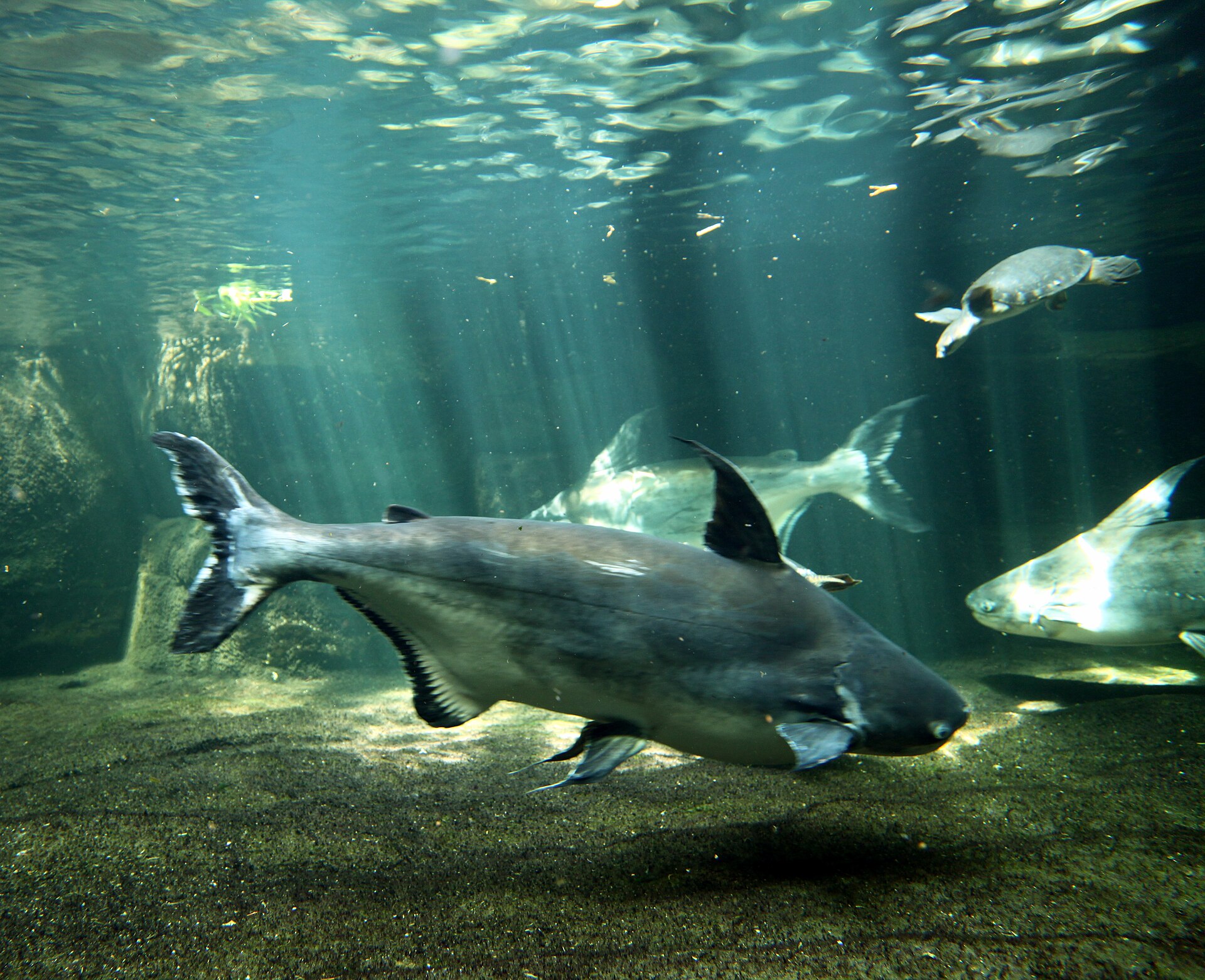
If a shop sells a sleek, grey, shark-shaped catfish under the name shark catfish or “giant pangasius,” look at the Latin. Pangasius sanitwongsei is not the smaller iridescent shark (Pangasianodon hypophthalmus) that already outgrows most tanks. It is a huge predatory pangasiid of the Chao Phraya and Mekong systems, a fish that can pass two to three metres and well over 100 kg in the river. It is critically endangered in the wild. It is not a community catfish. It is not a cleaner. It is not a “shark” in the cartilaginous sense. It is a giant river predator that should not be in a living-room aquarium at all.
A Southeast Asian giant with a collapsing river
The Chao Phraya of Thailand and the Mekong of mainland Southeast Asia are the home waters. These are monsoon rivers with depth, current, and migratory corridors. P. sanitwongsei uses the main channels as a large-bodied hunter. Dams, overfishing, and habitat loss have crushed the wild stock. IUCN lists the species in deep trouble. Every juvenile in the ornamental trade is a fish that either came from dwindling wild reproduction or from a culture system that still does not make the adult a pet.
This is not a flooded-forest dwarf. It is not a hillstream pleco. It is a pelagic-to-benthic giant that patrols open river. The honest modern home for an adult is a public aquarium the size of a hall, or the river itself. There is no third option that is kind.
Monsoon pulses, turbidity, and kilometres of swimming are not things you recreate with a powerhead in a 500 litre tank. People who have kept juveniles describe a fast, nervous, shark-like swimmer that then becomes an impossible problem.
The body that fools people at ten centimetres
Juveniles are fusiform, silver-grey, with a forked tail and a dorsal fin that reads as “shark” to a shopper. The mouth is wide and terminal, built to take fish, not to rasp wood. As the animal grows, the head broadens, the appetite becomes piscivorous on a serious scale, and the swimming needs become those of a tuna-shaped catfish in a river, not a corner-dwelling pleco.
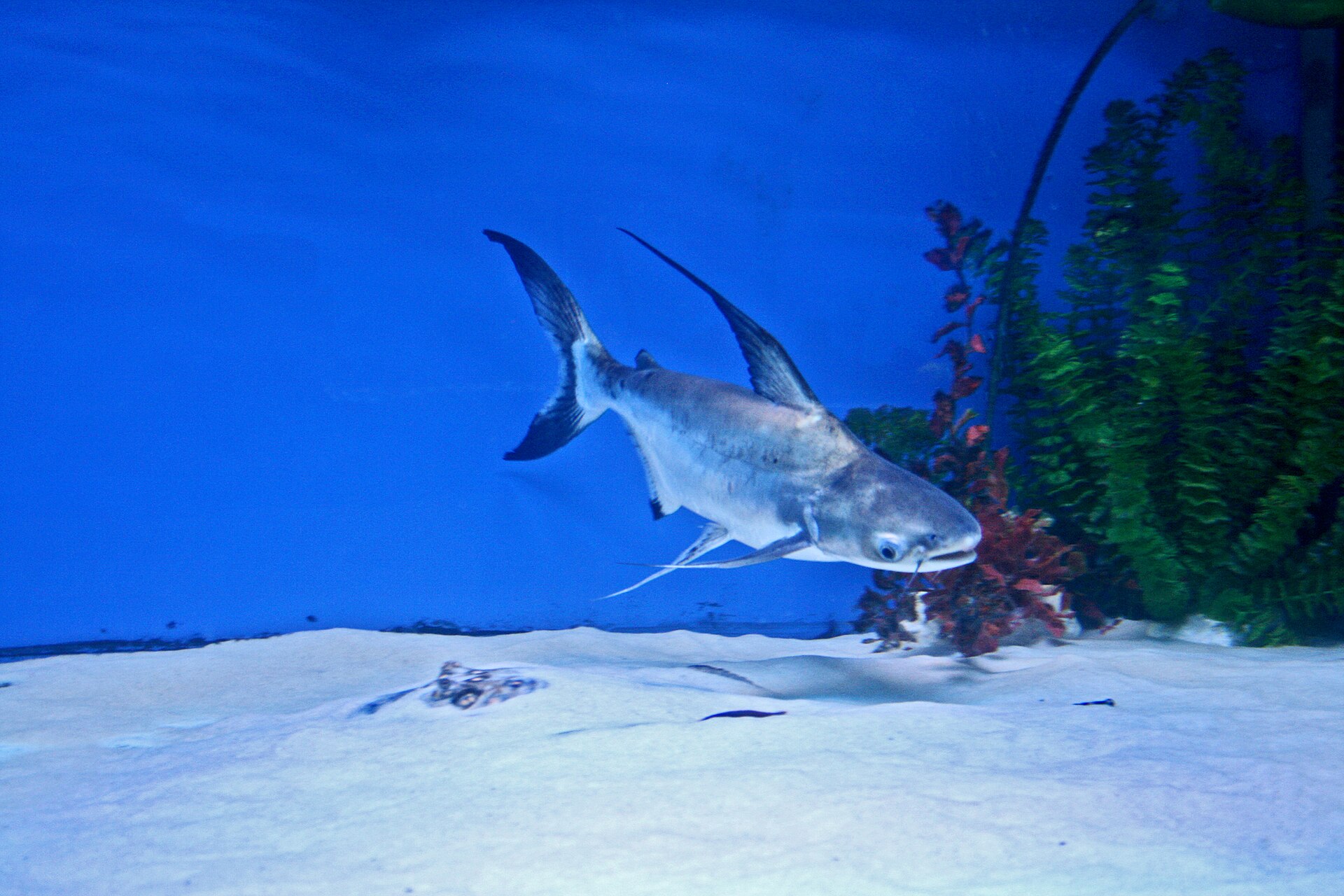
Do not confuse this species with Pangasianodon hypophthalmus, the farmed basa / iridescent shark, which is already too large for home tanks and is a different fish. Do not confuse it with Myxocyprinus, the Chinese high-fin, which is a cool-water sucker. Three different “sharks,” three different disasters if you buy the cute one.
Healthy river giants in public tanks show intact fins, no packed-in tail rot from panic swimming, and room to turn. A juvenile with shredded tail from glass crashing is telling you the enclosure is already wrong.
There is no honest home footprint
Skip the litre recommendations that pretend a 1.5 metre predator lives in “a large aquarium.” Adults need swimming volume measured in tens of thousands of litres, with length, depth, and filtration for a piscivore. Public aquaria sometimes succeed. Private living rooms do not. If you are reading this to plan a purchase for a house, the plan should be: do not purchase.
A tight lid matters for jumpers. Rounded décor that cannot be smashed matters. None of that makes a spare bedroom tank adequate. This is a huge predator of big rivers, not a community catfish you can “rehome later.” Later is always too late, and the fish is always bigger.
Warm, flowing, oceanic amounts of water

Temperature in the mid-20s °C matches tropical rivers. pH near neutral, typical river hardness, crushing amounts of oxygen and turnover. Ammonia from a fish this size is a public-aquarium engineering problem. Home filters are not that engineering. Water changes that would reset a community tank are a drop in a bucket for a growing pangasiid.
Do not keep this fish in cool goldfish water. Do not keep it in brackish mangrove water. It is a freshwater giant of mainland Southeast Asian rivers.
A piscivore, not a wafer customer
Diet in the wild is fish and other animal prey. In the few institutions that house them, diets are formulated large-predator feeds, fish flesh, and similar high-protein items, with waste management to match. Feeding live feeder fish as a hobbyist “solution” is ugly and does not shrink the adult. Algae wafers are irrelevant. This species will not graze your glass and save you from water changes.
A growing juvenile in a small tank will eat every companion and then sit in its own waste. That is the entire stocking story.
No tank mates except other impossibilities
Anything that fits in the mouth is food. Anything that does not still has to share a volume that private keepers do not have. Other giant river fishes in a public exhibit are a curator’s decision. A mixed tropical community is a buffet. There is no peaceful school of shark catfish for your 300 litre display.
Breeding is a river and hatchery story
Induced spawning and river migrations are how pangasiids reproduce at scale. You will not breed P. sanitwongsei in a garage. You should not try. Conservation belongs to range states, fisheries scientists, and accredited institutions, not to impulse buyers.
How the iridescent shark confusion makes this worse
Shops already sell Pangasianodon hypophthalmus as a “shark” that outgrows a house. Adding P. sanitwongsei to that shelf is a second, rarer disaster. The giant pangasius is more predatory, more endangered, and much larger. If a dealer cannot tell them apart, you are not in a safe transaction. Ask for the Latin name printed on a bag, then search the adult length before money changes hands. A sleek 12 cm fish with a forked tail is not a personality type. It is a larval river monster.
Thai and Mekong fisheries scientists have spent years documenting the collapse of large migratory catfishes. Your living room is not a conservation hatchery. It is a dead end with glass walls. If you care about the species, support river protection and accredited public aquaria that already hold adults. Do not create demand for more juveniles.
The only responsible sentence
Pangasius sanitwongsei is a huge river predator and a species in conservation trouble. The ornamental juvenile is a trap. If you want a shark-shaped fish for a home, you still do not want this one — and you probably do not want the iridescent shark either. Leave giant pangasiids in rivers and in public halls. For water quality literacy that still will not make this fish keepable at home: chemistry, cycling.
Explore other topics
Dive into more aquarium guides across the site.