

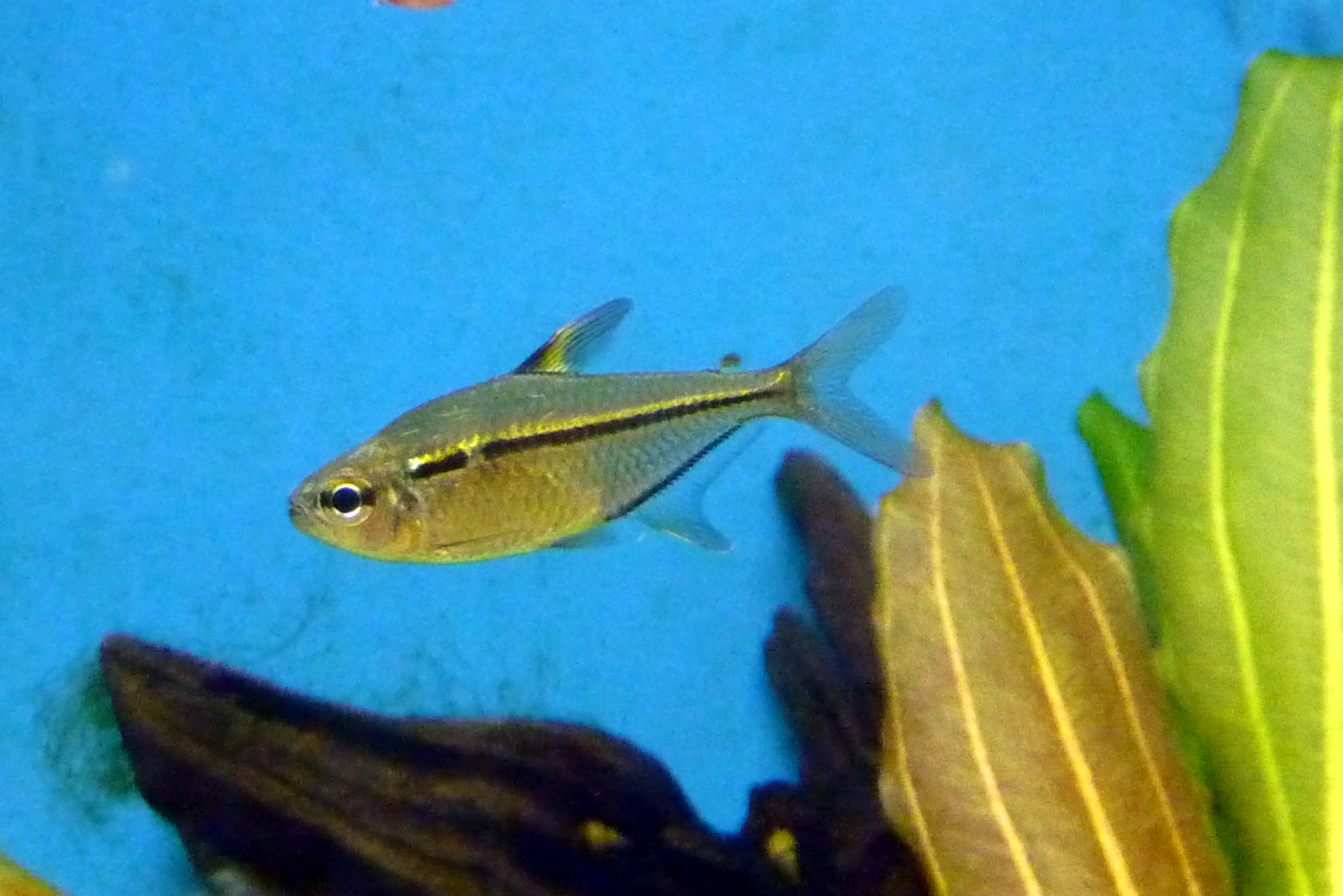
Hemigrammus ulreyi is the tetra that gets misidentified as a pencilfish, a penguin tetra, or “some kind of three-stripe characin.” Ulrey’s tetra is a Paraguay basin fish with three dark longitudinal bands on a gold-olive body. It is uncommon enough in shops that keepers often buy it on a guess and then copy care from a rummynose sheet. The guess is usually wrong on flow, temperature, and tankmates.
Stripes that belong to the Paraguay, not the Amazon postcard
The species lives in the Paraguay River system of Paraguay and Brazil — slower, seasonal, and farther south than Manaus. Water can be clear or lightly stained. Temperature in the wild includes cooler spells than a cardinal tetra ever sees. In the aquarium, 22–26°C is a working range; constant 28°C is unnecessary. pH around 6.0–7.5 and moderate hardness are acceptable. This is closer to a southern characin climate than to peat-swamp Boraras water, and it is not Mexican spring water either.
Structure in the wild is plants, roots, and open lanes. Ulrey’s tetras school in midwater and use stems as a hedge. They are not cave fish and not surface specialists.
Three lines, and why shops get them wrong
Adults reach about 5 cm. Two dark stripes run along the body with a third, often less complete, nearby; the overall effect is a lined gold fish, not a neon. The caudal fin may show red. They lack the penguin tetra’s strong oblique black band into the lower tail (Thayeria boehlkei). They lack the pencilfish’s needle profile and upturned mouth. If the fish in the bag is skinny, horizontal, and has a tiny terminal mouth, you may have a Nannostomus, not H. ulreyi.
Males are slimmer and often more intensely lined. Females are fuller. In a small group the stripes look messy because the fish do not lock into a school. In a group of eight to twelve the lines read as a single moving pattern.
A quieter Hemigrammus in a long box
They are more retiring than Buenos Aires tetras and less glittery than Costello tetras. A 80 litre tank with length, plants along the back, and a dimmer midground suits them. Gentle flow is enough. Strong current from a river-danio setup will pin them to the glass. A lid prevents panic jumps. They do not need the aerial spawning architecture of a splash tetra and they do not need a sealed lid for hatchet-level jumping, but gaps at the rim still lose fish.
Because they are uncommon, they often arrive as a handful. If you can only get five, keep them as a species-only group until you can add more of the same, rather than padding the tank with neon tetras that want warmer, softer water and will outcompete them at feeding time.
Food for a lined school, not a pencilfish
Ulrey’s tetras have a normal characin mouth, not the tiny pencilfish gape. They take flakes, micro pellets, frozen daphnia, and brine shrimp. They will not thrive on infusoria-only feeding meant for Boraras. They also will not graze plants to destruction the way Buenos Aires tetras do. Feed in midwater. Watch the school come forward. If they hang back while danios empty the surface, you have the wrong roommates.
Colour in the stripes depends on diet and background. A dark substrate and mixed frozen foods beat a white sterile tank with flake only.

Compatibility without the penguin mix-up
Peaceful tetras of similar size, Corydoras, and small rasboras can work if temperature overlaps. Penguin tetras can share a large tank, but then you have two striped silhouettes and identification gets worse, not better. Pencilfish are poorer companions than people expect: they lose food and they occupy a different mouth-size class. Large barbs and Congo tetras will bully Ulrey’s tetras off the feed.
Do not house them with Mexican tetras in a small tank. The Astyanax is simply bigger and hungrier. Do not house them with hatchets as a “tetra community” unless the tank has a true surface zone the hatchets own and a midwater zone the Ulrey’s own, with food delivered to both.
Spawning a scarce fish
They scatter eggs among fine plants. Soft, slightly acidic water in a dedicated tank improves odds. Adults eat eggs. Because wild collection is not the flood of neon-tetra aquaculture, every spawn is worth protecting if you care about the species remaining in the hobby. Condition with live foods. Remove parents. Raise fry on infusoria then baby brine shrimp.
Do not assume breeding notes for H. pulcher or H. hyanuary copy over in every detail. Those are warmer Amazon fish. Ulrey’s tetra will often spawn more readily with a modest temperature drop and rise that mimics a southern season than with a constant 27°C.
Why you should not copy a “standard tetra” quarantine essay
They still need isolation after purchase. They still get ich. What they do not need is a hospital tank decorated like a cave or a surface-only feeding regime. Watch the lines: when a fish is ill the stripes fade and the fish peels from the school. That is your cue, not a generic list about sand-sifters and nocturnal catfish.
If you wanted a pencilfish, buy a pencilfish and feed it like one. If you wanted three black bars on a gold tetra from the Paraguay system, keep Hemigrammus ulreyi cool enough, calm enough, and numerous enough that the stripes can do their job.
Further reading: glowlight tetra for a more common Hemigrammus, and three-lined pencilfish if the bag you almost bought was the wrong family entirely.
Buying a handful without inventing a community
Because Ulrey’s tetras trickle into shops, the temptation is to house five of them with whatever else is already swimming. Resist padding the school with glowlights unless the water already suits both. Resist padding with penguin tetras unless you enjoy two striped silhouettes and endless identification arguments. A short, dedicated tank with a plan to add more H. ulreyi beats a pretty mixed box that leaves them last at every feeding.
When you do find more stock, match size and acclimate slowly. Mixing a new trio into an established five can trigger a week of chasing. Rearrange a plant or two so territories reset, and feed well in midwater so the newcomers actually eat. That is specific to a scarce, lined Paraguay tetra, not a ritual copied from cave-fish or hatchet care.
Explore other topics
Dive into more aquarium guides across the site.