

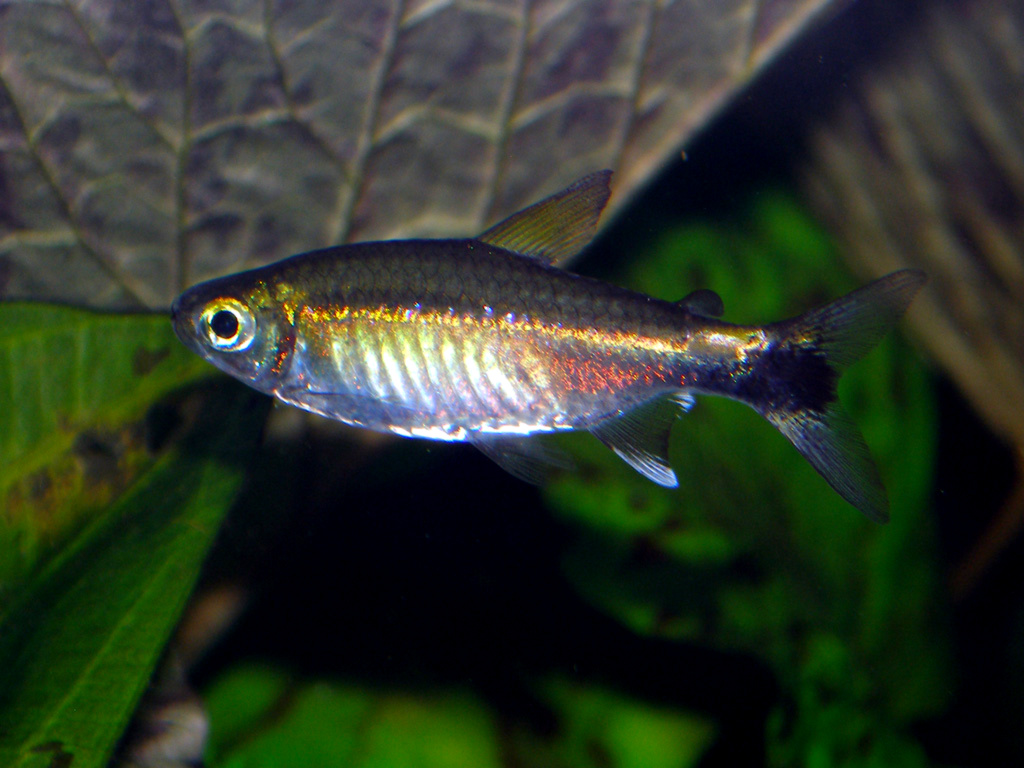
The Costello tetra is named for Lago Hyanuary, a lake near Manaus, not for a person named Costello. Hemigrammus hyanuary also travels as the January tetra or green neon tetra — the last name is a marketing problem, because it is not a Paracheirodon. The green you see is iridescence on a small Amazon characin with a dark mark on the tail base, not a neon stripe painted by evolution for a blackwater postcard.
A lake name and a river system
The type locality sits in the central Amazon. Wild fish use lakes, slow tributaries, and flooded forest edges: warm, often stained, and structurally busy. In captivity they want that mood more than they want a number copied from a Mexican tetra article. Aim for 23–27°C, pH around 5.5–7.0, and softness if you can provide it. They will persist in harder water; they will not look like the photos.
This is not a cool-water species. It is not a cave fish. It is a small, glittering schooler from the same general region as many classic tetras, with its own markings and a reputation for being a little more retiring than a neon crowd.
Green that is really a trick of light
Adults reach about 4 cm. The body is translucent olive to silver. In side lighting a green-gold sheen runs along the flank, and a dark comma or blotch sits on the caudal peduncle. Fins are mostly clear with hints of warmth. When the fish is stressed the sheen dies and you are left with a grey splinter. That is why dealers photograph them over dark substrates in tannin water.
Males are slimmer; females carry more belly. The difference is modest. Buy a school and let it sort. Do not buy two because they “look green in the shop LED.”
Why they vanish in a busy community
Costello tetras sit in midwater and use plant thickets. They lose feeding contests to danios, large tetras, and anything that hits the surface like a hatchet. A dedicated 54–80 litre tank with a school of ten, floating plants, and a darkish backdrop shows the iridescence. A 200 litre community with Congo tetras and Buenos Aires tetras will hide them in the corners until you forget they are there.
Wood, leaf litter, and a gentle sponge or spray-bar return fit the lake-edge idea. Strong current is wasted on them and burns energy they should spend schooling. A lid is still wise; Amazon tetras jump when nets come out.
Feeding a fish sold as a “green neon”
Mouths are small. Offer crushed flake, micro pellets, frozen cyclops, and baby brine shrimp. They will take good flakes if the pieces are small enough to finish before they hit the sand. They will not convert a jumbo pellet. Colour does not come from a “green tetra” dye product; it comes from condition, lighting, and background. Dyed fish sometimes appear in mixed bags. Avoid them. You want wild-type sheen, not pigment forced into the skin.
Feed twice a day in amounts the school clears. If Corydoras get fat and the hyanuary stay thin, you are feeding the bottom, not the midwater.

Tankmates that keep the sheen visible
Other small, calm Amazon tetras, small pencilfish, Corydoras, and shrimp-friendly setups work. Avoid large alestids, aggressive barbs, and surface flocks of hatchets unless the tank is large enough to separate feeding zones and the hatchets are not so numerous they monopolise the top. Green neon tetras (Paracheirodon simulans) share a colour nickname and a preference for warm, soft, stained water; they can cohabit in a well-planted tank, but they are a different fish with a true neon-style stripe. Do not assume the Costello will “fill in” if the simulans school is already huge.
Scatter spawning in warm, soft water
They are egg scatterers. A dim tank, fine-leaved plants or a mop, and a pair conditioned on live foods is the standard. Adults eat eggs. Fry are tiny even by tetra standards. Infusoria first. This is closer to a rummynose or small Hemigrammus spawn than to the aerial circus of a splash tetra.
Soft water helps egg viability. If your tap is liquid limestone, use RO mix for a breeding tank even if the display runs harder. The display can be a compromise; the spawn usually cannot.
Health after a long label chain
Because the trade name jumps between Costello, January, and green neon, fish get dumped into neon vats. Quarantine. Watch for wasting, ich, and columnaris after shipping. They are more delicate than Mexican tetras and less plant-hostile than Buenos Aires tetras. Temperature stability in the mid-twenties matters more than a wide “18–28°C” slogan copied from a different characin.
If you wanted an actual neon stripe, buy neon tetras or green neons. If you wanted this specific caudal mark and green-gold flash from Lago Hyanuary’s namesake, keep H. hyanuary as a school in stained, planted water and stop treating the word “tetra” as a single care sheet.
Iridescence versus dye and versus simulans
Three different “green” stories collide in shops. Paracheirodon simulans has a true green-shifted neon stripe and a tiny body. Dyed green tetras are usually something cheap with pigment forced into the skin; the colour patches off and the fish often dies. Hemigrammus hyanuary has neither a neon stripe nor a dye job. Its green is a structural sheen that comes and goes with angle, health, and background. If the fish looks painted, walk away. If it looks faintly olive until it turns, you may have the right animal.
Keep a dark backdrop and a viewing angle from the side, not from above. Costello tetras are not hatchets; they do not put on a show at the glass lid. They flash when the school wheels in midwater. That is the behaviour to design the tank around: a turning lane, not a surface circus and not a cave. Warmth, stain, and a crowd of their own species will do more than any bottle labelled “tetra colour.”
A note on names in older books: January tetra is the same fish. If a care sheet lists 18°C as a minimum because it copied a Mexican tetra table, ignore the minimum. Hyanuary is a central Amazon lake name. Treat the temperature like other small Amazon Hemigrammus, not like a subtropical Astyanax.
Explore other topics
Dive into more aquarium guides across the site.