

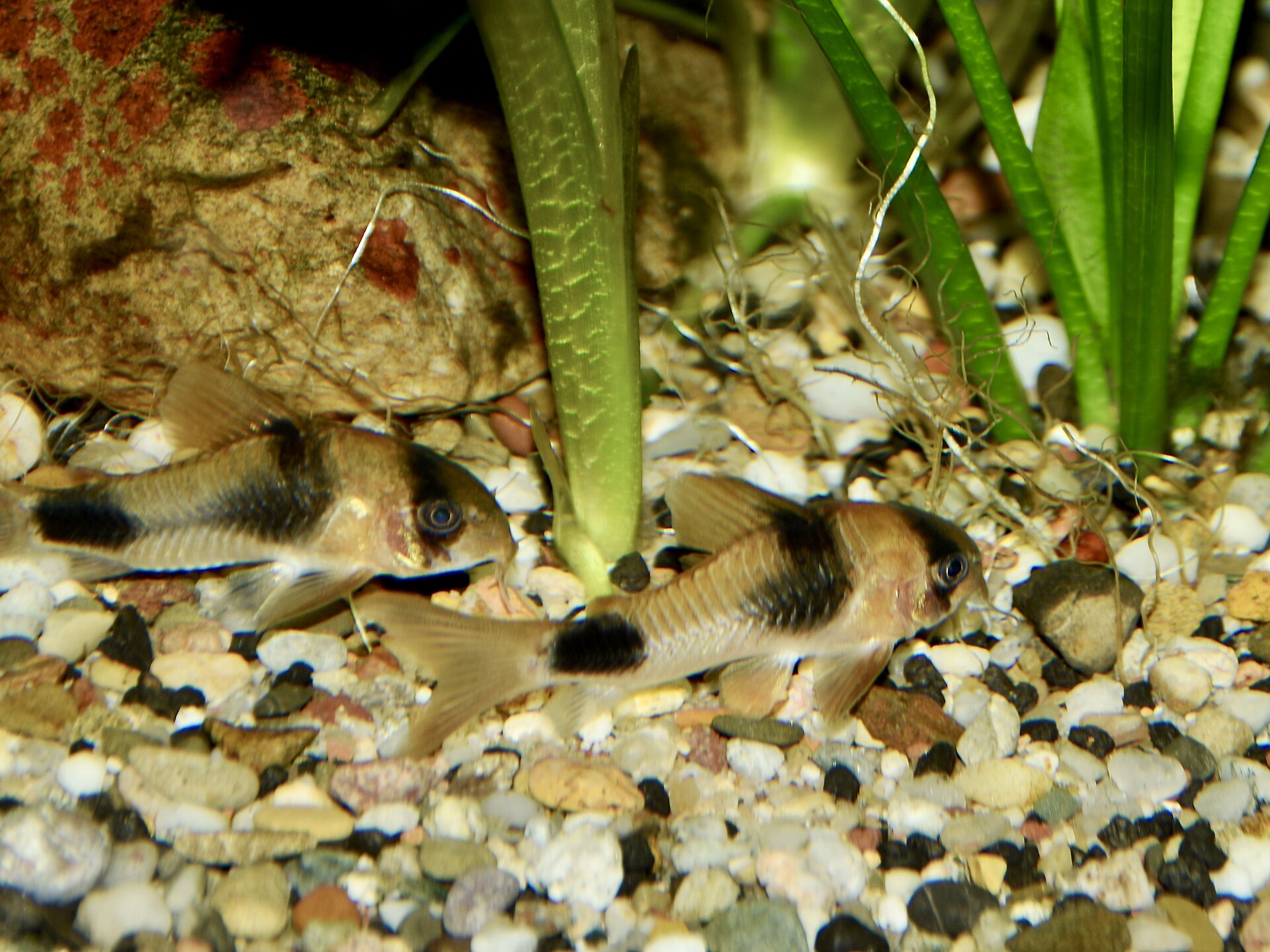
Weitzmani Corydoras (Corydoras weitzmani) is the Peruvian “fox” cory: a cream body, a dark mask, and warm orange-red in the fins that makes people reach for their wallets. It is named for Stanley Weitzman. It is not Adolfoi with extra lipstick, not a sterbai, and not a fish you should impulse-buy as a pair because the shop had two.
Fox face, not a blaze nape
Adults are modest, often 4–5.5 cm, a little more compact than leopardus. The ground colour is pale, almost ivory. A bold dark patch covers the eye region and can extend as a saddle or blotch that reads as a fox mask rather than Adolfoi’s orange crown. The pectorals and often the dorsal carry orange to brick-red pigment, especially on quality wild or well-kept fish. Spots may pepper the flanks, but the mask-and-orange combination is the ID. Under poor water the orange dies first and you are left with a beige cory and a story.
Shop mix-ups include anything pale with a dark eye band. Compare with adolfoi (orange nape, Negro, different saddle logic) and with various CW-number fox lookalikes. If the invoice says weitzmani and the fish has no orange in the fins after a month of good feeding, you may still have a washed-out weitzmani — or you may have the wrong pale cory.
Peruvian water, specialist price
The species is tied to Peruvian Amazon drainages (Ucayali / Madre de Dios region in hobby literature). That means tropical, typically soft, often slightly acidic water, sand, and forest streams — not SE Brazil cool, not Congo, not a Malawi mbuna tank. Wild fish have historically been sporadic and expensive. Captive-bred groups exist but are not in every chain store. Treat availability as a conservation and husbandry issue: do not buy two to “see if they make it.”
A tank worthy of the mask
Fine sand, shade, and a group. A 80 cm tank is a start for six; more length is kinder. Wood, a few leaves, and plants that like soft water. Gentle flow. Lid. Because weitzmani is often a high-value fish, people over-decorate with jagged rock “to make it special.” That is how you file the barbels off a fox. Keep the floor open and kind. Dim the lamps with floaters so the orange reads and the fish come out.
Chemistry: soft, clean, not theatrical
Temperature 22–26°C. pH 5.5–7.2. Low hardness. You do not need to hit pH 4 to prove a point. You do need zero ammonia and a sand bed that is not a mulm compost. RO plus remineraliser is reasonable if tap is hard. Sudden swings after a fancy blackwater mix are how expensive corys die on a Tuesday.
Groups of foxes
Six or more of C. weitzmani, not two “because they were pricey.” Cost is not a husbandry parameter. A pair will hide and lose the colour you paid for. They shoal and sift like other short-snouted corys. Mixed display with Adolfoi looks pretty in photos and complicates breeding. If you keep both, give each a real number in a large Negro/Peru-style tank, and do not sell the fry as weitzmani unless you are sure.
Feeding for orange

Colour is diet plus genes plus water. Sinking granules, frozen bloodworm, daphnia, brine shrimp, and occasional quality flake. Colour-enhancing foods help some fish and do nothing for others. Starvation never helps. Midwater thieves are the enemy of expensive bottom-dwellers: feed after the room lights drop and confirm the foxes ate. They are omnivores, not algae crews.
Neighbours that will not steal the show — or the food
Small, peaceful tetras and pencilfish that share soft water. Quiet dwarf cichlids if the tank is large. No large predators. No hyperactive barbs. Weitzmani is peaceful to a fault. It will lose. Build the community around the catfish if the catfish is the expensive part.
Breeding a fish people still photograph more than spawn
Standard cory spawn when the group is mature, well fed, and hit with a rain-style water change. Eggs on glass. Parents eat them. Fry are small. Soft, clean water. If you succeed, you are doing more for the hobby than another photo of a mask. Do not hybridise with random pale corys.
Losing the mask
Stress fades the dark pigment and the orange together. Barbel damage is substrate. White spots are ich, not extra fox markings. Quarantine is mandatory on wild imports; a $something fish still carries skin flukes. Watch for a fish that sits apart — in a small high-value group, one sick animal is a large percentage of your stock.
Is weitzmani for you?
Keep Corydoras weitzmani if you can buy a proper group, offer Peruvian-soft water, and care about a fox mask that is not Adolfoi’s blaze. Skip it if you wanted a cheap patterned cory (schwartzi) or a green tank-buster (Brochis splendens). Stanley Weitzman’s fish is a specific Peruvian catfish. The orange fins are the tell. The group on sand is the method. The rest is not a template from a Negro lookalike.
Orange fins as a husbandry meter
The fox mask sells the fish. The orange in the paired fins tells you whether the fish is actually thriving. After a month in good Peruvian-soft water with sinking meaty foods, the colour should be brick, not beige. If it is not, look at temperature swings, hardness, and whether the tetras ate every ration. Weitzmani is too expensive to keep as a pair of hide-and-seek pets. Six foxes on sand, dimmed light, and a settling period without an audience are how the mask stays dark and the fins stay warm.
Specialist breeders exist; prefer them to beaten wild bags when you can. If you only find two fish, wait until you find six. Price is not a reason to understock a shoaling catfish. It is a reason to wait. Stanley Weitzman’s name deserves a troop, not a lonely beige ghost under a piece of Malaysian driftwood. Feed the sand, not the rumour that a fox cory will live on leftover flake while you admire the mask from the sofa.
Explore other topics
Dive into more aquarium guides across the site.