

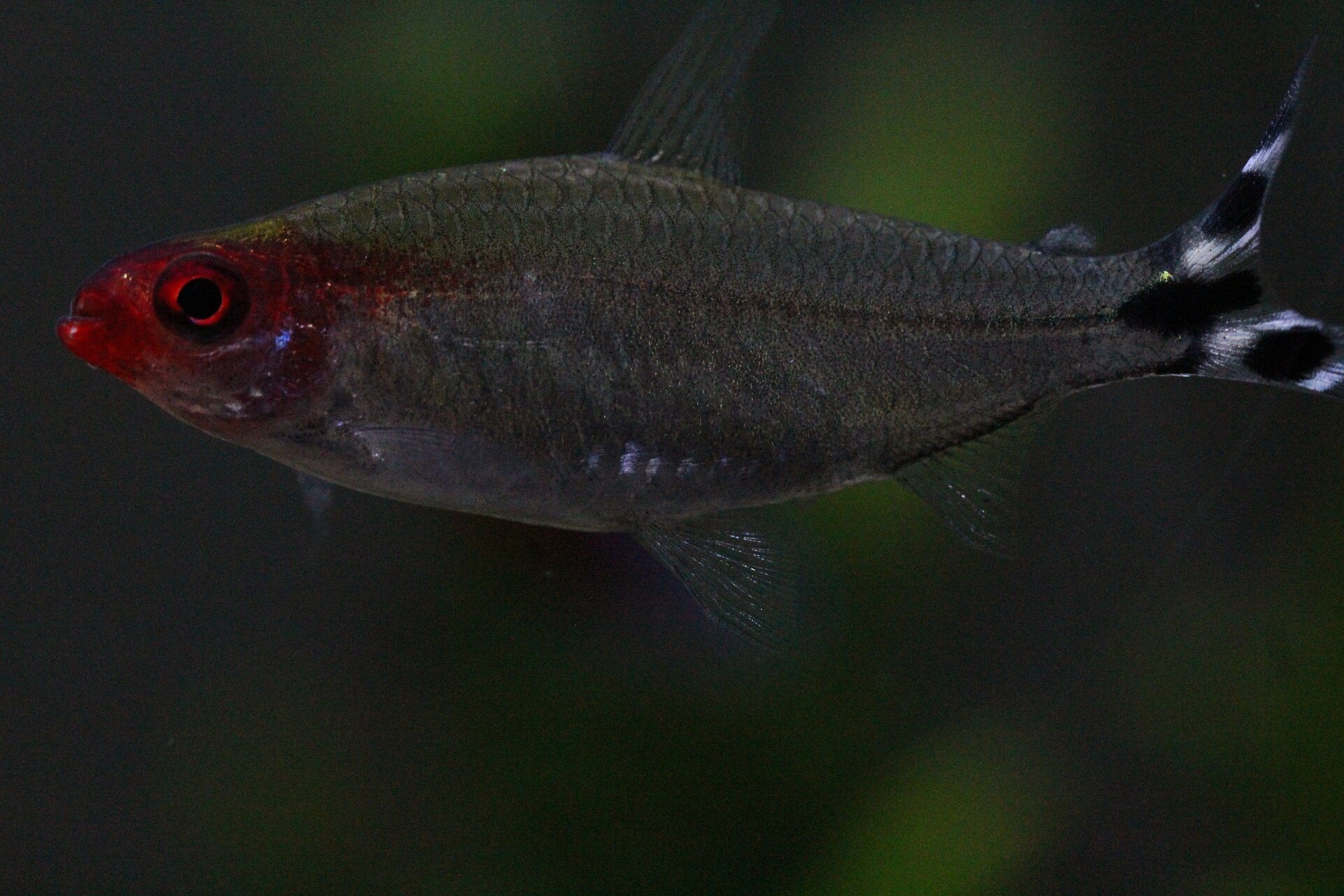
The red nose is a water-quality instrument whether you wanted one or not. Petitella bleheri, the true rummynose tetra, carries a crimson face that paled the last time your nitrate climbed or the pH swung after a clumsy water change. That is not folklore. Stressed rummynoses wash out; comfortable ones look dipped in paint. They are a Rio Negro and upper Amazon schooler, 4–5 cm, and they are not the same fish as Hemigrammus rhodostomus or Petitella georgiae — the “false” and other rummynoses in the trade. Bleher’s has a more extensive red on the head and a tail with a cleaner black-and-white pattern. Shops mix them. If you care, look at the snout and the caudal. If you do not care, the care is still this: soft, acidic, warm, a school of ten or more, and no hard-water roommates.
They are the tetra that makes a planted blackwater tank look finished. They are also the tetra that dies in a new, unstable aquarium while the shop is telling you they are hardy. They are hardy in the right water. They are honest about the wrong water. That honesty is the point of keeping them.
Negro water is the brief
Petitella bleheri is associated with the Rio Negro and nearby blackwaters: ion-poor, acidic, stained, warm, forested. The fish schools in midwater along margins, over leaf litter, among roots. Conductivity is low. pH can sit well below 6 in nature. You do not have to hit pH 4.5 in a Toronto apartment. You do have to get off alkaline tap and off the idea that a rummynose is a glowlight tetra that likes whatever comes out of the faucet.
Tannins, botanicals, RO water blended to a low GH, peat if you know how to use it — these are tools. The goal is soft, stable, and slightly stained, not a chemistry flex for social media.
Red to the eye, bars in the tail
True rummynose red typically extends further back on the head than in H. rhodostomus, and the caudal banding is often more defined — a black centre with white. Use a good photo key if the distinction matters to you. Adult size 4–5 cm. Sexing is subtle: males slimmer, females fuller, a slightly more pointed dorsal on some males. Buy a school, not a sexed pair. They do not pair. They school.
A pale nose on an otherwise swimming fish is your cue to test ammonia, nitrite, nitrate, temperature, and whether you just changed water with unmatched tap. A pale nose on a clamped, isolated fish is more urgent. The instrument is only useful if you read it.
A lane through the trees
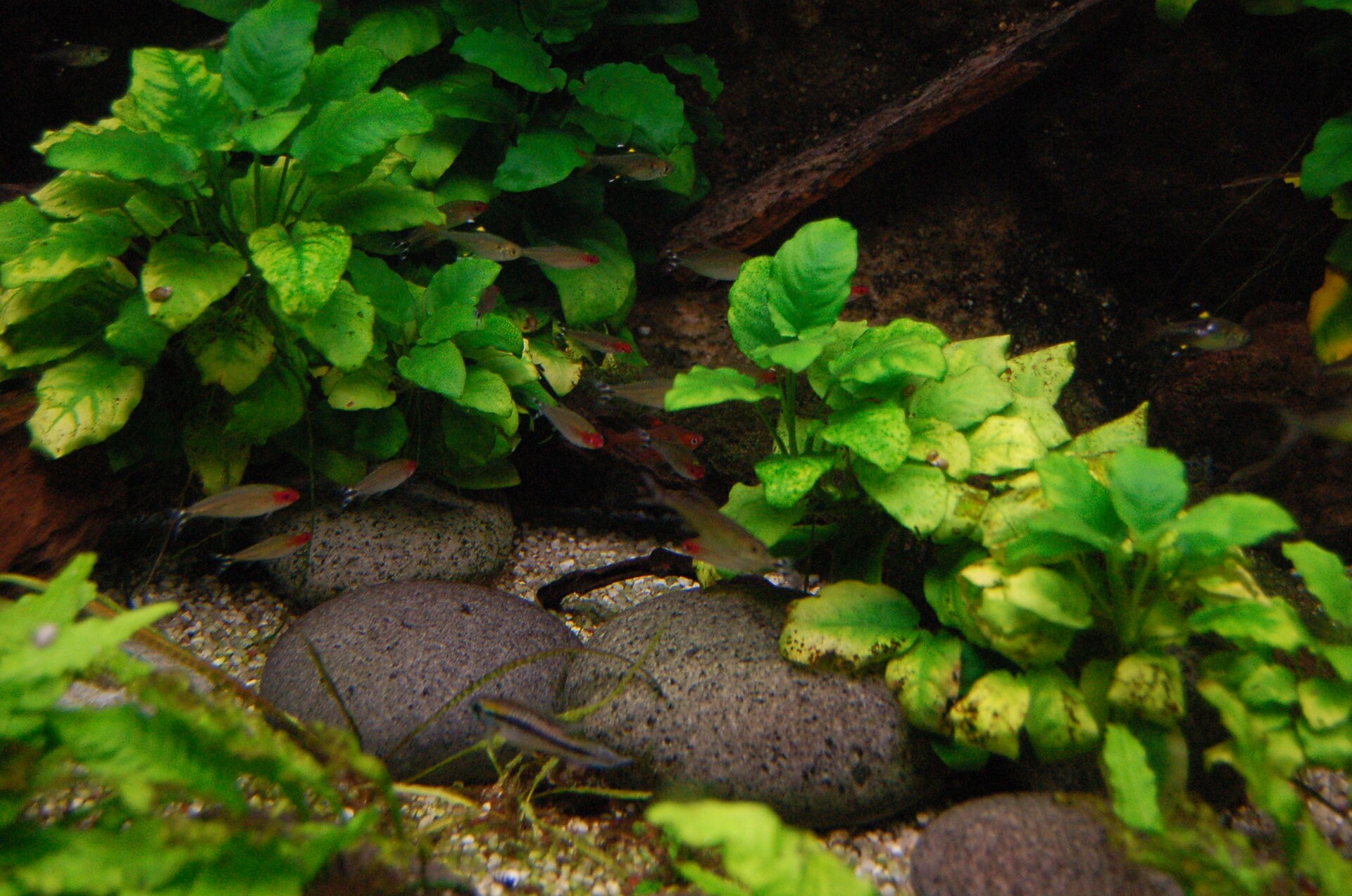
Eighty litres and up, longer than tall, plants and wood at the sides and back, a swimming path through the middle. Dark substrate. Floating plants to dim the top. They are not as surface-bound as hatchetfish but they like overhead cover. Gentle to moderate flow — a little current along the length, not a gyre. Sponge or baffled canister. Lid; they startle as a unit and can jump.
They look wrong in a hardscape of white limestone and Malawi rock. They look right over leaves. That is not aesthetics as luxury; it is the habitat that lets them school instead of hide.
Acid that does not swing

Temperature 24–27°C (hotter is unnecessary and shortens oxygen). pH 5.5–7.0, with the better colour and better long-term luck toward the acidic side. Very low GH. If you cannot keep pH from crashing because there is no KH at all, you have gone too far toward pure RO; add a measured remineraliser. If KH is high, pH will not stay in the sixes and the noses will tell on you.
Ammonia and nitrite at zero always. They are among the first to show a filter wobble. Nitrate modest. Weekly changes of RO-mixed water that matches the tank. A giant tap-water change is how a beautiful school goes pink-beige overnight and picks up ich by the weekend.
Omnivores that still want small prey
Flake, micro pellets, frozen daphnia, brine shrimp, cyclops. They are not picky once settled. They are small-mouthed. Feed twice a day in the midwater. A school of fifteen will eat more than you think and still look slim if competitors (larger tetras, danios) take the first wave. Watch the rummynoses at feeding time. If they only get leftovers, they will lose colour and then condition. Live baby brine is excellent for conditioning spawners and for thin imports.
Fifteen red commas in formation
Ten is a minimum; fifteen or twenty in a larger tank is when the school becomes a single animal. They are peaceful. They do not nip like some pencils. They are eaten by anything with a cichlid mouth. Good companions: cardinals, other small Amazon tetras, Corydoras, apistos in a big tank, otos, shrimp. Bad companions: large cichlids, fin-shredders, hard-water livebearers, rift-lake fish. The water recipe excludes more tank mates than temperament does.
They eat eggs and fry, including their own. Adult shrimp generally fine.
Scattering in the moss, a project if you want it
Egg scatterers. Very soft water, a spawning tank, Java moss, the school or a selected group, then adults out. Eggs are sensitive to fungus and to hardness. Fry need infusoria and baby brine. This is a known but not trivial spawn. Most keepers never breed them and still succeed if the display water is right. Do not buy rummynoses as a breeding project unless you already keep blackwater well. Buy them as a school that reports on your husbandry every morning when you look at their faces.
The nose as a daily check
Drip acclimate from the shop — their bag water is often softer than yours, or sometimes shockingly different. Quarantine a school in mature, soft, planted water. They can carry ich; they show stress clearly. Do not medicate in the display on day two because one fish is pale; test water first. Many “diseases” are a pH crash or a heater failure.
A school of Petitella bleheri in a stained, planted, ion-poor tank is one of the best sights in freshwater aquaria: a moving red edge, a clean tail flag, a group that turns together. The work is not a secret food. The work is making the Negro, in miniature, and then not wrecking it on Sunday with a bucket of tap. When the noses stay red, you did that work. When they do not, the fish already filed the report. Read it, then mix the RO.
Explore other topics
Dive into more aquarium guides across the site.