

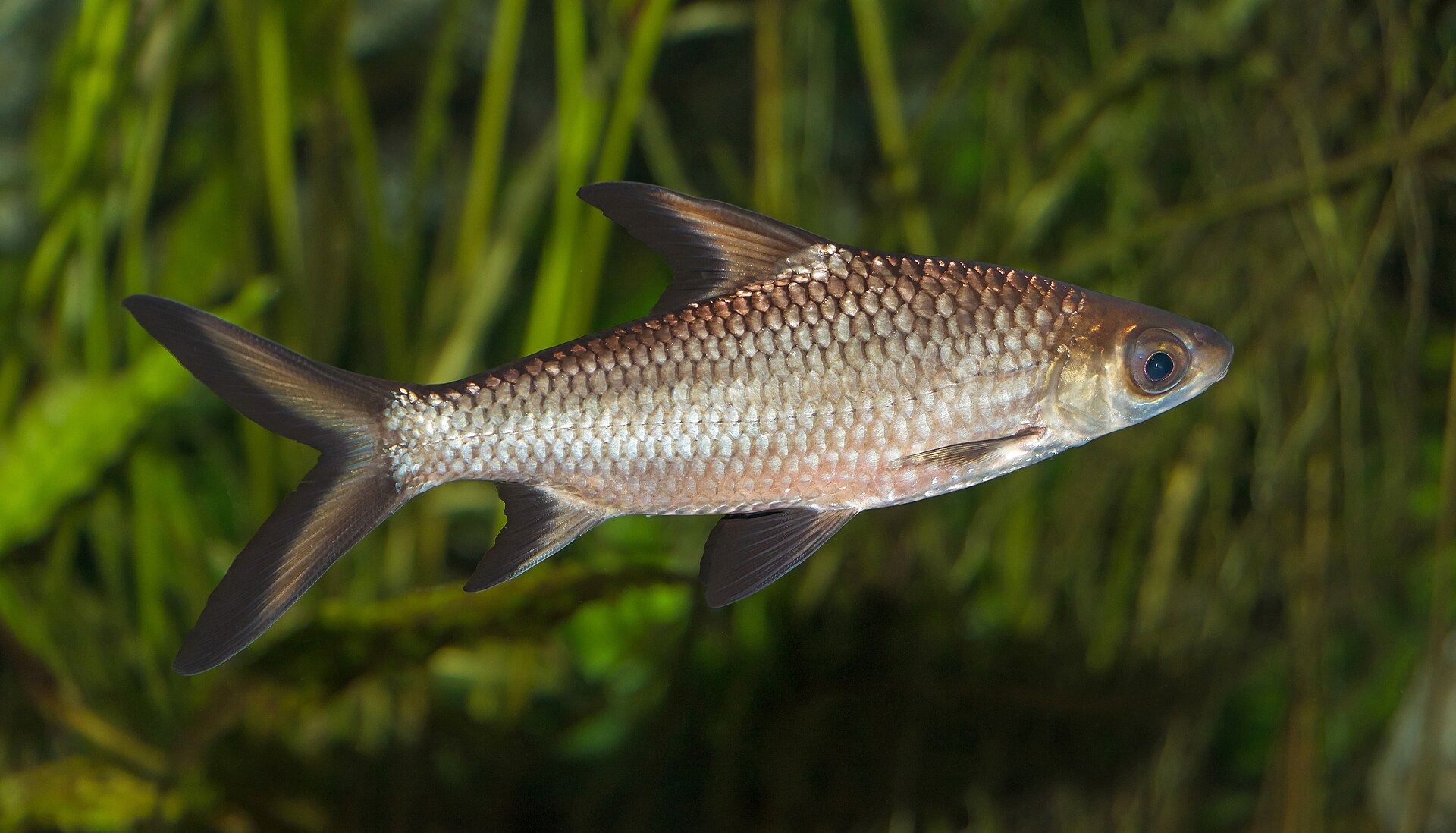
The bala shark is not a shark. It is a large cyprinid, Balantiocheilos melanopterus, with a silver body and black-trimmed fins, and it has probably caused more undersized-tank misery than any other “beginner” fish that looks harmless in a cup. Juveniles of 5 cm are sold every week. Adults of 30 to 35 cm need a tank that looks like furniture for a room, not a starter kit. They also need a group. A single bala in 200 litres is a scared, pacing, jumping silver missile. A group of five in 200 litres is the same missile, multiplied, still in the wrong room.
Wild fish came from rivers of Sumatra, Borneo and the Malay Peninsula. Habitat loss, dams and overfishing have hammered them; the species is widely listed as endangered in the wild, and most aquarium fish are now captive-bred. That does not shrink them. Captive-bred bala sharks still grow into the same animal that used to cruise big, turbid rivers in a school.
If your tank is not a room, stop reading and pick another fish
Four hundred litres is a grim minimum for a small group of young adults. Six hundred litres and up, with a long footprint, is where they start to look like themselves. Height matters less than length and unobstructed swimming. Décor should be smooth and set at the ends or back. Sharp wood in the middle of the racetrack will split a panicking fish. The lid must be heavy and complete. Bala sharks jump. They jump when the light flicks, when you walk past in a hat, when thunder happens, when a filter burps. A gap at the back of the hood is a death certificate with a delayed date.
Temperature 22 to 28°C, pH 6.0 to 8.0, and ordinary hardness will do. They are not fragile chemically. They are fragile physically when the volume is wrong. Filtration has to match a school of large, messy omnivores: oversized, well maintained, with intakes screened so a 8 cm juvenile does not become a 8 cm lesson. Water changes are weekly and real, not decorative.
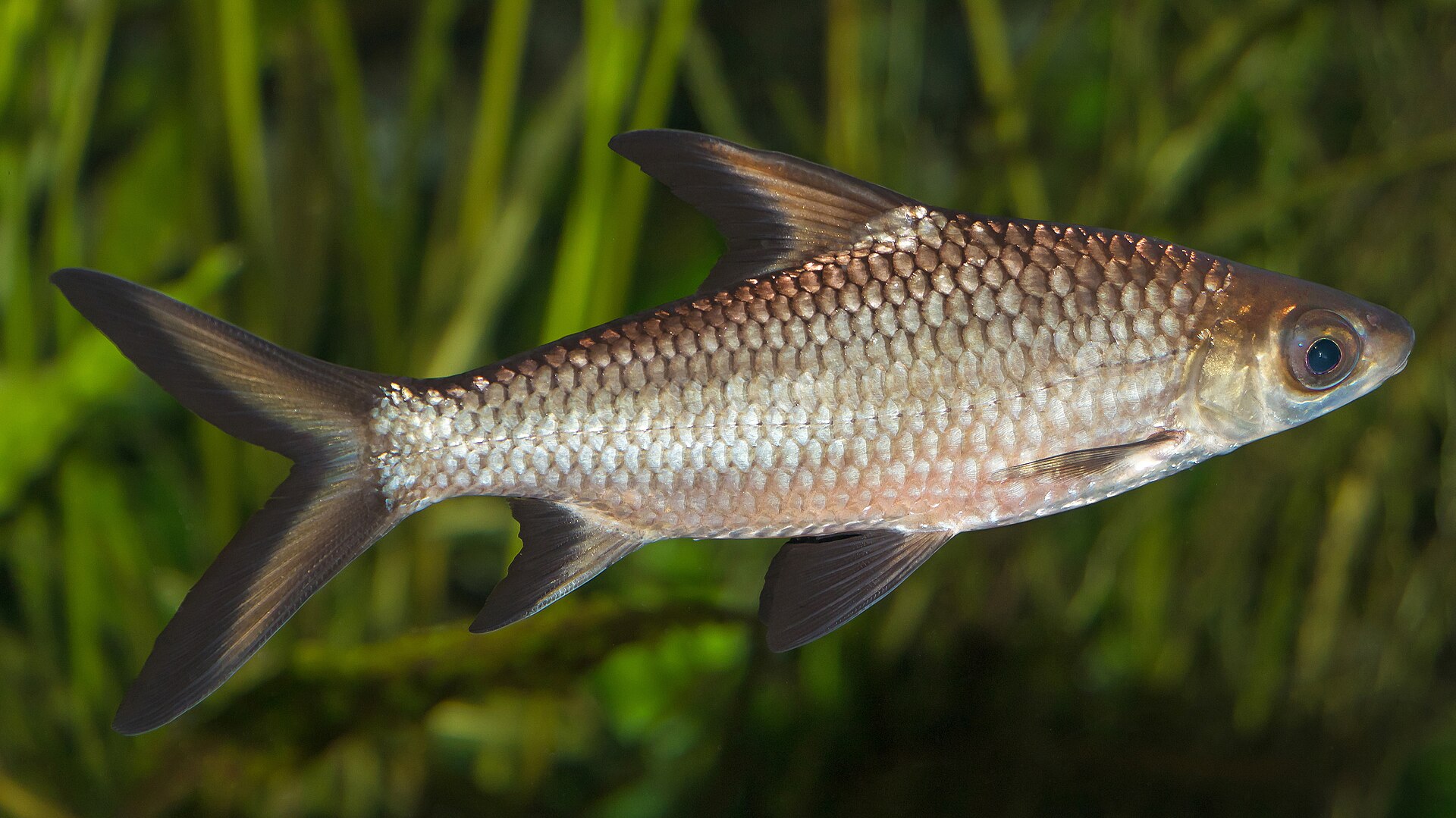
Silver, black margins, and a face that is all eye
The look is simple and good: a torpedo of silver, deeply forked tail, dorsal and anal and caudal all edged in black as if someone inked them. The eye is large. The mouth is terminal, slightly upturned, built for picking in midwater and at the surface, not for rasping wood. Sexing adults is unrewarding for most keepers. Females may be fuller. Males may be slimmer. There is no dramatic colour split. You will not reliably pair them in a shop.
They are peaceful toward other large fish. They are not peaceful toward a 4 cm neighbour in the sense that a 35 cm mouth passing at speed is an accident waiting to happen. Tiny fish vanish. Long, slow fins get ragged in a small tank because balas are clumsy when they are cramped, not because they are mean. In a huge tank with similarly scaled tank-mates they are among the more civil large cyprinids.
A school is not optional branding
Keep five or more. Solitary balas pace, hide, and lose condition. Pairs often produce a dominant and a wreck. The school spreads nerves. It also multiplies bioload, which is another reason the tank has to be large. Suitable companions are other big, calm, midwater or bottom fishes that will not be eaten and will not treat the balas as prey: large barbs, big gouramis, peaceful catfish of comparable size, and other riverine cyprinids with room to spare. Unsuitable: anything tiny, anything that needs still, planted nano water, and large aggressive cichlids that will rake silver flanks for sport.

Plants will be uprooted if they are not anchored. Tough, heavy plants at the back can survive. A Dutch carpet in the middle of a bala highway will not.
They will eat whatever you throw, which is not a diet plan
Omnivores. Quality floating pellets for large tropicals, frozen mixes, blanched vegetables, and occasional insect or shrimp items cover it. They have a greedy surface strike. Feed in several places so the back of the school eats. They will take flake as juveniles and then look underfed as adults if you never graduate the pellet size. They will also become obese if you enjoy the feeding show too much. A thick-bodied bala that cannot turn cleanly is a husbandry problem, not a success.
They are not dedicated algae eaters. They will pick, then ignore the glass. You still clean the glass.
Breeding at home is a rumour with a postcode in a fish farm
Commercial production uses hormones and ponds. Documented home spawns are rare enough that you should not buy juveniles on the promise that you will breed them in a 400 litre box. They are egg scatterers in principle. In practice, your job is to grow them humanely, not to fill the hobby with fry. Sexing remains hard. If you ever see spawning behaviour — frantic chasing, a softening of the female — you would need a vast, separate volume and a plan. Most keepers never will. That is expected.
The ethical part, said without a lecture-shaped heading
Do not buy three juveniles for a 120 litre “community” because they look like small sharks and the staff said they stay small. They do not stay small. Rehoming a 30 cm school is difficult. Releasing them is illegal and destructive. The endangered status of wild populations is a separate wound; dumping pets does not heal it. If you cannot commit to a tank measured in hundreds of litres for a decade (they can live ten years and more), admire them in a public aquarium and buy a fish whose adult size matches your glass.
Quarantine still matters. Large cyprinids ship poorly when packed tight. Look for pinched bellies, clamped black fins that should be crisp, and flashing. Treat in a huge quarantine if you can; a 30 cm fish in a 40 litre hospital is another cruelty. Ich on a bala school in a display is a nightmare because of the water volume and the jumping. Prevention — good dealers, observation, unhurried acclimation — is cheaper than a litre of medicine and a fish on the floor.
When they have the room, Balantiocheilos melanopterus is a graceful, nervous, schooling river fish that patrols like a thought you can see. When they do not, they are a warning on a care sheet that too many people skip. The black edge on the fins is pretty. The adult length is the actual description of the animal. Believe the centimetres.
Explore other topics
Dive into more aquarium guides across the site.