

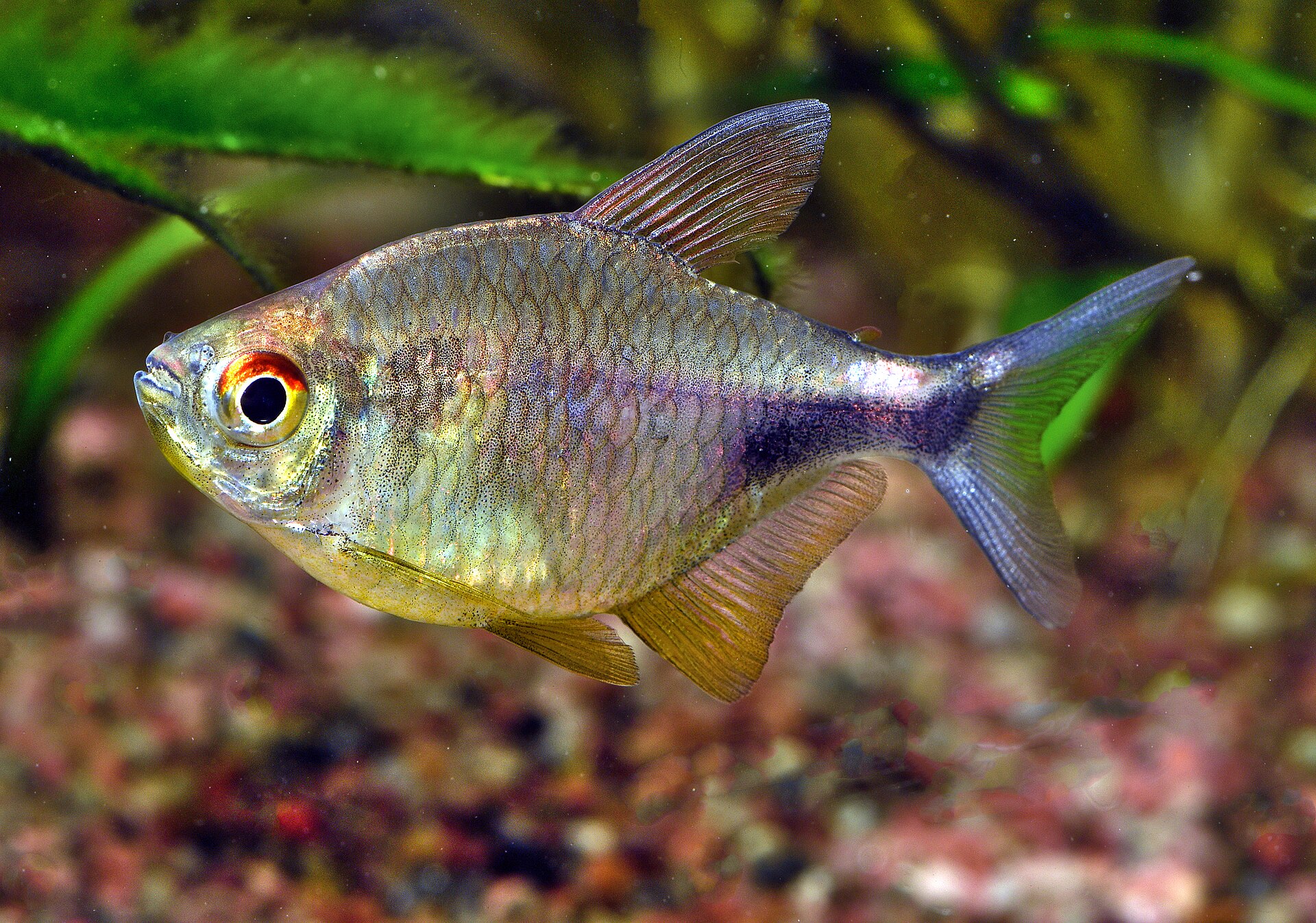
Hemigrammus pulcher is sold as the garnet tetra, pretty tetra, or black-wedge tetra, depending on the shop’s mood. The fish itself is consistent: a western Amazon schooler with a silver body, a warm tint, and a dark triangular smear that occupies the rear of the flank and the caudal peduncle. That wedge is how you tell it from a dozen other small Hemigrammus in a mixed tetra barrel.
Peru, Ecuador, and stained tributaries
Wild fish come from Amazon tributaries of Peru, Ecuador, and neighbouring Colombia — often in forest streams with leaf litter, roots, and a tea tint. They are not high-current fish. They use cover. In the tank, a bare blue-gravel box with a powerhead on full is the opposite of that habitat. Soft to moderately soft water, pH about 5.5–7.5, and temperature 22–27°C match the range they actually see. They can adapt to harder tap, but the wedge looks greyer and the fish stay skittish.
Blackwater extract and botanicals are useful here in a way they are not for Mexican tetras. You are aiming at a forest tributary, not a Mexican spring.
Reading the wedge
Adults reach roughly 4–5 cm. The black mark is the field character: it sits on the posterior body, often with a metallic glint in front of it when the fish is in good light. Fins may show red or warm edges. Males are slimmer; females are deeper. In a tight school the wedge reads as a repeating pattern, which is part of why a group of ten looks finished and a group of four looks like leftovers.
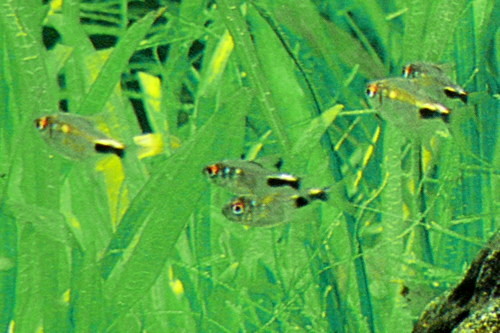
Shop confusion with glowlight tetras and other Hemigrammus is common. Glowlights have a neon-like lateral stripe. Garnets have the rear wedge. If the bag is labelled only “assorted tetra,” look before you commit; you may be buying three species that want slightly different things.
Layout that lets pulcher sit in the middle
They occupy midwater, with short dashes into plant cover. A 60–80 litre tank is a reasonable start for a dedicated school of eight to twelve. Length matters more than height. Wood, floating plants to break the light, and a clear lane give them a daily rhythm: hover, turn, vanish, reappear. Bright, open water with no overhead shade keeps them pale and against the glass.
Substrate can be sand or fine gravel. They do not sift it. Leaf litter is optional and helpful. A lid is sensible. They are not splash tetras, but they will jump if panicked by a net or a sudden light.
A diet of small moving things
Garnet tetras take flakes and micro pellets, but they colour and fill out on frozen or live cyclops, daphnia, and baby brine shrimp. They are small predators of zooplankton with some plant matter in the mix. Feed where they swim. Sinking wafers meant for Corydoras will not train a garnet school. If you keep them with hatchetfish, the hatchets will take surface food and the garnets will take what hangs in midwater — a workable split, unlike stacking two surface specialists.

Underfeeding shows as a pinched belly and a school that does not push forward at feeding time. Overfeeding shows as cloudy water and a wedge that still looks dull because the chemistry crashed.
Peaceful, but not a dither for cichlids
They are genuinely peaceful with each other and with similar-sized fish. That makes them targets. Large angelfish, ram cichlids in a tiny tank, and anything with a mouth that fits a 5 cm tetra will thin the school. Good neighbours include other small Amazon tetras, Corydoras, small peaceful gouramis if the tank is large enough, and shrimp if you do not need a breeding colony of shrimp.
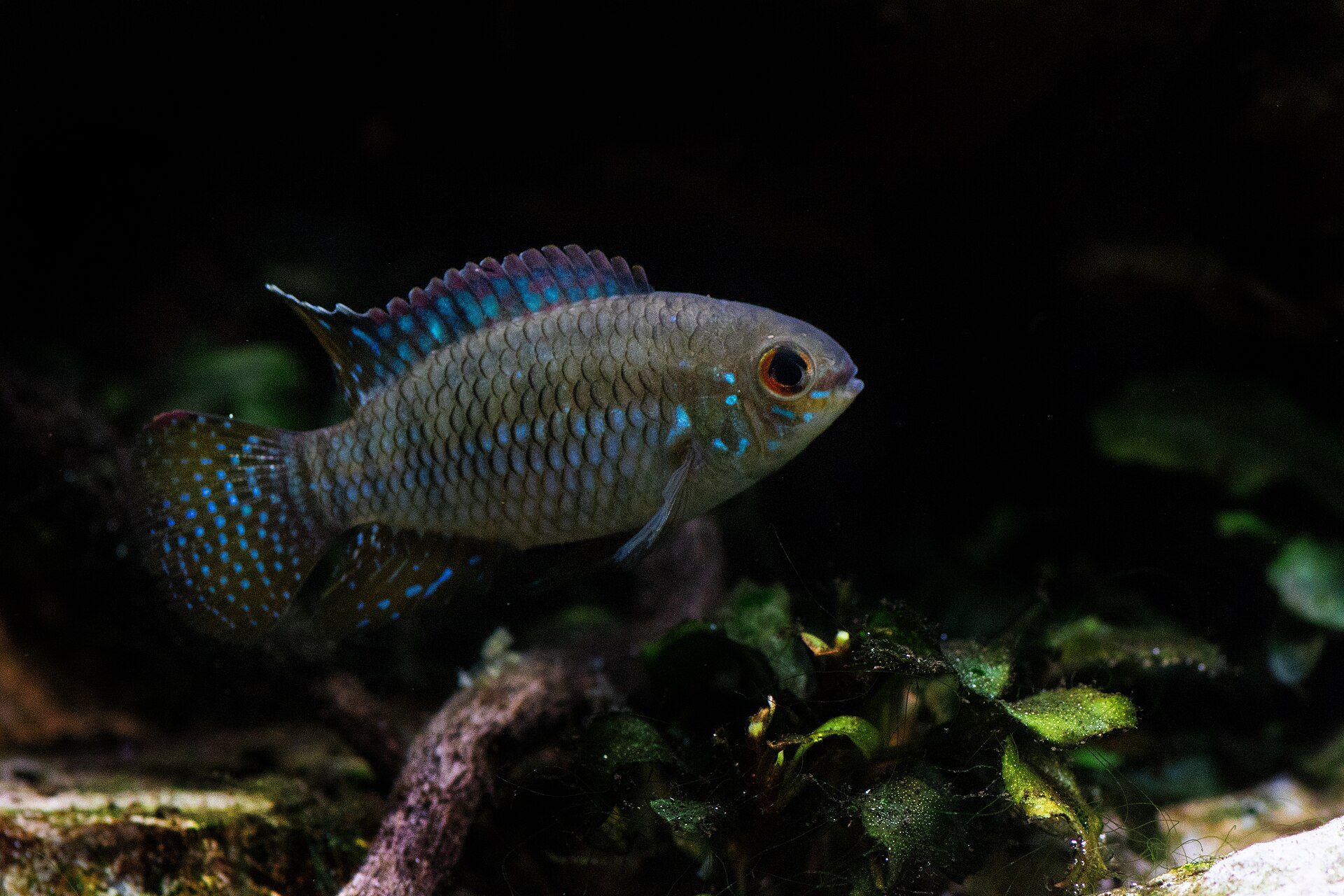
Do not use garnets as “moving décor” for a pair of apistos unless the tank is big, the cover is dense, and you accept losses. They are a display school of their own, not fodder.
Eggs in the roots
Like most Hemigrammus, they scatter adhesive eggs among fine plants, moss, or mops. Soft water, a slight temperature bump, and heavy feeding with live foods often trigger a spawn. Remove adults. Fry need infusoria-scale food first. A species tank with moss and no egg predators can produce accidental young; a mixed community almost never will.
Sexing at a glance is unreliable in juveniles. Buy a group and let pairs declare themselves by shape as they mature.
Import stress and the mixed vat
Garnets often travel in mixed tetra shipments. Quarantine anyway. Watch for neon tetra disease-like wasting (not unique to neons), ich, and bacterial haze on fins. They are not as thermal-tolerant as Mexican tetras and not as plant-destructive as Buenos Aires tetras. If a care card in the shop lumps all three together, ignore the card.
Long-term colour depends on tannin-friendly lighting, a real school, and food they can catch. If you want a brighter red tetra, look at ember tetras. If you want this specific black-wedge pattern, give H. pulcher the western Amazon box it evolved in, not a generic “tropical community” recipe copied from a danio sheet.
What the wedge is for
The posterior blotch is a schooling mark as much as decoration. In stained water a repeating dark triangle is easier to track than a faint silver body. That is why a proper group looks “more garnet” than a pair: you are seeing the pattern work. Break the school and the mark still exists, but the fish stops behaving like H. pulcher and starts behaving like a lost tetra in a box.
Do not confuse the wedge with the caudal spot of a Mexican tetra or the humeral blotch of a yellow phantom. Those are different landmarks on different bodies. If you are identifying mixed stock, look at the rear third of the fish, the overall size, and whether the water in the shop vat is even close to Amazon tributary chemistry. Garnets that have sat in hard, cold water for a week look like a different species until they recover in stained, warm conditions with food they can catch.
Explore other topics
Dive into more aquarium guides across the site.