

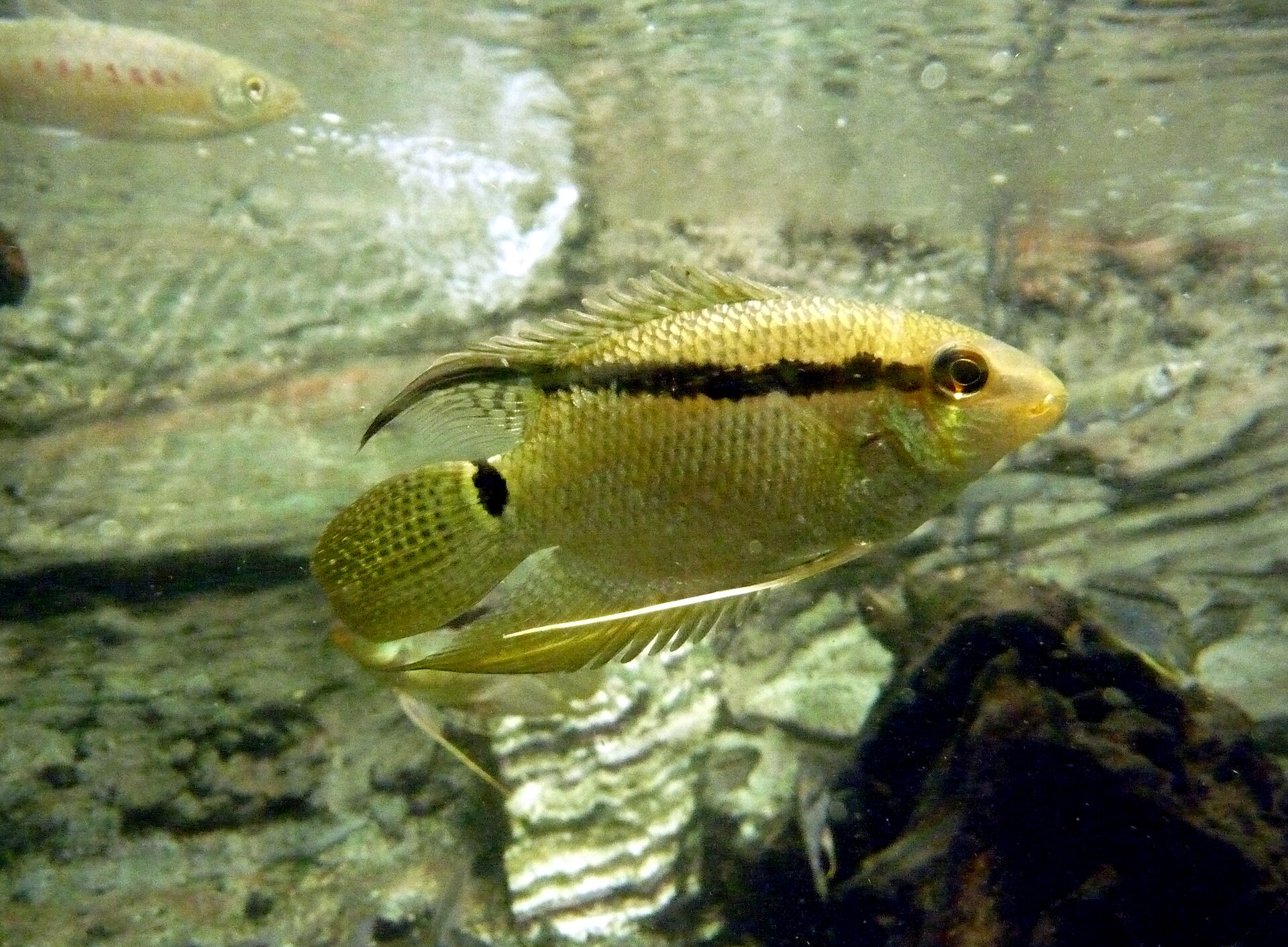
The diagonal stripe on a flag cichlid is not a flag. It is a line from the mouth, through the eye, up the nape and into the dorsal, as if someone drew a path the fish should follow through stained water. Mesonauta festivus, the festivum, is an Amazon-basin cichlid — Brazil, Peru, Bolivia, Paraguay drainages depending on which Mesonauta you actually bought — that lives in the midwater around wood and plants rather than on a territorial rock like a mbuna. It is one of the larger cichlids that can still be called relatively peaceful, which in cichlid language means it will not usually murder everything, and it will still spawn with a straight back and a bad attitude toward close neighbours.
The trade dumps several Mesonauta species into the “festivum” bucket. M. festivus is the name on this article. Care across the genus is close: soft to moderately hard water on the acidic side, warmth, a group or a pair, and a tank tall enough for a laterally compressed, disc-adjacent body that likes to hover at a forty-five degree angle in the snags.
A hanging fish, not a bottom bully
Adults reach 15 to 20 cm. The body is tall, the snout pointed, the stripe the identification. Ground colour is beige to gold with a metallic hint. Fins are long and can be lyre-ish in mature fish. They often rest head-down among branches, which looks broken until you realise it is how they blend with sunken wood. Sexing is poor until spawning. Males may grow a little larger and more pointed in the fins. A pair is something you observe, not something you order from a dropdown.
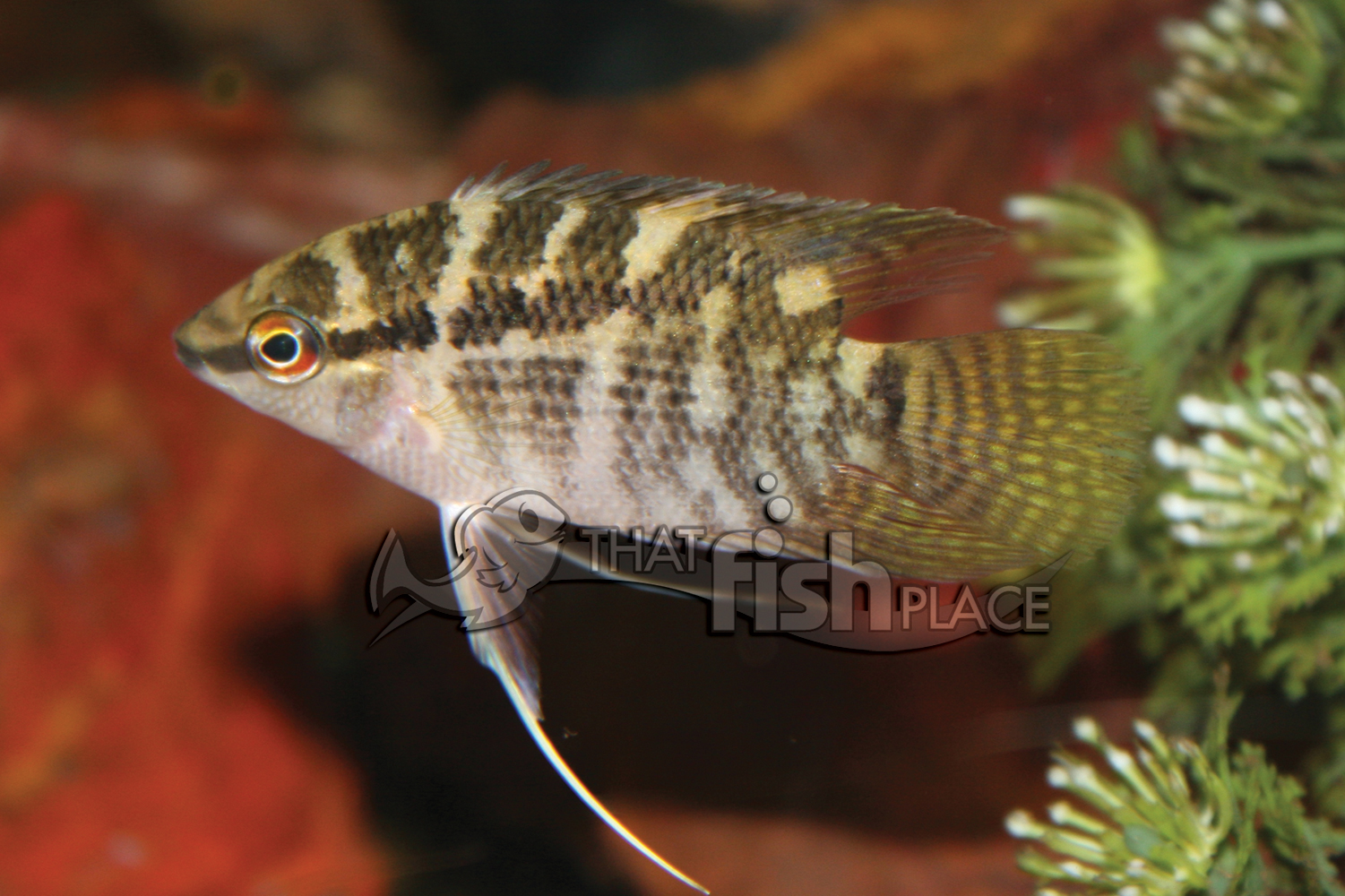
Wood in stained water
Two hundred litres for a pair or a small group is a working start; more height is better than a long, shallow trough. Branches, tall plants, and a dimmer midwater make them use the tank. White, barren tanks make them pace and darken. Sand, botanicals, a little tannin. Temperature 24 to 28°C. pH 5.5 to 7.5. They will adapt to harder tap than a wild-caught discus would, but they look and spawn more readily toward the soft, warm, clean end of that range. Filtration should be strong and the flow not a jet in their hovering lane. They are not as messy as a green terror, but they are not nano fish.
A lid helps. Startled festivums go up.
Omnivore with a bias toward small animals
Pellets for medium cichlids, frozen mysis, bloodworm, daphnia, brine shrimp, and some vegetable matter. They will graze aufwuchs on wood. They will not usually demolish a garden the way silver dollars will, though they may pick at very soft plants and they will eat fry of other fishes. Feed in the midwater. Watch that shy individuals in a group still get food; a hierarchy exists even in a “peaceful” cichlid.
They appreciate insect-based foods. They do not require livebearers as feeders. Skip feeders.

A community, with the usual Amazon asterisks
Festivums can live with similarly sized, similarly water-chemistry, non-aggressive fishes: larger peaceful characins, angels if the tank is huge and the individuals agree, peaceful catfish, other relatively calm South American cichlids that do not want the exact same branch. They should not live with tiny schoolers that fit in the mouth, with mbuna, or with punchy Central American bruisers. A group of festivums in a large tank often looks better than a single pair in a box, because the stripe reads as a pattern in a shoal. A pair in 200 litres will still claim a woodpile at spawning time and the rest of the community will take the hint or take the hits.
They are more nervous than their size suggests. Fast, nippy tank-mates will shred those long fins. Slow, giant predators will eat them. The middle is the point.
Eggs on a leaf, parents in a slant
They spawn on a pre-cleaned leaf, piece of wood, or slate, often at an angle, which matches how they live. Both parents tend the clutch. Brood care is generally good. Other fish should be elsewhere if you want a high yield. Fry take baby brine. The adults may move the wrigglers. It is less of a gravel-pit circus than a Jack Dempsey spawn and more of a midwater, wood-stain event. If they eat the eggs, look at disturbances, nitrate, and whether the pair was actually a pair.
Stripe as a mood ring
A crisp, dark diagonal on a gold body is a settled fish. A faded stripe on a dark, blotchy body is a stressed or spawning-coloured fish — context matters. Clamped long fins mean water or bullying. White specks mean ich, and those long fins get it badly. Quarantine. Festivums in shops are often pale from crowding; colour returns in a week of stained, quiet water and decent food, or it does not, and you have a parasite problem.
Hole-in-the-head is less famous here than in discus and oscars but still appears in dirty tanks. You know the sermon: changes, not potions first.
Why the stripe is enough
Mesonauta festivus is for people who like Amazon structure, a tall tank, and a cichlid that occupies the water the way a leaf occupies a current: at an angle, in a group or a pair, not as a gravel tyrant. It will never be as electric as a hap or as cuddly as a keyhole. It will, in the right woodpile, look exactly like the drawings in old aquarium books, which is rarer than it should be. Give it warmth, a little tea in the water, room to hover, and neighbours that do not chew fins or fit in its mouth. The flag, which is not a flag, will stay drawn on.
If your dealer cannot tell festivus from other Mesonauta, keep the fish anyway if it is healthy, and do not build a locality biotope around a guess. The care is Amazon midwater cichlid care. The Latin on the bag is a best effort. The stripe is the truth you can see.
Explore other topics
Dive into more aquarium guides across the site.