

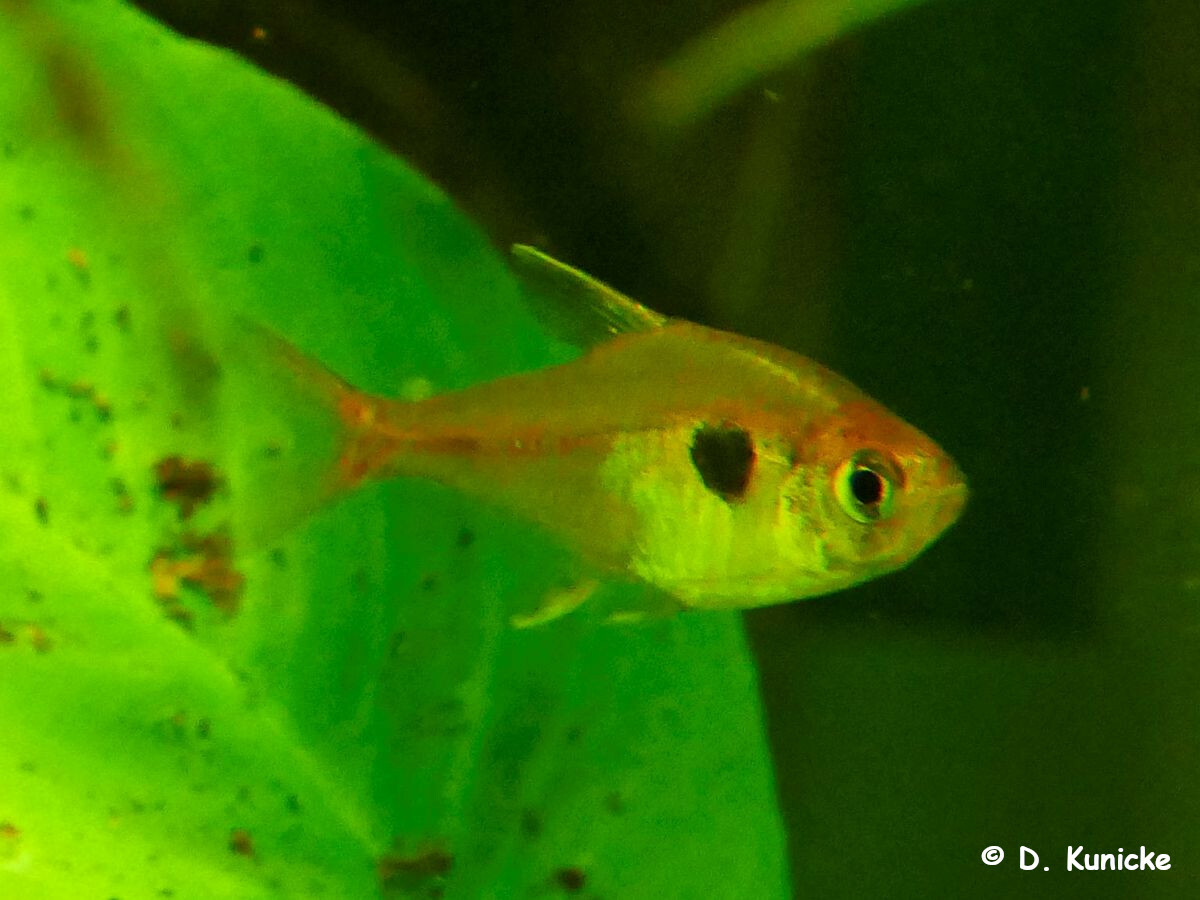
The yellow phantom tetra is not a bleached black phantom. Hyphessobrycon roseus is its own Guiana Shield fish: a small, golden-olive schooler with a dark shoulder blotch and a quieter temperament than the name “phantom” sometimes suggests. If your experience of phantoms is the tall-finned, smoky H. megalopterus from Brazil and Bolivia, reset the picture before you buy.
Shield creeks, not a generic “South American tank”
Yellow phantoms come from drainages in Guyana, Suriname, French Guiana, and adjacent Amazonian waters — tea-stained, often soft, and structured with roots and leaf litter. They are small-creek and floodplain fish, not open-channel sprinters. In the aquarium that means stained or at least gentle lighting, fine-leaved plants or wood, and a school that can sit in midwater without being shouldered aside by bigger tetras.
pH in the 5.5–7.0 range and low-to-moderate hardness suit them. Temperature around 22–28°C works; they are true tropical fish, unlike Buenos Aires tetras. They will live in harder tap if you acclimate slowly, but colour and spawning success are better when the water is closer to the Shield than to a rift-lake mix.
Gold, a blotch, and a modest adult
Adults are about 3–4 cm. The body carries a warm yellow to rose-gold wash, a distinct humeral spot, and reddish tints in the fins when the fish is settled. Males are slimmer and often show more colour in the unpaired fins; females are rounder. They never become the deep-bodied, flag-dorsal presence of a male black phantom. Shop photos taken in blackwater make them look richer than they will in a sterile, bright tank with three fish.
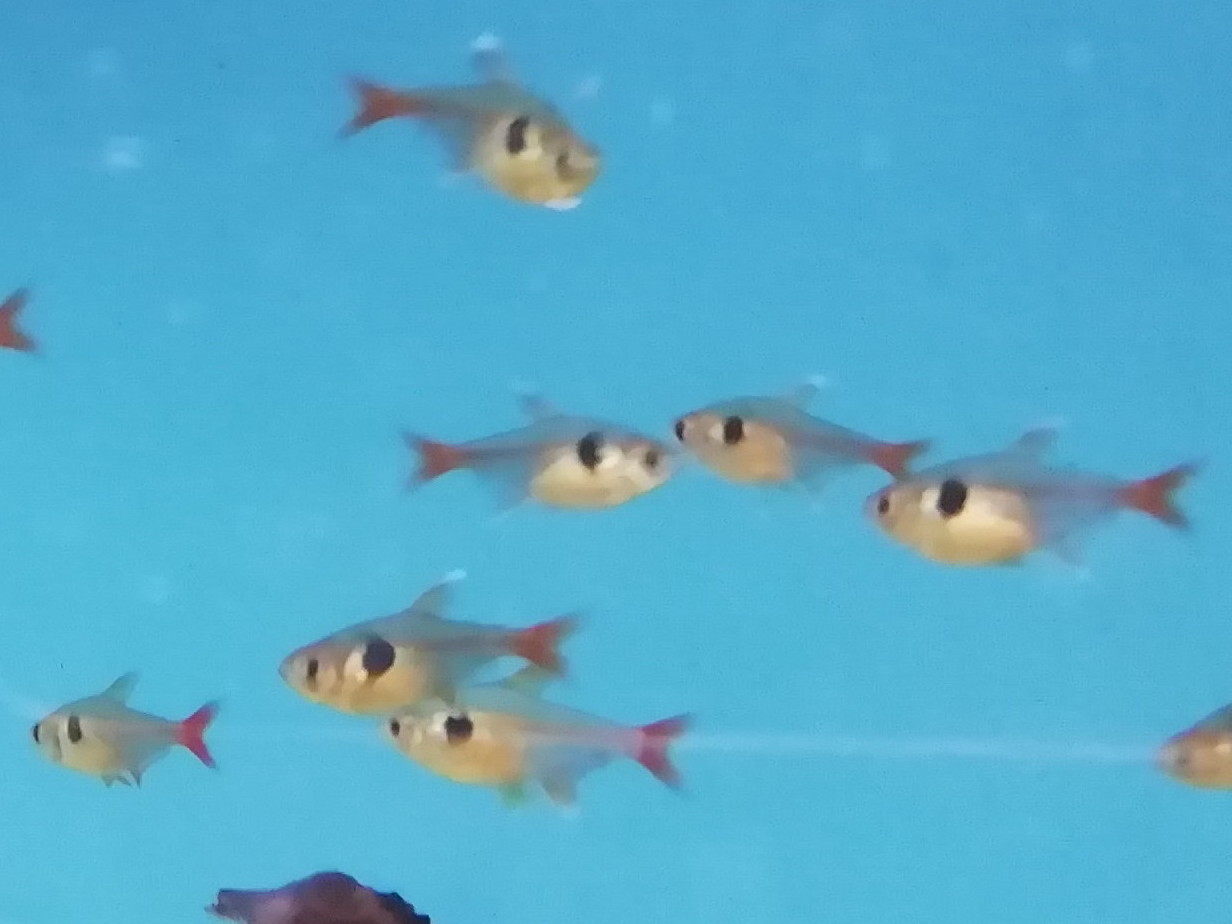
Faded fish in a dealer tank are usually stressed, underfed, or sitting in hard, alkaline water after a long export chain. They can recover. They will not recover in a mbuna display or a goldfish vat.
A quiet school in a planted box
Ten or more is a better target than six. Yellow phantoms are peaceful to the point of disappearing if you house them with robust, greedy midwater fish. They occupy the middle of the water column, use plant thickets as a psychological hedge, and look their best when the group turns together in a gap between wood and stems.
A 60 litre tank can hold a dedicated school. Mixed communities need more space so they are not competing with larger tetras for the same lane. Sand or fine gravel, leaf litter if you like the look, and a lid for the odd jump complete the hardware. They are not dedicated surface jumpers like hatchets, but any startled characin can leave a gap at the rim.
Food sized for a small mouth
They are micro-predators and omnivores. Crush flakes. Offer micro pellets, frozen cyclops, daphnia, and baby brine shrimp. Large bloodworm cubes that sink past them in two seconds will fatten Corydoras and starve the phantoms. Feed small amounts twice a day and watch whether the school actually reaches the food. In a tank with danios or Buenos Aires tetras, they lose.

Colour diet lore (astaxanthin, spirulina, and so on) helps only after the water, the group size, and the lighting are already right. No colour flake repairs a school of four in a spotlight.
Companions that do not erase them
Good company: other small, calm tetras, pencilfish, small Corydoras, Otocinclus, shrimp if you accept some predation on shrimplets, and rasboras of similar scale. Poor company: large barbs, boisterous danios that occupy the same midwater, cichlids, and anything that regards a 4 cm tetra as a snack. Black phantoms can share a large, well-structured tank, but the yellows will be the subordinate school; give them numbers and cover.
They do not belong with African alestids the size of Congo tetras unless the tank is huge and heavily planted. Size and feeding speed will sort the yellows out of the food queue.
Spawning a Shield Hyphessobrycon
They scatter eggs among fine plants or mops. Soft, acidic water, dim light, and a pair or a small group conditioned on live and frozen foods is the usual approach. Adults eat eggs. A separate spawning tank, or a heavily planted display you do not expect to harvest, are the two honest options. Fry are tiny. Infusoria or commercial fry food comes first; newly hatched brine shrimp follows when mouths allow.
Do not use the black phantom’s courtship — the male’s expanded dorsal and the more obvious pairing — as a template. Yellow phantoms are subtler. Watch for females filling out and for a morning scatter after a water change rather than a dramatic display.
Stress, ich, and export fish
Like many small Shield tetras, they arrive thin if the chain was long. Quarantine, feed well, and do not add them to an unfinished cycle. Ich and velvet hit small, stressed characins hard. Gentle heat within their range, good oxygen, and actual treatment when parasites are present beat “a little salt because tetras are hardy.” They are not Buenos Aires tetras. They are not cave morph Mexican tetras. They are a small golden school that needs clean, soft-leaning water and a crowd of their own.
If you like the phantom silhouette but want drama in the fins, keep black phantoms. If you want a warm gold midwater haze in a planted, tannin-friendly tank, H. roseus is the one that belongs there.
Lighting that does not bleach gold
Yellow phantoms photograph well under warm, dim LEDs over a dark substrate. Cool white light on white sand turns them into beige splinters. Floating plants — frogbit, Salvinia, or a thin layer of Riccia — do more for this species than a second bag of colour-enhancing flake. The fish uses the shade line the way Shield creek fish use overhanging vegetation: as a place to pause, not as a cave to hide in all day.
If the school spends the afternoon glued to the back glass, reduce light, add a group, or remove the fish that is claiming midwater. A yellow phantom that never turns its flank to you is not “naturally shy.” It is outnumbered or over-lit. Compare that with a Mexican tetra school, which will use open water even under brighter light because the river morph is a bigger, bolder fish in a different climate.
Explore other topics
Dive into more aquarium guides across the site.