

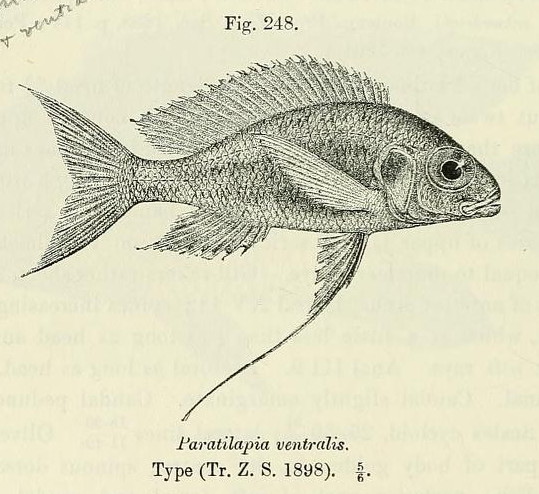
The first thing people notice about a mature male Ophthalmotilapia ventralis is not the body colour. It is the pair of thread-like pelvic fins trailing yellow oval marks that look, to a female, like eggs. He fans those fins over a patch of sand, shivers, and waits. That display is the whole animal in miniature: a Tanganyika featherfin that lives in open water, advertises on a lek, and only makes sense in a large, hard, alkaline aquarium.
Shops sometimes sell washed-out juveniles as “featherfin cichlids” without saying which species they are. O. ventralis is the one with the yellow egg-spots on the ventrals, a relatively slender body, and a habit of hovering several body lengths above the sand rather than hugging rock. Closely related featherfins exist in the same lake; do not assume a blue fish with long fins is this species. Ask for the Latin name and look at those ventrals before you pay.
Why the ventral fins exist
Lake Tanganyika mouthbrooders solved a problem: how does a female know she is dealing with a male of her own kind, and how does he convince her to pick up eggs she has not even laid yet? In Ophthalmotilapia ventralis the answer is those yellow spots. During courtship the male presents the spots in front of her face. She nips at them as if they were eggs, and in doing so she takes sperm into her mouth along with the real eggs she later collects from the sand. It is not a party trick. If a male’s filaments are torn off by rough décor or by other fish, his courtship falls apart even if he is otherwise healthy.
That is why the tank cannot be a jumble of jagged lava rock. Sand must be deep enough for him to dig a shallow courtship pit, and the swimming lane in front of that pit must stay open. Rock belongs at the back and sides as a visual break, not as a maze he has to thread his fins through.
The intermediate zone, not a boulder pile
Wild O. ventralis occupy the transition between rocky shoreline and open sand along Tanganyika’s coasts. Depths are modest by lake standards — often within the first ten metres — but the water is clear, mineral-rich, and stable. Males hold display sites on sand with a rock or two nearby. Females and non-territorial fish mill in loose groups just off those sites. There is little plant life. There is a great deal of light and a great deal of room.
Copying that habitat means a long tank more than a tall one. Three hundred litres is a realistic floor for a small group; four hundred and up is kinder if you want more than one adult male. Footprint matters more than height. A 150 cm tank with a sand floor and a rock spine along the back will show this species. A tall 200 litre cube stuffed with wood will not, even if the litre count looks acceptable on paper.
Substrate should be fine to medium sand, pale enough that you can see the yellow on the ventrals. Dark gravel hides the display and scratches the chin when males dig. A few pieces of smooth limestone or Tanganyika rock create territories without turning the tank into an mbuna cliff. Leave at least half the floor as open sand. That empty space is not wasted aquascaping; it is the stage.
Colour that arrives late
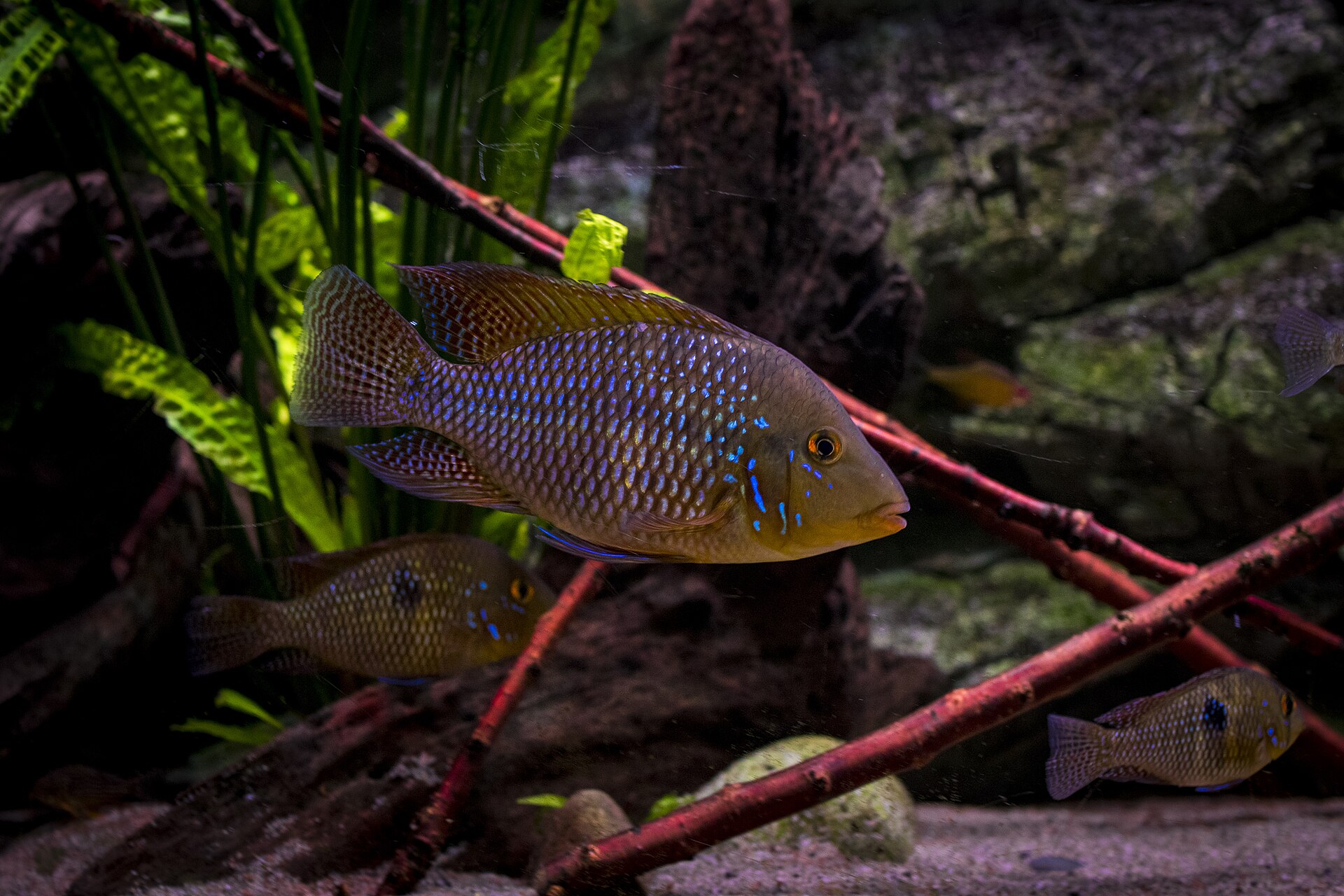
Juveniles are silver-grey with a dark mid-lateral blotch that fades as they grow. Adult males colour according to locality and mood: steel blue, yellow on the flanks, a dark bar through the eye, and those unmistakable ventral streamers. Females stay smaller and plainer, with shorter fins and less blue. Adult length is commonly 12–15 cm for males; females often stay a centimetre or two shorter.
Do not judge a fish in a dealer tank under yellow light. Wait until it has been eating well in your water for two or three weeks. A male that refuses to colour is often undersized, overcrowded, or sitting in water that is too soft. He is not “a different morph.”
Lake water, not Amazon water
Tanganyika is alkaline and hard. Aim for pH 8.0–9.0, carbonate hardness high enough that pH does not crash overnight, and temperature 24–27°C. Conductivity in the wild is far above typical South American tanks. If your tap is soft, mix a Tanganyika or Malawi salt blend into RO water according to the manufacturer and test. Do not drip discus water into this aquarium and hope the fish “adapt.” They will live for a while and then decline, often with holes in the head or stubborn bacterial issues that are really chronic osmotic stress.
Stability beats a perfect number. A tank that sits at pH 8.2 every morning is better than one that swings from 7.6 to 8.8 after each water change. Match new water to the tank before you pour. Large, regular changes — a quarter of the volume weekly is a sensible starting point — keep nitrate down without shocking the electric chemistry of the lake substitute you have built.

Filtration should be strong and well oxygenated. These fish hover in open water and appreciate current along the surface, but they do not want to fight a powerhead all day. A canister or a large hang-on with the output broken by a spray bar works. Keep the sand from blowing into dunes against the glass; if it does, the flow is aimed at the floor instead of the midwater where the fish actually live.
What they actually eat
In the lake, O. ventralis picks aufwuchs — the film of algae, microbes, and tiny invertebrates on rock and sand — and also takes plankton in the water column. In the aquarium that translates to a diet with a real green component, not a bag of high-protein “cichlid pellets” meant for piscivores. Spirulina flakes, vegetable wafers broken into pieces, and quality omnivore pellets form the base. Frozen mysis, brine shrimp, and daphnia add animal protein a few times a week.
Feed small amounts two or three times a day rather than one heavy meal. Males on a lek will sometimes ignore food while displaying; drop a little near the females first, then offer the male after the rush is over. Watch body shape. A hollow belly on a fish that still “looks coloured” is a feeding problem, not a colour problem. Uneaten food on white sand is obvious — siphon it. Nitrate from leftover krill will undo the water work you did with salts.
One stage, many females
A single adult male with two to four females is the classic working group. Two males in a tank that is not huge will spend their energy on each other. In a very large aquarium you can run several males if each has a sand court out of sight of the others, but that is a specialist layout, not a default. Females are not decoration. Without them the male’s display has no audience and he often paces or hammers on the glass.
Tank mates, if any, should be other Tanganyika species that use different space: a small group of Cyprichromis in the upper water, or a rock-dwelling julie that stays in the hardscape and ignores the sand stage. Do not add mbuna. Do not add Malawi peacocks unless you already know how to manage mixed rift-lake aggression, and even then O. ventralis is usually happier in a species tank or a carefully chosen Tanganyika community. South American cichlids, tetras, and catfish from soft water do not belong here. The chemistry is wrong and the featherfin will either ignore them or chase them off the sand.
Shrimp will be eaten. Small snails may survive. Decorated the tank for the cichlid, not for a cleanup crew you then have to protect.
Mouthbrooding on a sand patch
Spawning follows the lek. The female lays on the sand, collects the eggs, nips the male’s ventral spots, and leaves with a mouthful. She will hold for roughly three weeks, depending on temperature. During that time she eats little or nothing. A holding female should have a quiet corner and should not be hounded by the male or by dither fish. Some keepers move her to a bare holding tank with the same water; others leave her in the display if the group is calm. Both approaches work if you watch her. A female that spits early has been stressed. A female that holds to term and then swallows the fry has often been disturbed at release.
Fry are small. They take infusoria and newly hatched brine shrimp. The male will spawn again if females are ready; he does not help raise the young. Do not expect a pair to “guard a nest” the way a krib does. This is a maternal mouthbrooder with a public courtship, not a cave family.
Buying, quarantine, and the long view
Buy fish that are already showing sex differences if you can. A box of identical 4 cm juveniles will take a year or more to become the animal you saw in photographs, and you may end up with five males. Quarantine new arrivals in hard, alkaline water — not in a soft hospital tank “because it is only temporary.” Medications that alter gill function should be used with care; these fish live in mineral water and do not appreciate copper dumped in as a guess.
Look at the ventrals on arrival. Split fins heal if water is clean and décor is smooth. Missing filaments on a show male are a longer wait. Watch for Malawi bloat-type symptoms: stringy white faeces, refusing vegetable food, sitting in corners. The usual cause is too much protein and not enough greens, or a sudden menu change after import. Fix the diet before you cycle through antibiotics.
A well-kept group will live many years. The display does not stay at peak every day. Males rest. Females fade after holding. That rhythm is normal. What is not normal is a fish that never comes over the sand, a male that hides in the rock like a julie, or a group that only colours for a minute at feeding time. Those are layout and stocking problems. Open the floor, check the hardness, and give the ventrals room to trail.
Explore other topics
Dive into more aquarium guides across the site.