

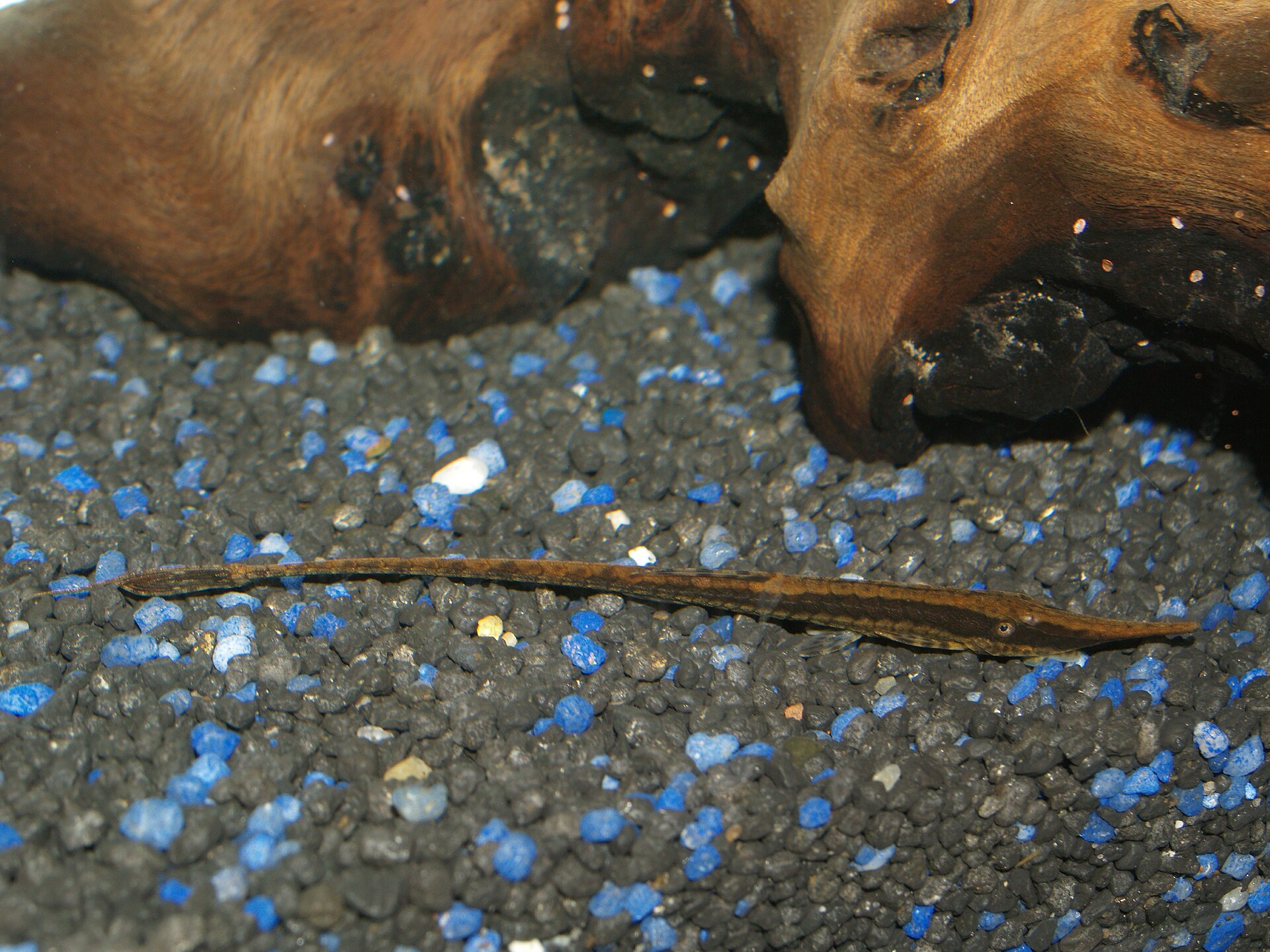
A twig that breathes: that is the joke until the fish starves. Twig Catfish (Farlowella vittata) is a loricariid from the Orinoco world, a stick-mimic that grazes aufwuchs on wood and plants. It is not a Corydoras. It does not shoal on sand as a sifting pack. It does not eat leftover flake off the gravel. If you add one to a clean new tank because it “eats algae,” you have bought a slow death that looks like décor.
Camouflage as a lifestyle, not a paint job
F. vittata is extremely elongate, roughly 15–20 cm of very little mass, with a tiny suckermouth at the end of a broomstick body and a caudal filament that adds to the twig illusion. Colour is brown with a darker lateral stripe (the vittata). The snout is long and straight. The eyes are small. Sexual differences exist: males may show odontodes on the snout and a broader head when breeding, and they are the ones that guard eggs on a vertical surface. It is not Sturisoma (which is more robust, with a different head and usually a more whiptail-royalty look). It is not Rineloricaria (shorter, flatter, more willing to sit on sand and spawn in tubes). It is not a Farlowella of another species; several twigs are in the trade, and vittata is the Orinoco one commonly seen.
They are terrible at competing. That is the ID of their ecology as much as the stripe.
Orinoco wood, current, and biofilm
Range: Orinoco basin, Venezuela and Colombia, in flowing water with snags, roots, and surfaces that grow a film of algae, microbes, and trapped particles. Oxygen is high. The water is typically tropical, soft to moderate, not a stagnant bowl. In nature a twig catfish is always a few millimetres from its next graze. In a sterile aquarium it is always a few millimetres from nothing.
The tank is a grazing surface
Mature wood is the furniture. A new, bleached scape has no food. Run the tank until glass and wood grow a film, or feed so well that the film is replaced by vegetables and specialised foods — and still prefer a mature system. Length of tank matters because they patrol surfaces; a 90–120 cm aquarium with driftwood, botanicals, and plants is a start for a small group. Gentle to moderate current and high oxygen. Sand is fine as a bed but they are not sand-sifters; they rest on wood and glass, often at odd angles, mimicking sticks. Bright light can grow algae they need, but they also like to sit in dimmer wood piles. Lid on; they are sticks until they jump.
Filtration should be strong on water quality and not so violent that a 4 mm-wide fish is plastered to an intake. Sponge prefilters. No copper. No sudden medicine that strips the biofilm you were growing on purpose.
Water for a thin loricariid
Temperature 24–28°C. pH 6.0–7.4. Soft to moderate. Zero ammonia is more urgent than with a fat cory because there is no body reserve. Nitrates kept low. They are famous for crashing in dirty or new tanks. Weekly water changes of mature, matched water. They gulp? No — they are not callichthyid air-breathers in the same way. They need dissolved oxygen in the water. Surface ripple is good. Heat plus still water is bad.
How many sticks

They are peaceful among themselves and can be kept in small groups if food is abundant. They do not require a shoal of six for psychological reasons the way Corydoras do; they require a shoal of grazing opportunities. Two well-fed twigs in a mature 120 cm tank beat six starving twigs in a 60 litre cube. Males may guard a spawning slate and be mildly territorial on that patch only.
Diet: the part everyone skips
Aufwuchs, biofilm, soft algae, botanicals, sinking plant-based wafers, blanched courgette, cucumber, kale, specialised gel foods. They have tiny mouths. Bloodworm is not the staple; too much animal food without film leads to skinny sticks with full guts of the wrong thing — or empty guts. Feed vegetables daily and remove uneaten before they rot. Watch the belly: a twig should look like a slightly filled twig, not a concave needle. If you cannot see them rasp, you are failing. They will not outcompete otos, snails, or hungry plecos. In a planted tank with no dedicated feeding, they vanish while the plants look fine.
Tank mates that do not steal the film
Small, peaceful fish that do not eat the biofilm budget: some tetras, rasboras, shrimp if you accept competition. No large cichlids, no hungry synos, no gangs of otos plus Farlowella in a new tank. Corydoras can share the sand while Farlowella uses the wood — that combination works when both are fed for their own jobs. Angels and discus often mean a twig that never gets food.
Spawning on the vertical
This is a real, watchable loricariid spawn: male cleans a vertical glass or wood surface, female lays a clutch, male guards and fans. You can see it. Eggs fungus if water is dirty. Fry need even more biofilm and tiny foods than the adults. A breeding group is a reason to keep the tank mature and oxygenated, not a reason to strip-clean it weekly until it is sterile.
The skinny stick problem
Hollow belly is the classic. Also: locked in the intake, jumped, ich on a thin body, medications that kill the grazing film. Quarantine is hard because a bare hospital tank has no food; use a mature sponge, wood, and vegetables from day one. Do not buy emaciated twigs on impulse. Do not add them to a tank that started last weekend.
A loricariid, or nothing
Keep Farlowella vittata because you want an Orinoco twig cat that rasps wood in a mature, oxygenated tank, and you will feed vegetables and grow film on purpose. Keep Sturisoma if you wanted a heavier royal whiptail. Keep Rineloricaria if you wanted a sand-and-tube whiptail that is easier. Keep Corydoras if you wanted barbels in sand. The stripe is vittata. The stick is the camouflage. The biofilm is the diet. Miss any one of those and you kept a decoration until it died.
Explore other topics
Dive into more aquarium guides across the site.